A 98‑inch flagship that nails brightness and 144Hz motion — if you can handle the size, weight, and price.
Big-screen TV shopping often feels like choosing between brightness and control: cheaper massive panels can hit size, but lose HDR punch, suffer haloing, or blur during fast motion. At the same time, people who want a true living-room centerpiece also expect a polished smart platform and credible onboard sound — and those needs don’t always land on the same set.
The TCL 98QM9K tries to close that gap. This 98-inch Mini‑LED + QLED TV pairs 144Hz gaming, up to LD6000 precise dimming and a Halo Control system with Google Gemini–powered AI features and Bang & Olufsen–tuned Dolby Atmos sound. In practice we found it delivers class-leading brightness, contrast, and motion handling that matter right now — especially for serious gamers and large rooms — but its gargantuan size, calibration complexity, and power draw keep it squarely for buyers who truly need a 98‑inch centerpiece.
TCL 98QM9K 98-inch Mini LED QLED 4K
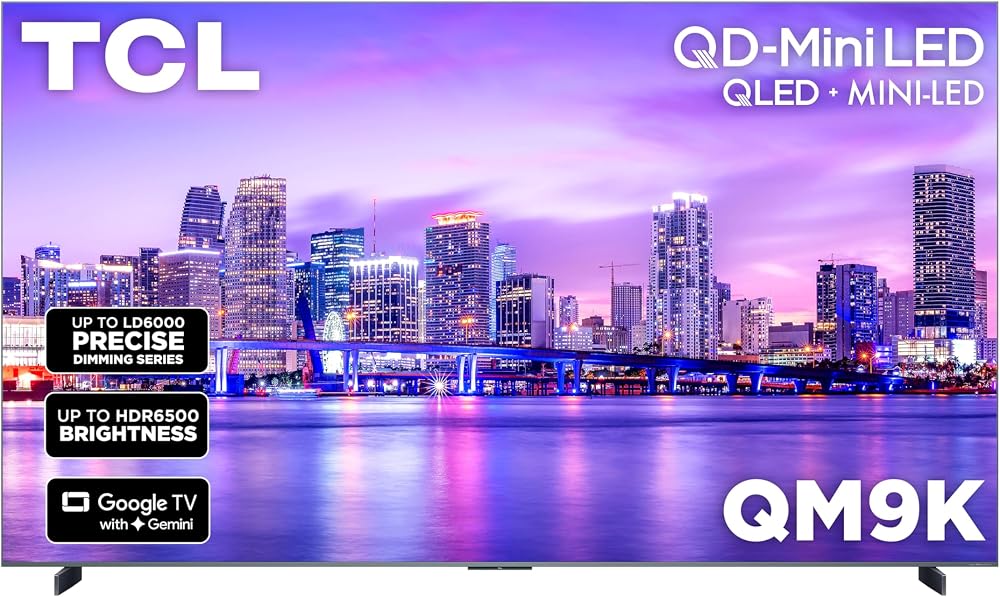
We think this TV delivers class-leading brightness, contrast and motion handling that reward large living rooms and serious gamers. Its AI conveniences and Bang & Olufsen–tuned audio round out a premium package, but size, weight, and cost mean it’s for buyers who really need a 98-inch centerpiece.
TCL QM9K Review — The New Mini-LED Flagship
Introduction
We approached the 98QM9K expecting a showroom-caliber panel and didn’t come away disappointed. TCL’s QM9K series pushes what conventional LCD-based TVs can do by combining a dense Mini LED backlight, QLED color layers, and new control systems the company calls Halo Control. On a 98-inch canvas, those technologies aren’t just marketing copy — they change how HDR and high-frame-rate content look at scale.
Design and build: big, purposeful, and demanding
The first thing you notice is scale. A 98-inch screen immediately becomes the focal point of the room, and TCL has treated the chassis like a premium product: narrow bezels, a low-profile stand option for large surfaces, and a build that feels engineered to handle the weight and size. Still, at 174 pounds and a footprint that needs careful planning, this TV demands preparation: wall reinforcement, a media cabinet that can handle the stand, or professional mounting.


Panel and picture technology: why Mini LED + QLED matters here
TCL’s QM9K layers QLED color enhancement over a densely controlled Mini LED backlight. The headline spec — up to LD6000 precise dimming zones — is meaningful when you push contrast on a 98-inch display. That many zones (or series of precise dimming clusters, per TCL’s Halo Control) means local highlights can pop without lighting up an entire area of the screen.
We like how that translates to real-world viewing: bright specular highlights have sparkle; skin tones retain texture; and black levels are deeper than you’d expect a giant LCD. The 4K resolution is still the right choice for 98 inches — pixels are not invisible up close, but TCL’s CrystGlow WHVA panel and edge-to-edge anti-reflective coating help minimize distraction glare.
Key panel points
HDR, brightness, and the reality of HDR6500
TCL publishes HDR6500 brightness and an HDR system that’s designed to deliver dazzling highlights. In bright-room viewing, that peak spec matters: specular reflections and HDR highlights are much closer to how mastered content was intended to look. The combination of peak brightness and fine-grain dimming also helps maintain detail in both highlights and shadows.
That said, peak brightness in nits numbers only tell part of the story. You’ll still want to watch HDR content in a controlled lighting environment for the best cinematic impression. We found that scenes with mixed bright highlights and deep shadows were where the Halo Control System earned its keep — fewer halos and more localized contrast than comparable VA panels without the same control.


Motion, gaming, and real-time performance
A native 144Hz panel with Motion Rate 480 and TCL’s Game Accelerator 288 positions this TV not just as a movie display but as a serious gaming centerpiece. Whether you’re watching fast sports or playing on a next-gen console, the 144Hz native refresh offers smoother motion and reduced judder.
Latency is low in Auto Game Mode, and HDMI 2.1 bandwidth (where implemented on inputs) supports variable refresh and high frame-rate modes. That combination is rare at this size and gives competitive gamers and simulation enthusiasts nothing to complain about on responsiveness.
Connectivity and ports
We expect a large-screen TV to be the hub for streaming devices, consoles, and audio systems. The QM9K offers the typical complement of modern ports and wireless options while leaning into Google TV for ecosystem integration.
Table — quick specifications snapshot:
| Spec | Detail |
|---|---|
| Size | 98 inches |
| Resolution | 4K Ultra HD (3840 × 2160) |
| Native Refresh | 144Hz |
| Dimming | Up to LD6000 precise dimming series |
| Weight | 174.2 pounds |
Audio and ecosystem: Bang & Olufsen plus Google Gemini
Onboard audio gets a meaningful uplift with Bang & Olufsen tuning and Dolby Atmos pass-through. It won’t replace a full AV receiver plus dedicated speaker array for audiophiles, but it is surprisingly capable for a TV’s built-in system. Dialog clarity and wider soundstage reproduction were notable during film viewing.
Software-wise, Google Gemini integration brings a more conversational, context-aware Google TV experience — hands-free commands, more seamless search, and AI-assisted recommendations. That integration is useful on a TV this size, where you may be interacting several metres away.
Real-world use and calibration notes
Out of the box, TCL’s default picture modes tend to favor punch — bright highlights and saturated colors. That’s great for sports and marketing demos, but we recommend a modest calibration pass (or using a cinema/Filmmaker mode) for movie night. Professional calibration unlocks the last stretch of HDR nuance, especially on scenes where you expect tight highlight control.
Who this TV is for
If you have the room, budget, and appetite for a dominant display, this is one of the most compelling LCD-based alternatives to very large OLEDs or projector setups. It’s ideal for:
Final thoughts
At this scale, small differences in contrast, dimming precision, and motion handling add up to a different class of viewing experience. TCL’s 98QM9K is engineered to make those differences visible: potent HDR highlights, deep blacks for an LCD, and fast motion handling paired with a modern smart platform. The trade-offs are obvious — installation complexity, weight, and — but for buyers who prioritize cinematic impact and gaming performance at very large sizes, this is a standout choice.
FAQ
Do we need a special mount or professional installation for a 98-inch TV?
Yes. At roughly 174 pounds and with a very large footprint, the TV requires a strong wall mount rated for its size and weight. We recommend professional installation to ensure studs, mount strength, and cable management are handled safely — especially if you plan to hide cables or mount above a fireplace — browse our product reviews.
How does Mini LED differ OLED on a very large screen?
Mini LED uses many small LEDs for local dimming behind an LCD matrix, which yields high peak brightness and strong HDR highlights. OLED produces perfect blacks on a per-pixel basis but typically has lower peak brightness and is expensive at very large sizes. For a 98-inch display, Mini LED can deliver more impactful HDR highlights and higher sustained brightness, while OLED retains the advantage in absolute black level consistency.
Is this TV good for gaming on next-gen consoles or a gaming PC?
Absolutely. The native 144Hz panel, Game Accelerator 288, and low-latency Game Mode make it excellent for fast-paced gaming. If you have a PC or console that can push high frame rates at 4K, the panel will show the benefit. Make sure you connect via HDMI inputs that support the necessary bandwidth (HDMI 2.1 where available).
How important is calibration on a TV with such high brightness capability?
Very. High peak brightness can make some content look oversaturated or clip highlights if not tuned properly. We advise using a cinema or Filmmaker mode for watching movies, and if you want the best accuracy, having a professional or using a calibration tool will significantly improve HDR detail and color fidelity.
Will the presence sensor and ambient modes actually save energy?
They can help. The presence sensor can automatically turn the set off when no one is near and bring up ambient content when you approach, which reduces wasted-on time. However, the TV’s absolute power draw during operation is still high due to the large panel and Mini LED backlight.
Should we pair this TV with a soundbar or a full surround system?
For many buyers, a quality soundbar will be a noticeable upgrade over the built-in speakers and will complement the TV’s Dolby Atmos processing. If you’re creating a dedicated home theater, a full surround or Atmos speaker setup paired with an AV receiver will deliver the most immersive results.
How does TCL’s Google Gemini integration change the Google TV experience?
Gemini brings more conversational, contextual interactions to Google TV — smarter voice searches, follow-up questions, and some AI-driven content suggestions. For day-to-day use we found it more responsive and practical, especially when controlling the TV several meters away in a large room.
Is a 98-inch TV overkill for most living rooms?
It depends on room size and seating distance. We consider a 98-inch screen ideal for larger living rooms or dedicated media spaces where viewers sit several meters away. In smaller rooms, pixel visibility and sheer scale can become overwhelming; for those spaces, a smaller large-screen TV or projector may be a better fit.

Ayesha Aftab is Option Cutter's product review editor. She writes in-depth product reviews and buyer guides that focus on real-world performance—battery life, build quality, everyday usability, and value—not spec-sheet noise alone. Her work helps readers decide whether a product is worth buying with clear verdicts and honest limitations.