We break down whether the Forerunner’s laser-focused training features or the Apple Watch Ultra’s polished design and iPhone-first ecosystem actually serve your life better — and why that distinction matters now as wearables become the hub for fitness, safety, and everyday computing.
We pit the Garmin Forerunner 955 Solar against the Apple Watch Ultra 3 to show who each gadget truly suits — from triathletes to weekend runners — comparing design, tracking, battery life, and ecosystem fit so you can choose smarter, faster today.
Endurance Focus

All‑Rounder Power

Forerunner 955
- Exceptional battery life, especially with solar assist
- Advanced multi-band GNSS and built-in full-color maps
- Deep training analytics (training readiness, HRV, race widget)
- Reliable physical button controls plus responsive touchscreen
- Extensive compatibility with third‑party sensors and apps
- Bulky on smaller wrists compared with typical smartwatches
- Smartwatch ecosystem and third‑party apps feel less polished than watchOS
Watch Ultra
- Rugged titanium case and very bright OLED display
- Dual‑frequency GPS with excellent tracking and navigation
- Deep system‑level health features and seamless iPhone integration
- Built‑in cellular, satellite emergency messaging and Action Button
- Battery life still lags high‑end dedicated sports watches under heavy use
- Heavier and larger — may feel overspec’d for casual users
Feature Comparison
| Endurance Focus Forerunner 955 | VS | All‑Rounder Power Watch Ultra |
|---|---|---|
9.5 / 10 | Battery life |
8 / 10 |
9 / 10 | GPS & Navigation accuracy |
9 / 10 |
9.5 / 10 | Training & performance features |
9 / 10 |
8 / 10 | Durability & build |
9 / 10 |
7.5 / 10 | Smart features & ecosystem integration |
9.5 / 10 |
$569.99 | Current price |
$774.50 |
| Buy for $569.99 | Buy for $774.50 |
Garmin Buyer’s Guide: Which Garmin Is Right for You?
Design, materials, and everyday wearability
Garmin Forerunner 955 Solar — built for function first
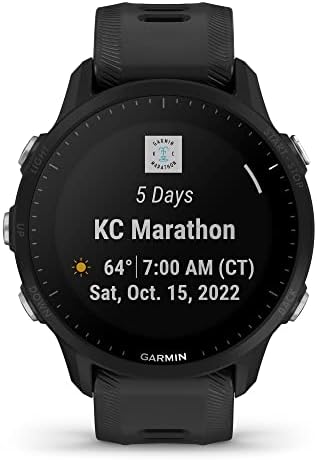
The Forerunner feels like a purpose-built tool: lightweight polycarbonate case, low-profile 1.3-inch sunlight‑readable display, and a design that prioritizes long workouts over wrist jewelry. We notice it sits low and unobtrusive during runs and bike rides, and the physical buttons plus a responsive touchscreen mean you can control it with sweaty hands or gloves without hunting for the right tap.

Apple Watch Ultra 3 — premium build, multifunctional wear
Ultra 3 pushes a different argument: a 49mm titanium case, sapphire crystal, and one of the brightest OLEDs in a sports watch. It reads beautifully in low light and at angles, and the Action Button plus Digital Crown give crisp tactile control — but the touchscreen remains the primary UI. It feels heavier (~2.24 oz) and more like a daily accessory you’ll keep on off‑duty.
Both watches work well as daily drivers; Garmin skews performance-first and invisible, Ultra 3 skews premium and versatile — which matters depending on whether you value extended comfort on long sessions or a watch that doubles as jewelry.
Sports and health tracking: sensors, metrics, and accuracy
We compare the Forerunner’s advanced running and triathlon features (detailed training load, VO2max, multi-band GPS and race-crafting tools) with the Ultra’s multisport ambition, health sensors, and on-device workout experience. Below we break down what actually matters on the road, trail, and open water.
Core sensors and training metrics
Garmin focuses on training decisions: optical HR, HRV-based recovery and training readiness (Firstbeat analytics), VO2max, running dynamics, and running power with broad third‑party sensor support in our fitness trackers hub. Those metrics feed features like daily suggested workouts and a race widget built for pacing and prediction — things that change how we train.


Apple packs a thicker health stack: ECG, SpO2, advanced heart‑rate alerts, sleep score, and Workout and Vitals apps — understand FDA wearable health device context before you treat alerts as diagnoses. It also surfaces running power, training load, and guided workouts with strong on‑device feedback, but Apple’s models are designed to serve multisport lifestyles and health monitoring first.


GPS, mapping, and open‑water navigation
Both use multi‑frequency GNSS for strong position tracking when you compare Garmin and Apple Watch models side by side. In our experience, Garmin’s multi‑band implementation and race-focused mapping give it an edge in long trail runs, dense canopy, and ultra-distance accuracy while preserving battery. Apple’s dual‑frequency GPS is impressively tight for technical navigation and backcountry route replay, but sustained tracking is more battery‑hungry.
Sport workflows and who benefits
We care less about raw spec sheets and more about which data actually changes your training; choose the Forerunner if you want coach‑grade insights and endurance reliability, choose Ultra 3 if you want wide health coverage and a polished on‑device workout experience.
Battery life, durability, and outdoor readiness
Real‑world battery: endurance vs. capability
We tested both for day-to-day outings and multi‑day trips. The Forerunner 955 Solar is built around endurance: Garmin’s Power Glass can meaningfully extend smartwatch and GPS runtimes if you spend hours outside. Official figures — weeks in smartwatch mode and dozens of hours in GPS mode — translate to real advantages on multi‑day trail runs and ultras where charging opportunities are scarce. The Ultra 3, by contrast, gives a richer feature set (cellular, satellite texting) but shorter all‑in battery life under continuous GPS + comms. It recharges faster, though, so it’s easier to top up between activities.
Durability and water resistance
Both are built for abuse, but they take different approaches. The Ultra’s titanium case and sapphire crystal prioritize scratch resistance and impact toughness; it’s explicitly rated to 100m for serious water sports. The Forerunner is rugged and swim‑capable (a triathlon watch through and through) and trades a little premium material sheen for lighter wrist feel and battery efficiency.
Safety, satellite comms, and thermal resilience
Apple’s Ultra 3 adds built‑in cellular and two‑way satellite emergency messaging — a huge safety win if you want solo trips without carrying a phone; see FCC wireless 911 guidance for how emergency calls route from wearables. Garmin’s Forerunner relies on a paired phone or separate Garmin inReach for true satellite SOS; that keeps costs and power draw down but forces a choice: longer runtime or on‑device emergency connectivity.
We think the trade‑off is simple: if your priority is expedition endurance and minimal charging, pick the Forerunner; if you want system‑level safety, comms, and a robust display for day trips, the Ultra is the better fit.


Ecosystem, apps, and day-to-day smart features
Platform and pairing
We found the difference here is philosophical. The Ultra 3 is an Apple device first — pairing to an iPhone unlocks cellular, payments, seamless Health sync, and a polished App Store. The Forerunner 955 Solar is a sports device first — Garmin Connect is training‑centric, phone pairing is straightforward, but the experience lives inside Garmin’s ecosystem.
Apps, notifications, and media
Apple wins for everyday smart features: rich, interactive notifications, on‑watch dictation and replies over cellular, and native streaming with Apple Music (or Spotify via apps). Garmin handles notifications reliably but offers limited interactivity. Music and podcast support exists on Garmin, but setup and streaming without a phone feel clunkier.
Mapping, navigation, and offline use
Garmin’s maps and route tools are purpose-built: GPX/course imports, breadcrumb navigation, and topo data work offline — crucial for remote outings in our product comparisons hub. Apple Maps is smoother for city navigation and turn‑by‑turn when you have coverage, but offline navigation and detailed trail routing still lag Garmin.
Data, coaching, and ecosystem lock‑in
Where Garmin shines is in sports integrations and sensor compatibility: ANT+, Bluetooth, Stryd, TrainingPeaks, Strava syncing, and exportable FIT/TCX files make it coach‑friendly. Apple integrates tightly with trainers and Fitness+, but raw export and third‑party sensor support are more limited, which matters if you rely on custom coaching or specialized power meters.
Updates and longevity
Apple provides predictable OS updates and multi‑year support; Garmin issues feature updates focused on athletes but with less predictable cadence. That difference affects device lifespan and how future‑proof your purchase feels.
Frequently asked questions
Which is better, Garmin Forerunner or Apple Watch Ultra?
There is no universal winner: Garmin Forerunner fits some buyers and Apple Watch Ultra fits others. We compare specs, daily use, and trade-offs in this guide so you can match the pick to your budget and workflow, not a single spec sheet.
What is the main difference between Garmin Forerunner and Apple Watch Ultra?
Garmin Forerunner and Apple Watch Ultra target overlapping but not identical use cases. The sections above break down design, performance, ecosystem, and value so you can see where each product pulls ahead and where it compromises.
Should I buy Garmin Forerunner or Apple Watch Ultra first?
Buy the product that removes your biggest daily friction first. If Garmin Forerunner solves your primary pain point, start there; if Apple Watch Ultra is the bottleneck in how you actually work or play, prioritize it. Many households add the other later.
Is Garmin Forerunner worth it over Apple Watch Ultra?
Garmin Forerunner is worth the premium over Apple Watch Ultra when you will use the features that justify the price—extra performance, build quality, or ecosystem lock-in. If those extras go unused, Apple Watch Ultra usually delivers better value.
Can Garmin Forerunner replace Apple Watch Ultra?
For some users, yes; for others, no. Garmin Forerunner can cover most tasks Apple Watch Ultra handles, but gaps in compatibility, accessories, or specialized workflows may still matter. Use our comparison table and verdict to see which gaps apply to you.
Who should choose Garmin Forerunner vs Apple Watch Ultra?
Choose Garmin Forerunner if its strengths match how you will use it every day; choose Apple Watch Ultra if you need its specific advantages or a lower entry price. When in doubt, favor the option that fixes your most frequent frustration—not the highest spec on paper.
Final verdict: Who it’s really for
We think the Apple Watch Ultra 3 is the overall winner for most people — especially iPhone users who want a premium titanium build, seamless app and notification integration, on‑wrist apps, and satellite safety tools in our Apple Watch Series 11 lineup. Its polished UX and richer ecosystem deliver more everyday value, even if battery life lags behind specialized rivals.
But for endurance athletes and multisport users who prioritize long battery life, advanced training metrics, open-data export, and a no‑nonsense sports UI, the Garmin Forerunner 955 Solar is the smarter buy. Price‑to‑value flips depending on priorities: choose Ultra 3 for lifestyle and safety, Forerunner 955 Solar for pure performance. Ready to commit? Match use case to strengths and buy accordingly right now.

Princess Rioboca is the Lead Editorial Writer at Option Cutter, bringing over seven years of hands-on experience in consumer technology journalism. Specializing in home networking and smart home architecture, she transforms complex technical data into practical, real-world upgrades. Princess personally tests and audits every product she reviews—evaluating real-world Wi‑Fi throughput, cable management durability, and streaming ecosystem stability—to filter out spec-sheet noise. Her rigorous, field-tested insights are designed to give readers transparent, unbiased buying advice on what to purchase, what to skip, and exactly why.