We tested the Echo Show 8 and Nest Hub Max in real homes to settle the key question: does Amazon’s camera-forward design or Google’s tighter Nest and Assistant integration give you the smarter, more useful smart display for daily life?
Over coffee we ask our smart displays to play music, run timers, and show the door — and they either help or fumble. We pit the new Echo Show 8 against Google’s Nest Hub Max, comparing design, daily use, assistant smarts, ecosystem fit, and value today.
Spatial Audio

Family Hub

Echo Show 8
Nest Hub Max
Feature Comparison
| Spatial Audio Echo Show 8 | VS | Family Hub Nest Hub Max |
|---|---|---|
8.4 / 10 | Display & UI |
9.2 / 10 |
9 / 10 | Audio Quality |
8.6 / 10 |
8.6 / 10 | Voice Assistant & Intelligence |
9.5 / 10 |
9 / 10 | Smart Home Integration |
8.2 / 10 |
$179.99 | Current price |
$299.99 |
| Buy for $179.99 | Buy for $299.99 |
Echo Show Showdown: Echo Show 5 vs 8 vs 10 — Which One Should You Buy?
Design and Display: Size, Build, and What You Actually See
Size and what you actually see
We start with the obvious: the Echo Show 8’s 8.7‑inch Vibrant HD panel is compact and easy to tuck on a nightstand or crowded counter, while the Nest Hub Max’s 10‑inch canvas gives you noticeably more room for video, recipes, and multi‑pane controls in our smart displays aisle. The extra diagonal on the Nest Hub Max makes split views and cook‑along videos easier to follow without squinting; the Show 8 still works fine, but its interface elements feel denser.


Color, brightness, and viewing angles


Build, bezels, and physical controls
The Show 8 leans utilitarian — solid plastic chassis and a more pronounced bezel that frames content. The Nest Hub Max looks cleaner on the counter: slim glass front and a soft fabric back that reads more like home tech than a gadget. Both have responsive touchscreens and adaptive brightness; the Show 8’s touch feels a hair snappier in our use, while the Hub Max’s glass surface is smoother for swipes.
Why those differences matter
A slightly larger screen or cooler, truer color profile changes behavior: we reach for the Nest Hub Max for shared cooking, video calls, and photo slideshows; we grab the Echo Show 8 for quick glances, timers, and where counter space is tight. And on the software side, Alexa’s denser layout tends to feel more crowded on the 8.7‑inch display, whereas Google’s UI scales into looser, easier‑to‑scan panels on the 10‑inch Max.
Audio, Camera, and Daily Use: Media, Calls, and Hands-Free Convenience
Speakers and media playback
We tested both devices in a small kitchen and a medium bedroom. The Echo Show 8’s “spatial audio” tuning actually makes a noticeable difference in tight spaces: stronger low end, wider perceived soundstage, and fuller-sounding tracks at moderate volumes. Vocals and dialogue come through with a touch more warmth, which helps when you’re watching shows while cooking.


The Nest Hub Max has clean stereo separation and an integrated woofer, but it leans toward clarity over theatrics. It won’t rattle a big pot, but it renders dialogue and acoustic instruments with less coloration — better for podcasts and news, slightly less fun for bass-forward pop.

Camera and video calls
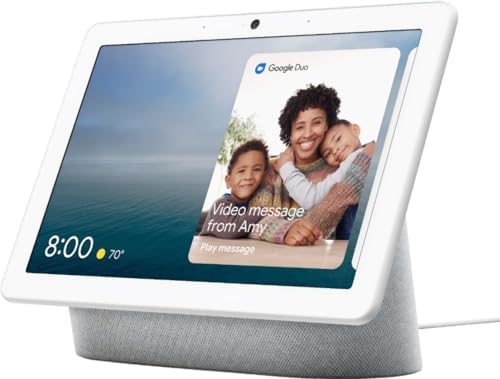
The Nest Hub Max’s 6.5 MP camera produces sharper video and more detail on calls; auto-framing is smooth and gives a more natural field of view for small group calls — review FTC home-security camera privacy guidance before you enable always-on lenses. The Show 8’s centered camera with 3.3× zoom keeps you well framed and benefits from effective noise reduction, but its image is a bit softer. For family calls where clarity matters, we pick the Nest Hub Max.
Voice pickup and daily responsiveness
Both devices hear us across a noisy kitchen, but they differ in feel. Alexa can be fast and proactive—routines trigger locally and responses feel immediate. Google Assistant is usually quicker with search-style queries and contextual follow-ups. In daily interactions the Show 8’s touchscreen felt a hair snappier; the Hub Max’s glass swipes smoother but occasionally shows slight lag when switching heavy views.
Assistant, Ecosystem, and Smart-Home Integration
Core assistant behavior
We tested conversational accuracy and follow-ups across both devices in our voice assistant lineup. Google Assistant on the Nest Hub Max is stronger at search-style queries and keeping context across follow-ups; it feels more natural when you drill deeper into a topic. Alexa on the Echo Show 8 is faster with practical home tasks and local automations, and Alexa+ Early Access adds proactive suggestions and personalized follow-ups based on recent activity.


Routines and multi-step tasks
For multi-step chores—“start my morning routine, then play the news, then set the thermostat”—Alexa’s routines are more flexible for conditional triggers (location, time, device state) and Omnisense enables presence and visual triggers locally. Google’s routines are cleaner to set up and better at chaining search results into actions, but they rely more on cloud checks for some complex sequences.
Ecosystem control and device compatibility
Practical integration matters more than raw smarts in our product comparisons hub. Echo Show 8 is the natural center if you use Ring, Fire TV, Prime Video/Music, and thousands of Alexa-compatible smart lights and Zigbee devices. Nest Hub Max is better if you live in Google’s world: Chromecast streaming, YouTube, Nest devices, Google Photos, and Android continuity (quick handoffs from phone to screen).


Exclusive features and cross-platform limits
Cross-platform pain points are real: casting to Nest is easier from Android; AirPlay or tight Apple integrations are limited on both. Similarly, some streaming services and device controls remain proprietary (Fire TV vs Chromecast), so which ecosystem you pick will shape future device choices and convenience.
Privacy, Updates, Price, and Value: What You Give Up and What You Get
Privacy controls and local processing
We tested each company’s privacy messaging and found meaningful differences — the Energy.gov smart-home energy tips is a useful checklist for shutter, mic, and retention settings. The Nest Hub Max includes a visible camera switch that cuts power to the camera (and lights an indicator), plus Google emphasizes on‑device processing for Face Match and some smart‑home routines. The Echo Show 8 gives you a mic/camera mute button and in‑app camera controls, but Amazon’s model lacks a physical sliding shutter — the lens is disabled electronically. Both do limited on‑device work (AZ3 Pro/Omnisense on the Echo; local Face Match on Nest), but conversational queries still go to the cloud. That distinction matters: if you want a tactile shutter and clearer promises about local biometric processing, we lean toward Google.
Updates and feature longevity
Both companies push regular firmware and assistant updates. Google tends to keep Nest features tightly integrated with other Google services (Photos, Nest Cam) and rolls out improvements tied to those services; Amazon rapidly iterates Alexa features (Alexa+), sometimes gating the best bits to newer hardware. Expect both devices to receive features for several years, but long‑term guarantees are soft — neither publishes a fixed support window.
Price, discounts, and subscription nudges
Both push subscriptions: Amazon for Prime/Unlimited music; Google for YouTube/YouTube TV, Google One, and Nest Aware — know your rights to cancel under the FCC voice-recording privacy guidance before you enable paid tiers. The Echo’s lower street price and heavy sale cadence can offset UI limits; the Nest’s premium is justified if you live in Google’s ecosystem and value tighter photo/camera integration.
Who should buy which
Frequently asked questions
Which is better, Echo Show 8 or Google Nest Hub Max?
There is no universal winner: Echo Show 8 fits some buyers and Google Nest Hub Max fits others. We compare specs, daily use, and trade-offs in this guide so you can match the pick to your budget and workflow, not a single spec sheet.
What is the main difference between Echo Show 8 and Google Nest Hub Max?
Echo Show 8 and Google Nest Hub Max target overlapping but not identical use cases. The sections above break down design, performance, ecosystem, and value so you can see where each product pulls ahead and where it compromises.
Should I buy Echo Show 8 or Google Nest Hub Max first?
Buy the product that removes your biggest daily friction first. If Echo Show 8 solves your primary pain point, start there; if Google Nest Hub Max is the bottleneck in how you actually work or play, prioritize it. Many households add the other later.
Is Echo Show 8 worth it over Google Nest Hub Max?
Echo Show 8 is worth the premium over Google Nest Hub Max when you will use the features that justify the price—extra performance, build quality, or ecosystem lock-in. If those extras go unused, Google Nest Hub Max usually delivers better value.
Can Echo Show 8 replace Google Nest Hub Max?
For some users, yes; for others, no. Echo Show 8 can cover most tasks Google Nest Hub Max handles, but gaps in compatibility, accessories, or specialized workflows may still matter. Use our comparison table and verdict to see which gaps apply to you.
Who should choose Echo Show 8 vs Google Nest Hub Max?
Choose Echo Show 8 if its strengths match how you will use it every day; choose Google Nest Hub Max if you need its specific advantages or a lower entry price. When in doubt, favor the option that fixes your most frequent frustration—not the highest spec on paper.
Final Verdict: Which Should You Put on Your Counter?
We found the Echo Show 8 is the better value and the clear winner on counters — it nails Alexa breadth, delivers good spatial audio for music and video, and Amazon’s discounts make it an easy buy. The Nest Hub Max wins if you prioritize Google Assistant smarts, a larger 10-inch display for video calls, and tighter Android/Chromecast integration; its camera and on‑screen cues make multi-person calling and home control smoother. We’d pick Echo for audio-forward users; Nest Hub Max for Google-first homes.
If you want our call in product comparisons: buy the Echo Show 8 today unless your ecosystem is Google-first — then wait only if you expect major camera or OS upgrades in the next refresh. Ready to pick one? Or is an upgrade looming? Either way, deals will likely appear during sales seasons again this year.

Princess Rioboca is the Lead Editorial Writer at Option Cutter, bringing over seven years of hands-on experience in consumer technology journalism. Specializing in home networking and smart home architecture, she transforms complex technical data into practical, real-world upgrades. Princess personally tests and audits every product she reviews—evaluating real-world Wi‑Fi throughput, cable management durability, and streaming ecosystem stability—to filter out spec-sheet noise. Her rigorous, field-tested insights are designed to give readers transparent, unbiased buying advice on what to purchase, what to skip, and exactly why.