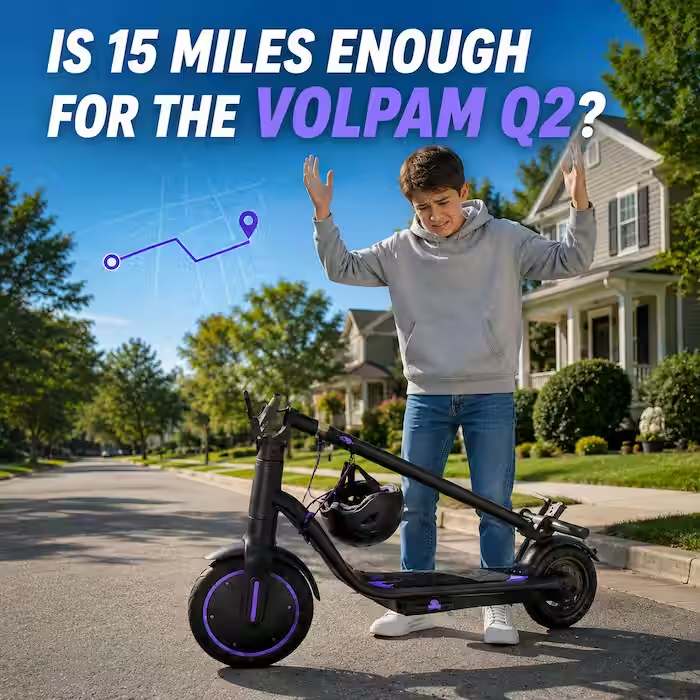

The VOLPAM Q2 range is advertised with up to 15 miles of range from its 36V, 187.2Wh battery. That sounds straightforward: if your trip is less than 15 miles, you’re covered.
That’s not how we’d make the buying decision.
VOLPAM describes 15 miles as the scooter’s maximum range, not a guaranteed distance every rider will achieve on every route. The same listing pairs that battery with a 350W motor, a claimed top speed of 19 mph, an advertised 15-degree climbing capability, 8.5-inch solid tires and a maximum rider load around 264 pounds.
Those specifications tell us what the scooter is designed to do.
They don’t tell you exactly how many miles you will get.
For a commuter, the better question is:
How much of that 15-mile claimed range can you afford to depend on?
The short answer
If your normal trip uses only a modest portion of the Q2’s advertised 15-mile maximum, the range specification may be perfectly adequate.
If getting home requires you to achieve almost all 15 advertised miles, we’d choose a scooter with more battery capacity instead.
That’s because scooter energy consumption isn’t fixed. Research on electric-scooter performance identifies variables including rider mass, slope, wind and vehicle characteristics as factors affecting required power and energy use.
In other words:
15 miles is the headline. Battery margin is what makes a commuter practical.
What does “up to 15 miles” actually mean?
The current Q2 listing specifies a 36V 187.2Wh battery and a maximum distance of 15 miles.
The important phrase is “up to.”
It tells you the manufacturer believes the scooter can reach that distance under the conditions used for its range claim.
It doesn’t mean:
- every rider will get 15 miles
- you’ll get 15 miles at maximum speed
- you’ll get 15 miles on a hilly route
- you’ll get 15 miles carrying the maximum load
- you’ll always get the same range throughout ownership
For buying purposes, we’d treat 15 miles as an upper boundary to work backward from, not as a commute distance you should automatically plan around.
A 14-mile commute and a 6-mile commute are not both “within range”
This is where spec-sheet shopping can produce a bad decision.
Imagine the scooter’s stated maximum range is 15 miles.
Buyer A needs 6 miles between charges
There’s substantial advertised-range headroom.
The scooter could consume more energy than the headline figure implies and still potentially complete the required trip.
Buyer B needs 10 miles between charges
Now range deserves more attention.
Hills, load, riding style and other conditions matter more because there is less room between required distance and advertised maximum.
Buyer C needs 14 miles between charges
Technically, 14 is less than 15.
Practically, we would not buy a scooter rated for up to 15 miles if completing a routine 14-mile trip depended on achieving almost the full manufacturer maximum.
That’s not enough margin for a commute you need to complete reliably.
The relevant question isn’t:
“Is my commute under 15 miles?”
It’s:
“How badly would things go if I got materially less than 15?”
If the answer is “I’d be stranded,” buy more range.
VOLPAM Q2 Range vs Rider Weight
The Q2 is listed with a maximum load around 264 pounds.
That tells you the allowable load.
It does not mean range will remain identical from the lightest rider to someone approaching the maximum.
Moving more mass requires energy, and electric-scooter research specifically treats rider mass as one of the variables influencing energy consumption and performance.
Also remember that “rider weight” isn’t necessarily just your body weight.
A commuter might add:
- a laptop
- backpack
- lock
- work equipment
- groceries
- clothing
- other cargo
So don’t ask only whether you’re below the weight limit.
Ask:
How much work am I asking this 187.2Wh battery to do on my particular route?
If you’re a heavier rider, regularly carry cargo, or combine that load with hills, be more conservative about your range assumptions.
Hills can eat into your range margin
VOLPAM advertises the Q2 as capable of handling inclines up to 15 degrees.
That doesn’t mean a hilly commute and a flat commute place the same demand on the battery.
Research modeling electric-scooter performance specifically includes slope grade among the variables affecting required power and energy consumption.
Think of the difference between these two routes:
Route one:
Five miles on a mostly flat bike path.
Route two:
Five miles containing repeated climbs.
The odometer records five miles either way.
The battery doesn’t experience the same workload.
This is why route distance alone isn’t enough when determining whether the Q2’s advertised range suits you.
If your commute has one short hill, that’s one thing.
If most rides involve repeated or sustained climbs, we’d want significantly more advertised battery range than the bare minimum needed to cover the mileage.
Speed matters too
The Q2 is advertised with a top speed of 19 mph.
Range and maximum speed should not be mentally combined into one promise.
A buyer can easily see:
19 mph + 15 miles
and unconsciously interpret that as:
“I can ride around at 19 mph for 15 miles.”
The product listing doesn’t establish that.
The safer way to read those specifications is:
- up to 19 mph is a maximum-speed claim
- up to 15 miles is a maximum-range claim
They describe different performance limits.
If range matters more to you than arriving a few minutes sooner, don’t build your purchase decision around riding at maximum performance all the time.
Stop-and-go commuting is different from cruising
Urban commuting isn’t normally one uninterrupted run.
You may repeatedly:
- accelerate from intersections
- slow for pedestrians
- stop at traffic lights
- change speed around traffic
- climb ramps or curb transitions
- detour around construction
Real routes are variable, which is one reason accurate energy prediction for electric micromobility is more complicated than applying one fixed consumption number to every trip. Research using real-world e-scooter and e-bike trip data has specifically focused on improving energy-consumption predictions because actual use varies with trip conditions.
That doesn’t mean stop-and-go riding will always destroy your range.
It means you shouldn’t assume your commute will reproduce whatever conditions produced a maximum-range figure.
Cold weather deserves extra margin
If you live somewhere with genuinely cold winters, battery performance is another reason not to plan around the absolute maximum.
Lithium-ion batteries can deliver less available capacity and energy at low temperatures than at room temperature; U.S. Department of Energy battery research has documented substantial low-temperature performance losses in lithium-ion systems.
That doesn’t give us a defensible number of exactly what is the VOLPAM Q2 range you will lose in your adverse weather.
And we wouldn’t invent one.
It simply means a rider facing cold-weather commuting should be even less willing to make a 15-mile maximum-range scooter responsible for a trip that already consumes nearly all 15 miles.
Don’t forget the return journey
One of the easiest range mistakes is thinking only about the outbound trip.
Suppose work is six miles from home.
Six miles sounds comfortably under a 15-mile maximum.
But if you can’t charge at work, you’re not buying for a six-mile commute.
You’re buying for a 12-mile battery cycle.
That’s much closer to the scooter’s stated maximum.
Now change one thing:
You have a confirmed outlet at work and enough time to recharge.
Suddenly the scooter only has to complete six miles between charging opportunities.
Same house.
Same workplace.
Same scooter.
Very different range requirement.
So calculate your distance between reliable charging opportunities, not just the distance to your destination.

The Q2 takes about five hours to charge
The current listing gives the Q2 a battery charge time of around five hours.
That makes workplace charging potentially useful, but only if it actually fits your routine.
Before counting on it, check:
- Is there an outlet where you store the scooter?
- Are you permitted to charge it there?
- Will it remain there long enough?
- Do you want to carry the charger every day?
- What happens if your usual charging location becomes unavailable?
Charging access is a dependency.
If your purchasing calculation only works when that dependency works perfectly, your range margin may be too small.
How much Volpam Q2 range reserves should you save?
There is no single percentage we can honestly promise every Q2 buyer.
Your appropriate reserve depends on how costly running short would be.
For recreational riding near home, you might accept more uncertainty.
For commuting to work at a fixed time, we’d be considerably more conservative.
Think of range in three zones.
Green zone: your trip is comfortably below the maximum
You aren’t asking the scooter to demonstrate its full advertised capability every day.
There is meaningful room between the distance you require and the 15-mile headline figure.
This is the range situation we’d prefer.
Yellow zone: your trip consumes a large portion of the claim
Now route conditions matter.
Look closely at:
- rider and cargo weight
- hills
- speed
- charging access
- weather
- consequences of running short
The Q2 may still fit, but range should be investigated rather than assumed.
Red zone: your routine depends on nearly all 15 advertised miles
We’d skip it for that use.
Even if your commute is technically one mile shorter than the manufacturer’s maximum, you’re buying too close to the edge.
Choose a scooter whose advertised range leaves substantially more room.
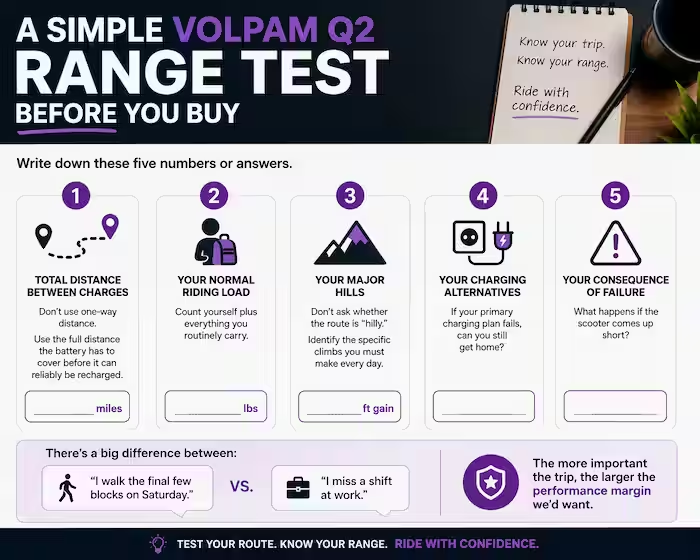
Save this simple VOLPAM Q2 range test before you buy
Write down these five numbers or answers.
1. Total distance between charges
Don’t use one-way distance.
Use the full distance the battery has to cover before it can reliably be recharged.
2. Your normal riding load
Count yourself plus everything you routinely carry.
3. Your major hills
Don’t ask whether the route is “hilly.”
Identify the specific climbs you must make every day.
4. Your charging alternatives
If your primary charging plan fails, can you still get home?
5. Your consequence of failure
What happens if the scooter comes up short?
There’s a big difference between:
“I walk the final few blocks on Saturday.”
and:
“I miss a shift at work.”
The more important the trip, the larger the performance margin we’d want.
Example: 4-mile round trip
A commuter travels two miles each way over relatively flat streets and charges at home every night.
The total required distance is four miles between charges.
That’s far below the Q2’s advertised 15-mile maximum.
Range probably isn’t the first reason we’d reject the scooter for this buyer.
We’d spend more time examining ride comfort, braking, storage, road quality and ownership support.
Example: 8-mile round trip
A rider travels four miles to work and four miles home, with no charging at the destination.
Now the scooter must cover eight miles reliably.
That’s still materially below the advertised maximum, but we’d start asking more questions.
Is the route flat?
Is the rider carrying much?
Are there repeated hills?
Does the scooter need to work in cold weather?
Eight miles isn’t automatically a yes or no.
It’s where the buyer’s circumstances begin to matter more.
Example: 12-mile round trip
A rider travels six miles each way without destination charging.
Now the battery must cover 12 miles between charges against a maximum claim of 15.
That’s only three advertised miles of difference.
For occasional recreational use, a buyer might decide that risk is acceptable.
For mandatory commuting, we’d want more battery headroom.
A scooter with a substantially higher advertised range would make more sense.
Example: 14-mile round trip
This is where we’d stop debating it.
Yes, 14 miles is technically below 15.
No, we would not recommend choosing the Q2 specifically for a routine 14-mile journey without reliable charging.
You’re making a purchasing decision that depends on almost completely reproducing a maximum-range claim.
That’s unnecessary risk when longer-range scooters exist.
What if you can charge at work?
Destination charging changes the calculation dramatically.
A 12-mile round trip becomes:
6 miles → charge → 6 miles
instead of:
12 miles → charge
That may move the Q2 from questionable to plausible.
But confirm the charging situation before buying.
Don’t base the decision on:
“There are probably outlets somewhere.”
Range problems often aren’t really battery problems.
They’re dependency problems.
What if you only need the scooter occasionally?
Then you may reasonably tolerate less range certainty.
If the Q2 is being used for:
- short errands
- recreational rides
- getting from parking to an office
- first/last-mile transport
- occasional backup transportation
you may never get close to the battery’s limit.
In that case, paying extra for a huge battery you don’t need can be wasteful.
More range isn’t automatically better.
It’s better when your actual use requires it.
When the Q2’s 15-mile claim is probably enough
We’d feel best about the Q2 when:
- your required distance between charges is well below 15 miles
- your route is mostly flat
- your riding load isn’t near the maximum
- you don’t need to ride at maximum performance constantly
- you have dependable charging access
- running low wouldn’t create a serious safety or scheduling problem
That’s where a modest battery can make sense.
You’re using the available range as headroom, not as a target.
When we’d buy more range instead
Look elsewhere if:
- your routine journey gets close to 15 miles between charges
- repeated hills define your commute
- you regularly carry a heavy total load
- cold-weather commuting is unavoidable
- you have no backup charging option
- arriving late or stranded would have serious consequences
- you’re already thinking, “I should just about make it”
That final thought is particularly useful.
“I should just about make it” is not the feeling we’d want from a daily commuter purchase.
Don’t buy range you don’t need—but don’t buy exactly enough
There are two ways to make a bad range decision.
The first is paying much more for an enormous battery when your daily trip is only a couple of miles.
The second is buying the cheapest scooter whose maximum specification barely exceeds your commute.
The VOLPAM Q2 sits in a useful middle ground for some buyers because its 15-mile claimed range is more than enough for many genuinely short trips.
But it shouldn’t be stretched into a longer-range commuter simply because the arithmetic technically works.
Bottom line: how far should you trust the VOLPAM Q2 to take you?
VOLPAM advertises the Q2 for up to 15 miles per charge from its 187.2Wh battery.
We wouldn’t turn that into a made-up “real-world range” number, because actual energy use depends on the rider and route. Rider mass and slope are among the variables researchers have identified as affecting electric-scooter energy consumption, and low temperatures can also reduce lithium-ion battery performance.
So don’t ask:
“Will it go 15 miles?”
Ask:
“Does my trip leave enough room that I don’t need it to?”
If your commute is short enough that the 15-mile claim leaves plenty of unused capacity, the Q2’s range is much easier to live with.
If you’re planning a 12-, 13- or 14-mile battery cycle and hoping conditions cooperate, we’d buy more range.
A daily commuter should have enough battery that getting home is routine—not the day’s final range test.

Chris is the founder and lead editor of OptionCutter LLC, where he oversees in-depth buying guides, product reviews, and comparison content designed to help readers make informed purchasing decisions. His editorial approach centers on structured research, real-world use cases, performance benchmarks, and transparent evaluation criteria rather than surface-level summaries. Through OptionCutter’s blog content, he focuses on breaking down complex product categories into clear recommendations, practical advice, and decision frameworks that prioritize accuracy, usability, and long-term value for shoppers.