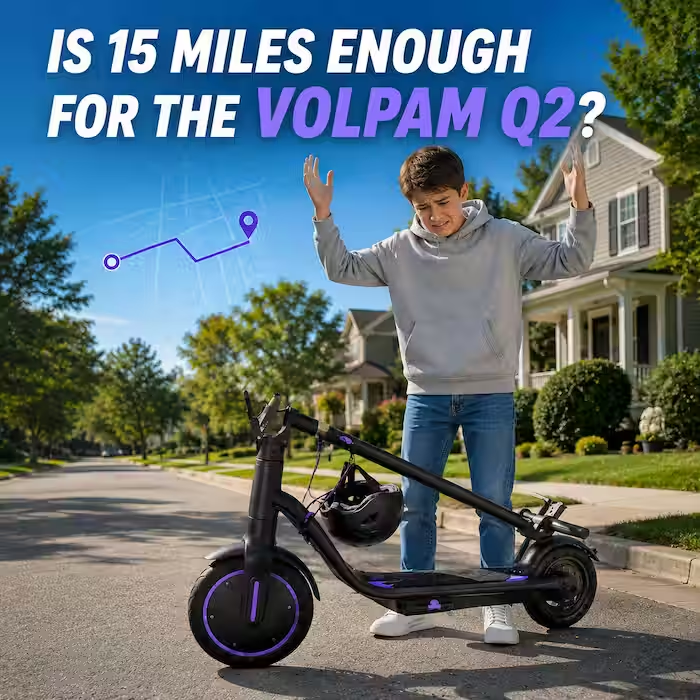

The VOLPAM Q2 looks like an easy commuter-scooter decision on paper. The current 350W version advertises a 19 mph top speed, up to 15 miles of range, 8.5-inch solid tires, a folding frame, dual braking, lights, app controls, and a 264-pound maximum load. The battery is listed at 36V/187.2Wh with about a five-hour charge time.
Those are useful specifications.
But they don’t answer the question that actually matters:
Will the VOLPAM Q2 work for your commute?
A scooter can be perfectly decent and still be a bad purchase if your route asks it to spend too much time near its limits. A five-mile ride over smooth pavement is a very different job from five miles of hills, broken asphalt, heavy traffic and a backpack full of gear.
So before deciding whether the Volpam Q2 is good value, compare the scooter with the trip you need it to make every day.
The short answer
The VOLPAM Q2 looks best suited to shorter urban commutes on reasonably smooth, mostly flat pavement where its advertised 15-mile maximum range leaves a healthy margin.
It becomes a more questionable choice when your commute involves:
- long round trips with no opportunity to recharge
- repeated or demanding hills
- badly broken pavement
- a rider and cargo load approaching the maximum
- a strong preference for ride comfort
- circumstances where arriving with a low battery would create a serious problem
The important word is margin.
You don’t want a commuter vehicle that can theoretically complete your trip. You want one that can complete it without requiring ideal conditions every day.
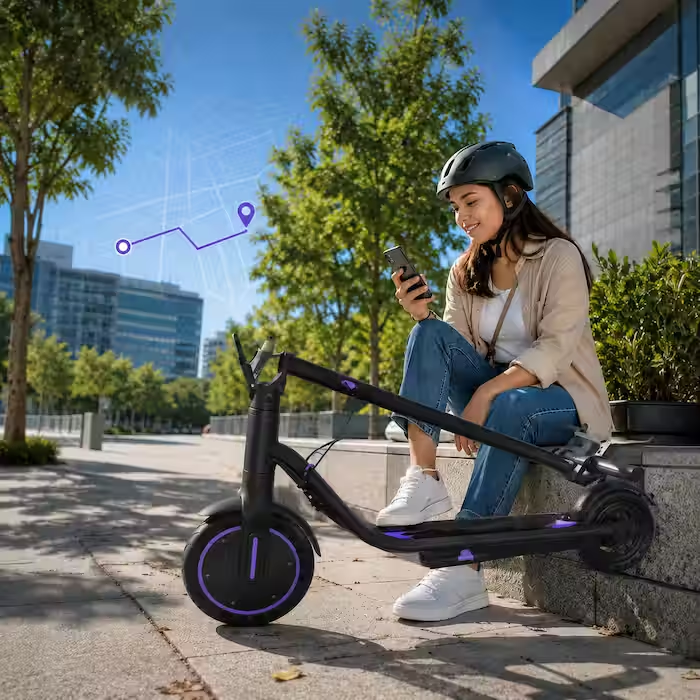
1. Start with the distance you must cover—not the advertised range
VOLPAM advertises up to 15 miles of range for this Q2 configuration.
That does not mean every rider should treat 15 miles as a dependable commuting radius.
Advertised maximum range is best thought of as a reference point. Your actual energy use can change with speed, rider weight, hills, stop-and-go riding, temperature and other conditions.
That distinction becomes important very quickly.
Imagine three commuters.
Commuter A: 2.5 miles each way
That’s a five-mile round trip.
Even without assuming the scooter will achieve its maximum advertised range every day, there is considerably more theoretical battery margin available.
This is the sort of commute that makes sense for further consideration.
Commuter B: 6 miles each way with charging at work
That’s also potentially workable because the scooter only needs to cover one six-mile leg before it can recharge.
The five-hour listed charging time means whether this is practical will depend on how long you’re at your destination and whether you’re actually allowed to charge there.
Commuter C: 7 miles each way with no charging
Now you’re asking the scooter to cover 14 miles between charges against an advertised maximum of 15.
Even if 14 is technically below 15, that’s a very different buying decision.
There is almost no advertised-range margin left for unfavorable conditions, battery degradation over time, detours or a ride that consumes more power than expected.
For a commute you have to complete reliably, being below the advertised maximum is not the same as having enough range.
Our rule
The closer your required trip gets to 15 miles between charging opportunities, the less comfortable we’d be choosing this particular Q2 based on its headline range.
If getting home depends on squeezing nearly every advertised mile out of the battery, consider a scooter with substantially more range instead.
2. Look at your pavement before you look at the motor
One of the Q2’s more appealing commuter features can also be one of its most important compromises.
This model uses 8.5-inch solid tires, and the current listing identifies its suspension as rigid.
Solid tires remove the normal worry about puncturing an air-filled inner tube. For someone who wants a low-maintenance commuter and hates the idea of dealing with flats on the way to work, that’s meaningful.
But air in a pneumatic tire also helps absorb imperfections in the road.
So the better question isn’t:
“Are solid tires good?”
It’s:
“Are solid tires good for the roads I actually ride?”
The Q2 makes more sense if your route is mostly:
- smooth asphalt
- paved bike paths
- relatively even streets
- predictable urban surfaces
Think harder if your route includes lots of:
- cracked pavement
- rough patches
- potholes
- brick or cobblestone
- badly maintained shoulders
- sharp transitions between road and sidewalk
A short commute isn’t automatically an easy commute.
A three-mile route over poor pavement could be a worse Q2 use case than a longer route over a smooth protected bike path.
If ride comfort matters strongly to you, don’t let the convenience of solid tires make you overlook the rigid setup. A scooter with pneumatic tires, suspension or both may suit your route better.
3. Hills change the problem
A 350W motor can sound like all the information you need, but motor wattage doesn’t describe your commute.
The Q2’s current configuration is built around a 350W motor with an advertised top speed of up to 19 mph.
For commuting, however, the important question isn’t whether the scooter can move quickly on level pavement.
It’s what happens when your route asks the motor to overcome:
- your body weight
- your backpack or groceries
- an incline
- reduced battery charge
- repeated hill climbs
A short hill you encounter once is different from climbing for several blocks every morning.
Likewise, “it can climb my hill” isn’t necessarily enough.
You also need enough battery left to finish everything that comes afterward.
A useful route test
Before buying, mentally divide your commute into its hardest sections.
Ask:
What’s the worst hill I have to climb?
How long is it?
Do I have to climb it once or repeatedly?
Will I usually be carrying anything?
Would slower uphill performance actually create a problem on that road?
If hills are one of the defining characteristics of your commute rather than an occasional inconvenience, we’d prioritize stronger hill performance and greater battery reserve over simply finding the cheapest scooter capable of moving you from A to B.
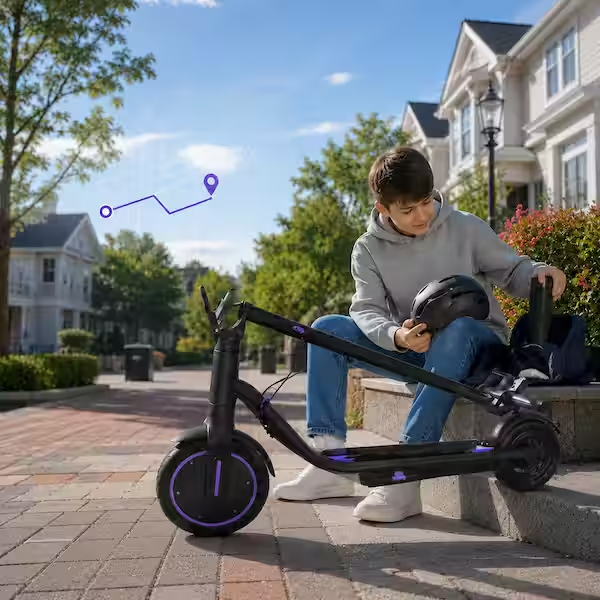
4. Count everything you’re carrying
The Q2’s listed maximum load is 264 pounds.
Remember that your commute isn’t made by your body alone.
Your actual riding load can include:
- backpack
- laptop
- work equipment
- groceries
- locks
- extra clothing
- anything else you’re carrying
Being underneath the maximum rated load does not necessarily mean every aspect of performance will be identical for every rider.
A 150-pound rider on flat pavement and a much heavier rider carrying cargo uphill are asking different things from the same motor and battery.
This is another reason to think in terms of performance margin rather than specification compliance.
“I’m below 264 pounds” answers one question.
It doesn’t answer:
“Will this scooter still give me the range and hill performance I need under my normal load?”
If you’re going to ride with a relatively high total load, be conservative about relying on maximum range and speed claims.
5. Charging access can completely change the answer
The Q2 battery is listed as taking about five hours to charge.
That means two people with the exact same commute can reach opposite buying decisions.
Consider a six-mile trip to work.
Rider one
They can safely bring the scooter inside and charge it throughout an eight-hour workday.
The scooter only needs enough reliable range for each individual leg.
Rider two
They have nowhere to charge.
Now the scooter must reliably cover the full 12-mile round trip.
The route hasn’t changed.
The scooter hasn’t changed.
The dependency has changed.
That’s why charging access belongs in the buying decision.
Before purchasing, find out:
- Can you charge at work or school?
- Is there a convenient outlet?
- Are you permitted to charge an electric scooter there?
- Can you leave it charging safely?
- Do you need to carry the charger with you?
- Will the scooter actually have enough time to recharge before your return trip?
Don’t assume destination charging will solve your range problem until you know it is available.
6. Think about what happens when the ride ends
Commuter reviews naturally concentrate on riding.
Ownership also includes everything you have to do before and after the ride.
The VOLPAM Q2 has a folding design intended to make transport and storage easier.
That’s useful—but “foldable” doesn’t automatically mean “convenient in my situation.”
Before buying, follow the scooter through your whole day.
At home
Where will it live?
Can you bring it indoors?
Do you have stairs?
Is there somewhere practical to charge it?
At work or school
Can you bring a scooter inside?
Is there secure storage?
If it must stay outside, how will you lock it?
Can you charge it there?
If public transportation is involved
Will you regularly combine the scooter with a bus or train?
If so, check the operator’s current rules on electric scooters and lithium-powered personal mobility devices before making the purchase.
The “last mile” problem isn’t solved if storing or transporting the scooter creates a new problem every day.
7. Decide how much you value avoiding flats
This is one area where the Q2’s trade-off is unusually clear.
Its solid tires mean you don’t have the same routine puncture risk associated with air-filled tires.
For the right commuter, that can be a major reason to buy it.
Maybe you’ve owned a pneumatic-tire scooter before and you’re tired of:
- checking tire pressure
- dealing with inner tubes
- worrying about punctures
- discovering a flat when you’re already late
If eliminating that maintenance burden matters more to you than having a softer ride, the Q2’s tire choice becomes a genuine advantage.
But another buyer may say:
“I ride over terrible pavement every day. Comfort matters much more to me than occasionally maintaining tires.”
That buyer should assign the trade-off differently.
Neither person is wrong.
They simply have different stakes in the decision.
The VOLPAM Q2 commute-fit test
Use this before buying.
Give yourself one point for every statement that’s true.
Your route
- Your required distance between charging opportunities is comfortably below the 15-mile advertised maximum.
- Most of your route uses reasonably smooth pavement.
- Your commute doesn’t depend on repeated demanding hill climbs.
Your load
- Your combined rider-and-cargo weight leaves reasonable room below the 264-pound maximum.
- You aren’t relying on maximum advertised performance while carrying a heavy load.
Your charging situation
- You can complete the necessary trip without assuming ideal battery performance.
- If you need destination charging, you’ve confirmed that it’s actually available.
Your priorities
- Avoiding pneumatic tire punctures is important to you.
- You’re willing to accept a firmer rigid/solid-tire setup in exchange for lower tire maintenance.
Your daily routine
- You have a practical place to store the scooter at both ends of the commute.
- Folding the scooter genuinely makes your transport or storage situation easier.
How to interpret your answers
Mostly yes: the Q2 deserves a closer look
If your commute is short, smooth, relatively flat and comfortably within the scooter’s range envelope, the Q2’s combination of a 350W motor, solid tires, folding frame and relatively simple commuter design makes sense on paper.
At this point, price, ownership experience, warranty and comparison with similarly priced alternatives become more important.
Several no answers: identify which compromises matter
One failed condition doesn’t automatically disqualify the scooter.
Maybe you have rough pavement but only ride one mile.
Maybe your trip is relatively long but you have guaranteed charging at work.
Maybe you carry a heavier load but your route is completely flat.
The question is whether one strength compensates for another weakness in your particular situation.
Mostly no: don’t let the price make the decision
If your commute is long, hilly, rough, heavily loaded and dependent on extracting close to the scooter’s maximum advertised range, the Q2 is probably solving the wrong problem.
You may need to spend more for:
- additional battery capacity
- stronger hill performance
- larger tires
- suspension
- better ride comfort
- a model with more performance margin
Buying the cheaper scooter isn’t saving money if its limitations eventually force you to replace it.
Who the VOLPAM Q2 makes the most sense for
The Q2 looks most compelling for someone who wants a straightforward electric scooter for short urban trips, particularly where avoiding flats and reducing tire maintenance matters.
A strong-fit buyer might have:
- a relatively short commute
- mostly smooth roads or bike paths
- few major hills
- somewhere safe to store the scooter
- enough range reserve that 15 miles is a ceiling rather than a target
- a preference for solid tires over the comfort of pneumatic ones
That’s a more convincing reason to buy the Q2 than simply seeing “19 mph” and “15 miles” on the product page.
Who should probably look at something else
We’d be cautious about choosing this version of the Q2 if:
- your normal trip gets close to its 15-mile advertised maximum
- you cannot charge at your destination
- steep or repeated hills are central to your route
- your roads are consistently rough
- ride comfort is a major priority
- you’re carrying a relatively heavy total load
- you want substantial performance headroom rather than just enough scooter for the job
Those don’t necessarily make the VOLPAM Q2 a bad scooter.
They make it a potentially bad match.
Bottom line: don’t ask whether the Q2 is good—ask whether your commute is easy enough for the Q2
The VOLPAM Q2 offers an appealing commuter specification for the right route: a 350W motor, up to 19 mph, up to 15 miles of advertised range, 8.5-inch solid tires, folding portability and a 264-pound maximum load.
But those numbers describe the scooter.
Your route determines whether they’re enough.
For a short, mostly flat commute over decent pavement, where puncture-resistant solid tires matter and the advertised range leaves plenty of reserve, the Q2 can make sense.
For a long, rough, hill-heavy commute where you need nearly every advertised mile, it’s much harder to recommend—even if the price looks attractive.
The best commuter scooter isn’t the one with specifications that technically cover your trip.
It’s the one that leaves enough margin that getting to work and getting home doesn’t become a daily experiment.

Iqra Jumar is Option Cutter's editorial writer. She writes practical editorials and buyer guides that focus on real-world upgrades—better Wi‑Fi, cleaner cable setups, smarter streaming, and everyday fixes—not spec-sheet noise alone. Her work helps readers decide what to change now, what to skip, and why.