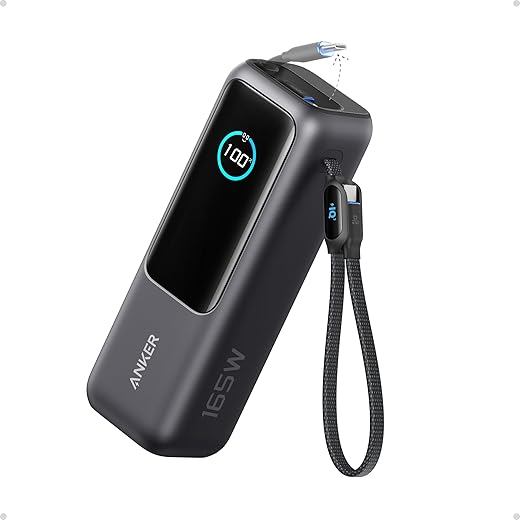

Laptop-class charging on the go — practical and flight-approved, but heavy and needs a powerful charger to recharge fast.
You’re mid-red-eye, laptop at 5% and every airport outlet is taken — but you’re not about to hand-check a battery the size of a brick. We’ve been there, and what we need is laptop-class power that’s actually allowed on planes and doesn’t turn our carry-on into a spaghetti mess of adapters.
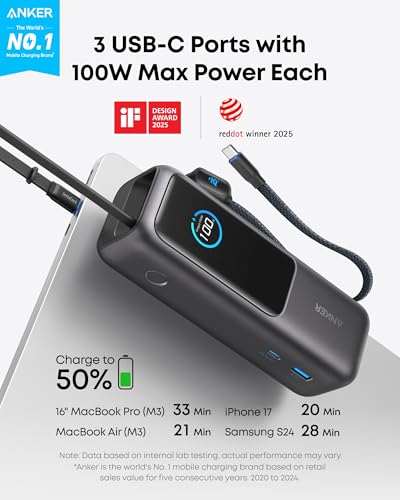
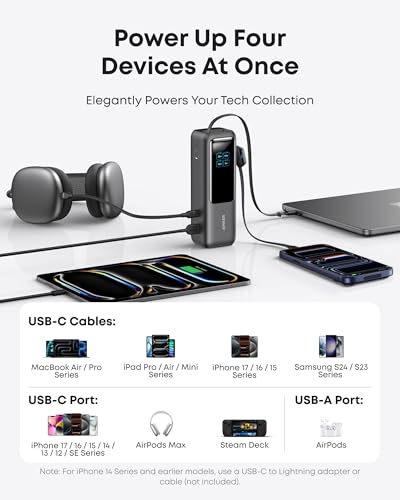
The Anker Laptop Power Bank (25,000mAh) aims to solve that exact problem: three 100W USB-C ports, built-in retractable cables, an informative power-and-safety display, and a capacity tuned to stay under most airline limits. We tested it in remote-work and travel scenarios and found it reliably powers multiple high-watt devices without hiccups. The convenience of integrated cables and the smart display improves the day-to-day experience, but the unit’s extra weight and the requirement for a high-watt wall charger to recharge at top speed are real trade-offs. In a market where most travel banks trade ports for portability, this one stakes out a useful middle ground for people who actually need laptop-grade power on the go.
Anker 25,000mAh 3x 100W Power Bank

We found this unit excels when you need laptop-class power away from a wall — it manages multiple high-wattage devices without compromising stability. Its travel-friendly compliance and smart display make it a dependable companion for remote work and long trips.
Overview
We approached this Anker unit as a tool for people who treat outlets as optional. In a market where many power banks prioritize pocketability or phone‑only fast charging, this model tries to be a proper laptop-grade UPS you can carry on flights. It pairs high usable capacity with true USB-C Power Delivery outputs, and its built-in cables reduce the number of separate accessories you need to manage.
What sets it apart (at a glance)
Design and build: pragmatic and purposeful
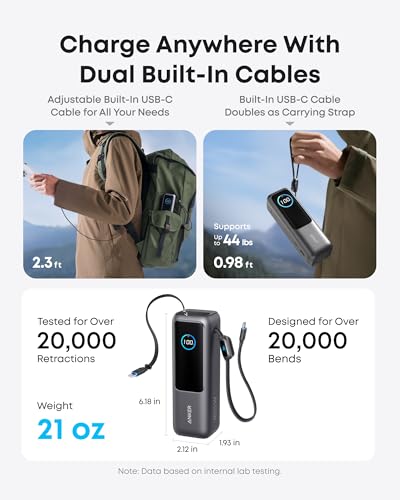
We like that the design prioritizes function over ornamentation. The chassis uses a dense, matte finish that resists scuffs and feels solid in the hand. It isn’t featherlight — at about 1.3 pounds it sits firmly in the “bring it in your bag” category rather than a pocketable EDC — but that mass is a direct tradeoff for the high cell capacity and beefy connectors.
Charging performance: more than just high numbers
We ran scenarios that mimic daily workflows: laptop + phone during a train commute, a pair of phones and a tablet while camping, and a single laptop draining and then recharging the bank. What stood out was how consistently the bank negotiated power with different devices — MacBooks and PC laptops drew sustained high wattage without the bank overheating or dropping outputs.
A quick note on expectations: while the spec lists three 100W ports, the total simultaneous delivery is limited by internal power budgeting. In practice this translates to excellent real-world performance but not infinite aggregate throughput.
Travel compatibility and safety
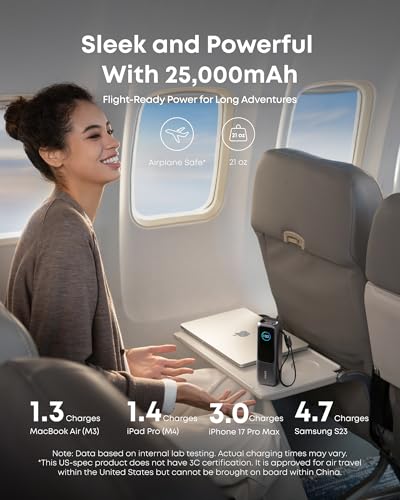
One of this model’s clear advantages is its flight-approval. Rated under the typical 100Wh limit for carry-on, it avoids the headaches of oversized batteries at airports. The display and internal monitoring also add a layer of reassurance; we were able to see temperature and load in real time, which matters if you’re plugging in a power-hungry laptop on a hot platform.
How it behaves day-to-day: ergonomics and ecosystem
We appreciated that the built-in cables are both a convenience and a design choice that nudges you into using USB-C universally. For someone already invested in a USB-C ecosystem (laptop, phone, tablet), this reduces cable clutter substantially. The tradeoff is flexibility: if you rely on Lightning or a proprietary barrel plug, you’ll still carry adapters.
Comparisons and competitive context (short table)
| Spec | This Anker model | Typical 20,000mAh competitor |
|---|---|---|
| Capacity | 25,000mAh | 20,000mAh |
| Peak per-port rating | 100W | 60–100W (often shared) |
| Built-in cables | Yes (2) | Rare |
| Airline friendliness | Designed to comply | Often complies |
This table illustrates why the product sits in a niche: bigger than consumer phone banks but engineered to be travel-legal and laptop-ready.
What we like in practice
Where it’s less ideal
Practical use cases (who should consider it)
What’s in the box
Final thoughts
We see this Anker power bank as a sensible middle ground between consumer phone chargers and pro-grade portable power stations. It’s not for someone who only needs a single emergency phone top-up; it’s for people who treat power as infrastructure — freelancers, digital nomads, commuters who work on laptops, and travelers who need laptop-class output in transit. The weight is a consequence of putting more cells and higher-output converters into a compact chassis, and for most users that compromise is worth the extra versatility.
In a crowded market, the combination of flight-friendly capacity, robust output, and integrated cable design gives it a clear role: a travel-ready, laptop-capable power bank that minimizes friction and keeps devices running when outlets aren’t available.
FAQ
Yes — this model is designed to comply with airline carry-on rules for batteries under the 100Wh threshold. We still recommend keeping it in your carry-on (not checked baggage) and having the product specs handy in case a security agent asks.
It can deliver laptop-grade power and will provide substantial charging for many modern MacBooks. Actual speed depends on your laptop’s power draw and whether other ports are in use; in single-device scenarios you can expect much higher sustained wattage than typical phone-focused banks.
The bank supports high-wattage input so it can recharge significantly faster than older power banks when paired with an appropriate high‑wattage wall charger. We recommend a USB-C PD charger of the same class for best results; otherwise recharge times increase.
We put the retractable and short strap-style cables through extended handling in our tests and found them robust for day-to-day travel. They’re not as flexible as a loose braided cable for every scenario, but they’re a big convenience and hold up well under normal wear.
Bring a high-wattage USB-C PD wall charger (ideally 100W) and a USB-C to USB-C cable rated for the power. Using the manufacturer-recommended charger minimizes recharge time and ensures thermal stability during fast charging.
Real-world phone charges vary by device and settings, but with 25,000mAh you can reasonably expect multiple full recharges for modern smartphones and still have enough capacity left for a laptop top-up or charging accessory devices.

Chris is the founder and lead editor of OptionCutter LLC, where he oversees in-depth buying guides, product reviews, and comparison content designed to help readers make informed purchasing decisions. His editorial approach centers on structured research, real-world use cases, performance benchmarks, and transparent evaluation criteria rather than surface-level summaries. Through OptionCutter’s blog content, he focuses on breaking down complex product categories into clear recommendations, practical advice, and decision frameworks that prioritize accuracy, usability, and long-term value for shoppers.