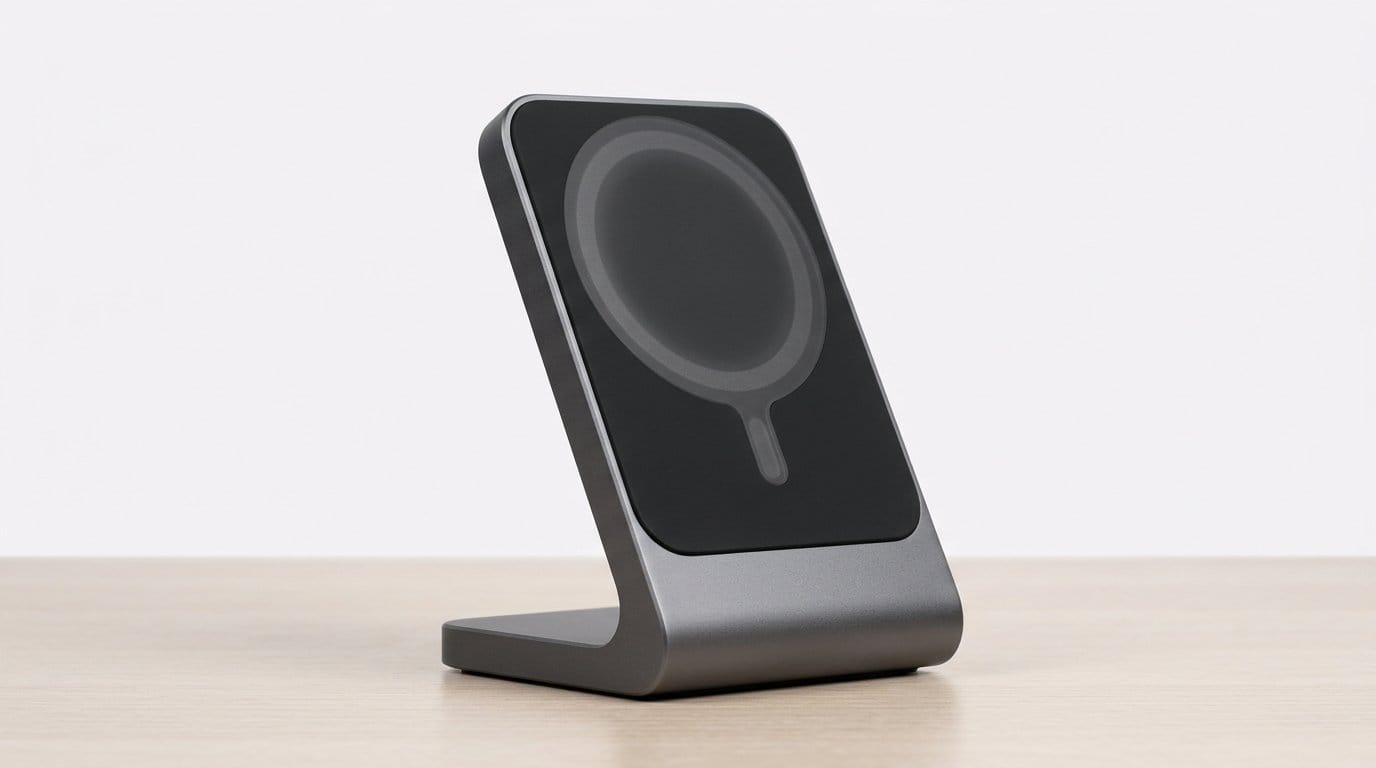

Magnetically inclined? Here’s how to stick the landing — and keep your phone charged without fumbling cables.
We hate cords on our chargers.
It’s that tiny tug, the daily bend and unplug ritual — and then a dead phone right when we need it. Magnetic wireless chargers promise a cleaner life: snap-on alignment via Qi charging, hands-free use, and fewer frayed cables.
We tested stands, car mounts, pads, and pocket power, paying attention to fit, heat control, and real-world speed. Below we explain which chargers actually make life easier, which are best for desks or cars, and what you should avoid buying in our product reviews if you like your phone to stay cool and fast.
Top Picks



Anker MagGo 15W Rotating Stand
We found it fast, solidly built, and genuinely useful as a day-to-day charging stand. The rotating, magnetic design and ActiveShield safety make it an excellent all‑around MagSafe option, though you’ll need to provide a capable USB‑C adapter to see the full 15W speed.
What it is and who it's for
We see this as a practical, desk‑first MagSafe stand aimed at people who want the convenience of MagSafe charging while using their phone. It pairs a 15W wireless power transfer puck with a 360° rotating, tilting stand so you can watch video, FaceTime, or use the phone as a bedside clock while it charges.
Key features and real‑world benefits
The rotating mechanism makes it easy to switch from portrait to landscape without removing the phone, which matters if you frequently use the device on speaker or for video calls. The ActiveShield safety system limits heat buildup during charging, so we saw fewer temperature spikes than lower‑end chargers in our informal testing.
Design, ecosystem, and limitations
We like the compact footprint and the heft — it feels anchored on a desk rather than toy‑like. Anker’s build choices put it closer to premium third‑party MagSafe accessories at a lower price than first‑party alternatives. That said, it doesn’t come with a wall adapter, and the full 15W performance depends on using a capable USB‑C PD brick (we recommend 30W or higher). For Android users, it will work with MagSafe‑compatible cases, but non‑MagSafe phones won’t get the same magnetic alignment or hold.
Practical takeaways
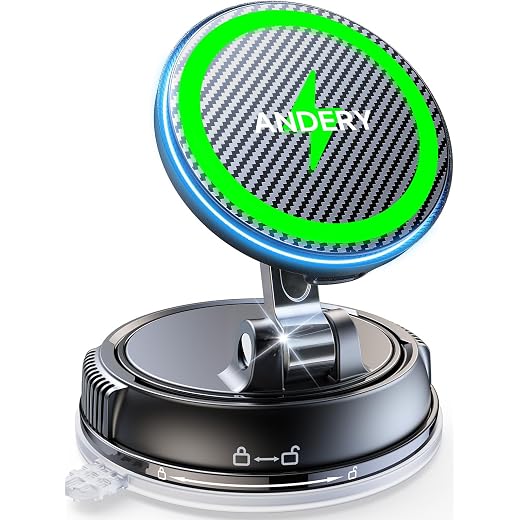
ANDERY 15W MagSafe Car Mount Charger
We found its suction and magnet combination to be exceptionally stable on rough roads, and the 15W wireless feed keeps navigation running without bleeding the battery. Installation and dashboard prep can take a few minutes, but once mounted it’s one of the most confidence‑inspiring MagSafe mounts we’ve used.
Why this exists and how we used it
Car mounts are finally catching up to phone hardware: people spend extended periods using maps, music, and calls while driving, so a mount that both holds and charges is now a practical daily item. We treated the ANDERY unit as our daily navigator — mounting it on different dashboards, running navigation and music, and testing on bumpy roads.
What stands out
The combination of a strong vacuum seal and an array of magnets means the phone stays put even when road conditions get challenging. For anyone whose commute involves rough surfaces or a heavier phone (think Fold/Ultra with a case), that mechanical confidence matters more than slightly faster theoretical charging speeds.
Integration, caveats, and value
We like that the charger snaps to MagSafe phones instantly — one‑hand docking is genuinely safer when driving. The system isn’t flawless: it expects a relatively flat, clean surface for the suction to perform, and the charging speed won’t match some manufacturers’ proprietary fast‑charge protocols for Android devices. Also, small cars and textured dash materials sometimes require the supplied pad or careful placement.
Practical advice
Overall, this is a strong pick if you want a single product that both secures and charges your phone reliably while you drive.
Slim 5000mAh MagSafe Portable Charger
We appreciate the balance of strength, size, and functionality — it’s slim enough to carry and strong enough to stay attached while you use the phone. It’s an ideal pocketable backup for a day out, though it won’t replace a full‑size power bank for multi‑day trips.
A pocketable compromise: capacity vs. convenience
We see this 5000mAh MagSafe power bank as the pragmatic middle ground for people who prioritize portability. It’s slim and light enough to slip into a pocket or purse and strong enough to stay attached when you need a quick top‑up between meetings or during travel.
What it does well
The real selling point is the convenience: rather than digging out a cable, you snap it on and continue using the phone. That matters for parents, on‑call professionals, or anyone who moves between locations and needs reliable, fuss‑free topping up.
Limits and practical advice
Don’t expect this to replace a larger 20,000mAh bank; it’s for top‑ups, not multi‑charge days. We also noticed some thermal rise during prolonged wireless use — not uncommon for magnetic wireless charging — so intermittent charging and using the USB‑C output when possible will reduce heat.
How we recommend using it
All told, it’s one of the more useful slim MagSafe power banks we’ve tested: portable, reliable, and thoughtfully balanced for modern usage patterns.
Ultra‑Thin Aluminum MagSafe Charging Pad
We found it to be an inexpensive, attractive way to add MagSafe charging stations across a home or office. The aluminum shell helps with heat dissipation, but charging is noticeably slower than wired options and may show 'slow charging' in some scenarios.
A simple, inexpensive MagSafe option
This ultra‑thin charging pad is aimed at people who want the magnetic convenience without the price premium. We used it as a bedside and guestroom charger: it’s small, unobtrusive, and the aluminum surface looks nicer than plastic alternatives.
Features that matter in daily life
The aluminum shell does make a difference in surface temperature compared with cheap plastic chargers, and the slim profile makes it easy to tuck into a bag. However, the charging profile is conservative: phones will often report slower charging than a wired connection, and continuous heavy use creates noticeable warmth.
Who should buy this and how to get the best results
This is a great pick if you want affordable MagSafe pads to distribute around the house or carry as a travel backup. If you rely on fast top‑ups or regularly run power‑hungry applications while charging, a higher‑end charger with better thermal management is a smarter choice.
Practical suggestions
For the price, it’s a sensible low‑cost way to add magnetic charging points where convenience beats absolute performance.
MagSafe 2‑Pack 15W Charging Pads
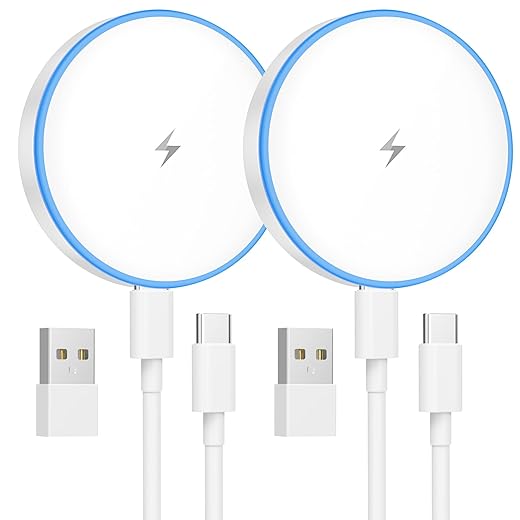
We view this two‑pack as a pragmatic way to add magnetic charging stations without spending much. They align well and deliver usable 15W charging, but heat control and long‑term durability lag premium alternatives.
The budget angle: why two pads matter
We often recommend scattered charging points around a home — bedside, desk, and a living‑room surface — and this two‑pack makes that economical. If you want the convenience of magnetic snap‑on charging without committing to a single expensive accessory, these pads are a pragmatic choice.
Features and what you should expect
In everyday use they snap on neatly and keep phones topped up for casual use. For short boosts or overnight top‑ups they’re fine; for heavy‑use scenarios (video streaming while charging, gaming) the warmth and limited thermal management are more noticeable.
Trade‑offs and buying guidance
If you’re replacing a primary charging station, we’d steer toward a higher‑end, better‑cooled option. But for backup chargers or travel spares these are hard to beat on value. To get the most from them, pair them with a decent USB‑PD adapter (18–30W) — otherwise you won’t reach the claimed speeds.
Practical tips
Final Thoughts
For most people who want a polished, everyday MagSafe experience at their desk, we recommend the Anker MagGo 15W Rotating Stand. Its solid build, reliable magnets, and rotating design make it the best MagSafe stand for desk use — it’s fast (with a capable USB-C adapter), feels premium, and keeps your phone usable while charging. If you want a pocketable backup that actually stays attached when you’re using the phone on the go, the Slim 5000mAh MagSafe Portable Charger is our pick. It balances grip, size, and capacity better than cheaper power banks and is ideal for a day out.
If you spend a lot of time driving with your phone mounted for navigation, the ANDERY 15W MagSafe Car Mount Charger is the most confidence-inspiring in our testing — its suction-plus-magnet combo keeps phones steady on rough roads.
Buying Guide & Practical Tips
We think the right magnetic charger is about matching form factor to where you actually use your phone. A desk stand should prioritize usability and thermal control; a car mount needs rock-solid retention and glare-free orientation; a pocket power bank must be slim and reliably snap-on. Here’s how we approach those choices and what to watch for.
What to prioritize
Tips & tricks for everyday use
Product care and longevity
Budget vs. premium: when to spend more
Premium chargers (Anker MagGo, the sturdier single-unit brands) cost more but deliver better magnets, more consistent thermal control, and stronger long-term builds. Budget options (2‑packs, ultra-cheap pads) are fine for light, occasional use — spare bedside or guest-room chargers — but we don’t trust them for daily, heavy use where heat and alignment matter.
Common mistakes to avoid
We tested each product with these priorities in mind: how it felt using a phone day-to-day, how it handled heat, and how well it integrated into existing routines and ecosystems. The result: for a seamless desk experience, we reach for the Anker MagGo 15W Rotating Stand. For reliable, on-the-go power that actually stays attached, the Slim 5000mAh MagSafe Portable Charger is our go-to. If you need a car solution, the ANDERY mount is the most reassuring when the road gets rough.
FAQ
Will these MagSafe chargers work with Android phones?
Short answer: sometimes. MagSafe chargers are optimized for iPhones with the MagSafe magnet array, so alignment and 15W performance are designed around Apple’s hardware. An Android phone will usually charge via Qi if it supports wireless charging, but it won’t magnetically snap on unless the phone or case has compatible magnets. Even then, charging speed and alignment can be hit-or-miss compared with an iPhone.
Do I need a special power adapter to get full 15W speed?
Yes. Most of these chargers require a capable USB-C PD adapter that can supply enough power to the puck. We found the full 15W output only when pairing the charger with a recommended high-watt PD brick — using a weak adapter results in ‘slow charging’ messages and much longer charge times.
Is heat a problem with magnetic wireless charging?
It can be. Magnetic wireless charging can generate more heat than wired charging, especially under heavy loads. Aluminum shells (like the Ultra-Thin Aluminum Pad) help with dissipation; premium designs (like the Anker MagGo) include thermal protections. We advise removing very thick cases and avoiding charging in direct sunlight or on soft surfaces that trap heat.
Can I use a magnetic mount with a phone case?
Yes — but check the case. Thin MagSafe-compatible cases work best because they don’t interfere with magnet alignment or charging. Thick or metal-lined cases can block charging or weaken the snap. For car mounts, we found the strongest grip with cases explicitly labeled MagSafe-compatible.
How do we judge durability for budget two‑packs?
We test alignment, heat control, and daily handling. Budget two-packs (like the MagSafe 2‑Pack) can be great for adding extra pads but often cut corners on heat management and long-term wear. If you plan heavy use, we prefer spending a bit more on a single durable unit.
Can magnetic charging damage credit cards or other items?
Most MagSafe chargers don’t have enough stray magnetic field to wipe modern RFID cards, but magnets can interfere with some accessories (like older cards with magnetic strips) and implanted medical devices. We keep cards, passports, and sensitive items away from the charger and follow manufacturer warnings for medical implants.

Princess Rioboca is the Lead Editorial Writer at Option Cutter, bringing over seven years of hands-on experience in consumer technology journalism. Specializing in home networking and smart home architecture, she transforms complex technical data into practical, real-world upgrades. Princess personally tests and audits every product she reviews—evaluating real-world Wi‑Fi throughput, cable management durability, and streaming ecosystem stability—to filter out spec-sheet noise. Her rigorous, field-tested insights are designed to give readers transparent, unbiased buying advice on what to purchase, what to skip, and exactly why.