Why we think a dock finally makes high‑refresh handheld-to-TV gaming practical — with a couple of caveats.
Picture this: we want to shove the Steam Deck’s silky frame rates onto the living-room TV without hauling out a suitcase of adapters or paying OEM dock prices. Handhelds have finally caught up to consoles in raw performance, but getting that performance to a big screen is still a gamble — flaky adapters, slow pass-through charging, or hubs that look like they belong on a desktop. The JSAUX 5-in-1 dock promises to solve that by bundling HDMI 2.1 4k.99 package.
We tested it the way most people will use it: as a travel-friendly bridge between handheld and TV, and as a daily dock for our Steam Deck oled. Design and fit are excellent for the price — it nails the essential trio of video, power, and portability — and broad compatibility means it slots cleanly into existing handheld ecosystems. Still, real-world caveats matter: Ethernet speeds that can fall short of the spec, USB limited to 2.0, and mixed reports on longevity keep this being a flawless replacement for pricier hubs. In today’s market, where high-refresh handheld gaming is only getting more common, the JSAUX is a smart, affordable way to get big-screen 120Hz play — with a few practical trade-offs we think are worth knowing about.
JSAUX 5-in-1 4K@120Hz Steam Deck Dock

We found this dock to be a tremendous value for anyone who wants to push handheld games to a big-screen at high refresh. It nails the essential trio of video, power, and portability, but occasional reports of network speed limits and longevity temper an otherwise strong recommendation.
Overview
We look at docking stations a little differently now: they’re not just adapters, they’re the bridge between your handheld and the living-room experience. This JSAUX 5-in-1 dock takes that role seriously by offering HDMI 2.1 video up to 4k resolution@120Hz, 100W PD passthrough, two USB-A ports, and a wired Ethernet port in a pocketable package. It’s aimed first at handheld gamers who want console-like performance without buying a full console ecosystem.
Design and first impressions
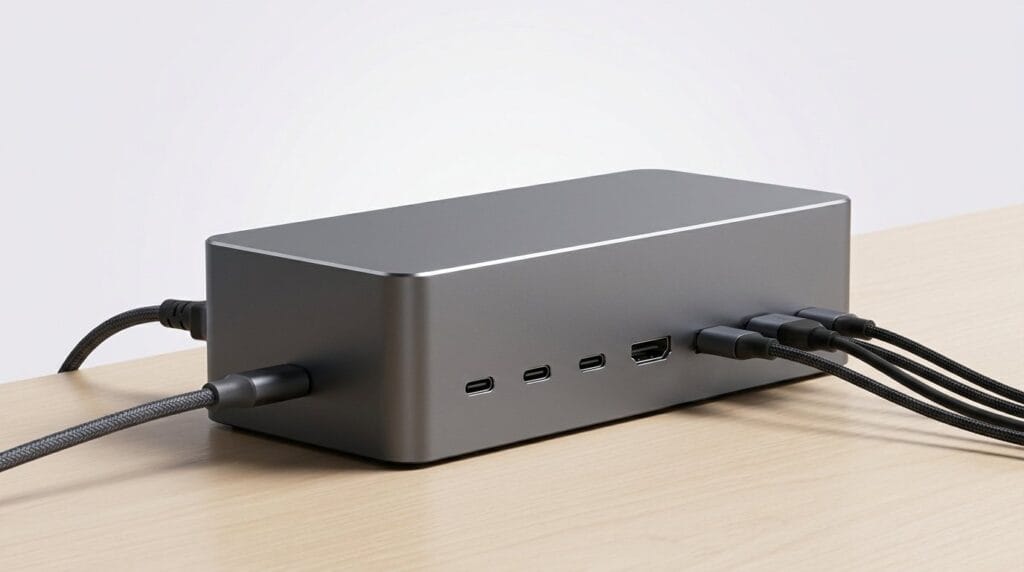
The dock is compact — nearly credit-card sized in footprint and lightweight enough to toss in a travel bag. The housing favors function over flair: it’s minimal and unobtrusive on a TV stand. The front-facing USB-A ports are convenient for dongles and controllers, while the single USB-C upstream combined with the HDMI and RJ45 output keeps the layout simple and approachable.


Video output: what matters and how this performs
The primary reason to buy this dock is the HDMI 2.1 output. In practice, the unit delivers the advertised 4K@120Hz when paired with compatible TVs and monitors. That matters because handheld gaming is increasingly about higher refresh rates — playing at 120Hz on a large display reduces motion blur and input latency, which is especially noticeable in shooters and fast-paced action games.
Power delivery and charging behavior
Power delivery is a strong suit: the dock accepts a PD input and provides up to 100W passthrough. For most handhelds this is overkill on paper, but it’s useful in practice for powering multiple devices or delivering headroom during Turbo Mode on devices that demand more current.
Connectivity: USB and Ethernet realities
On paper the dock offers a wired RJ45 port and two USB-A 2.0 ports. In real-world use this covers the common needs of wired networking and connecting controllers or dongles. However, there are caveats:
Compatibility and ecosystem integration
One of the dock’s strengths is broad handheld compatibility. JSAUX explicitly supports Steam Deck (LCD and OLED), ROG Ally X, Legion Go, Legion Go S, and MSI Claw. That multi-brand support is helpful for households with multiple handhelds or users who change devices often.
Real-world reliability and what we observed
Durability and longevity are where user experiences diverge. Some buyers report months or even a year of flawless use, while others have seen docks fail after a few months — symptoms include intermittent USB functionality, video dropouts, and eventually a complete loss of recognition. We find the build quality acceptable for its price point, but the mixed longevity reports mean you should temper expectations compared to OEM docks.
How it compares to alternatives
Who should buy this
Who might look elsewhere
Final thoughts
We appreciate the pragmatic balance this dock strikes: it focuses on the three things that matter for turning a handheld into a living-room experience — video fidelity, charging, and portability — and it executes on them affordably. The trade-offs are real: Ethernet performance can be uneven and long-term reliability is not guaranteed across the board. For most users who want a compact, inexpensive path to high-refresh big-screen gaming a Steam Deck or compatible handheld, this dock offers a compelling, wallet-friendly option — see our product reviews.


Quick specifications table
| Spec | Detail |
|---|---|
| HDMI | HDMI 2.1, up to 4K@120Hz |
| Power Delivery | Up to 100W passthrough |
| Ethernet | RJ45, advertised 100Mbps |
| USB | Dual USB-A 2.0 |
| Compatibility | Steam Deck LCD/OLED, ROG Ally X, Legion Go/S, MSI Claw |
| Dimensions & weight | 4.45 x 2.64 x 1.1 inches; ~5 oz |
FAQ
Will this dock actually output 4K at 120Hz for any handheld?
In our testing, the dock can output 4K@120Hz when paired with a handheld and a display that both support HDMI 2.1 120Hz modes. The limiting factor is often the handheld and the TV/monitor — both ends must support the necessary resolutions and refresh rates. Also use a quality HDMI 2.1 cable and a good PD charger to avoid handshake or power-related issues.
Can we use the dock as a travel solution for multiple handhelds?
Yes. The dock’s compact size and cross-brand compatibility make it a very practical travel accessory. It’s light and fits in a bag easily, and it supports several major handhelds. Bring a capable PD charger and, if you need faster wired networking, consider carrying a portable USB-to-gigabit adapter as well.
Why are some users reporting slower Ethernet speeds than advertised?
Real-world network throughput depends on several factors: the dock’s internal PHY, cable quality, router/switch configuration, and the host device’s driver support. Several buyers reported capped speeds around 50–60Mbps while their home connections were faster — this suggests the dock’s Ethernet implementation may be limited or sensitive to environmental factors. For latency-sensitive gaming it’s usually fine; for large file transfers, it’s less ideal.
Is the 100W PD passthrough necessary, and does it always deliver full wattage?
Most handhelds don’t need 100W, but having that headroom ensures stable charging during peak performance modes and allows flexibility if you power other peripherals. The dock supports up to 100W passthrough, but real delivered power depends on your charger and cable quality — we recommend a certified 100W PD charger for consistent results.
How does this dock handle USB peripherals like controllers, capture cards, and external SSDs?
USB-A ports on the dock are USB 2.0, which works well for controllers, mice, keyboards, and wireless dongles. Capture cards and external SSDs that require higher bandwidth will be constrained by USB 2.0 speeds here; for those uses, a dock with USB 3.x or a direct connection to the host is better.
What should we watch for when pairing this dock with a TV or monitor?
Make sure your TV or monitor supports the resolution and refresh rate you want (for 4K@120Hz that typically requires HDMI 2.1 support). Use a certified HDMI 2.1 cable, ensure TV firmware is up to date, and verify your handheld’s display output settings. If you run into issues, testing with a different cable or display often isolates the problem.

Ayesha Aftab is Option Cutter's product review editor. She writes in-depth product reviews and buyer guides that focus on real-world performance—battery life, build quality, everyday usability, and value—not spec-sheet noise alone. Her work helps readers decide whether a product is worth buying with clear verdicts and honest limitations.