
Menu

How to Choose a Portable Bluetooth Speaker with Deep Bass

Yogesh Kumar / Option Cutter
Picture of By Chris Powell
By Chris Powell

Why deep bass matters in a tiny speaker

We show how to pick a compact Bluetooth speaker that delivers deep, tight bass without muddying mids; we balance listening, specs, trade‑offs and ecosystem integration, design, and real‑world use choices.

What you’ll need

A clear budget range we’ll stick to
Phone and playlist for basic listening tests
Tape measure to check size and fit
Awareness of bass-vs-portability trade-offs
Best Value
Anker Soundcore 2 Portable Waterproof Bluetooth Speaker
24-hour battery and BassUp for punchy low end
We like the Soundcore 2 for delivering surprisingly large, distortion‑free sound and boosted low end thanks to Anker’s BassUp tech, all sealed in an IPX7, palm‑friendly design. In a crowded budget market it matters because it balances endurance, punch, and ruggedness for home, travel, and outdoor use where many rivals compromise on battery or bass.
Amazon price updated April 23, 2026 2:31 pm
Prices and availability are accurate as of the last update but subject to change. I may earn a commission at no extra cost to you.

Top Portable Bluetooth Speakers for Any Budget


1

Read beyond the marketing: what bass specs really tell us

Can a spec sheet predict a party? Spoiler: not entirely, but some numbers separate hype from reality.

Scrutinize specs, not slogans. Manufacturers love to tout driver diameter and frequency response, but we focus on the numbers that actually correlate with low‑end performance.

Check these key indicators:

Driver size & design: Larger diameter helps displace air, but enclosure type and passive radiators matter just as much — a tiny driver in a tuned chamber can outperform a bigger one in a sealed plastic box.
Frequency response: Note the caveats. A listed “20 Hz” floor without SPL data often hides roll‑off or distortion at listening levels.
Sensitivity & THD: Higher sensitivity gives louder output per watt; lower THD means cleaner bass under load.
SPL graphs / third‑party measurements: Look for published curves from reviews or labs for real behavior.

Account for DSP: modern EQ/bass‑boost can fake depth but may trade clarity and battery. Treat specs as a filter, not a verdict — eliminate underpowered units, then validate with listening tests and reviews.

Editor's Choice
JBL Flip 6 Rugged Portable Bluetooth Speaker
Pro sound with PartyBoost and IP67
We appreciate the Flip 6’s two‑way racetrack driver and dedicated tweeter for clear, punchy output, plus IP67 durability and PartyBoost for easy speaker linking. Compared with smaller portables, it prioritizes balanced tuning and expandability, making it our go‑to for outdoor gatherings and everyday carry where sound quality and robustness matter.
Amazon price updated April 23, 2026 2:31 pm
Prices and availability are accurate as of the last update but subject to change. I may earn a commission at no extra cost to you.

2

Focus on the hardware that moves air: drivers and radiators

Why a passive radiator can be the secret sauce — and when it’s just marketing glitter.

Inspect drivers and passive radiators first. The physical parts dictate how a tiny speaker produces real bass: more cone area and longer excursion move air, so a single larger driver or multiple well‑matched drivers often outpace gimmicky driver counts.

Look for build cues that signal serious design work:

Prefer stiff cones and rubber surrounds for controlled movement.
Prefer substantial magnet structures for better excursion control.
Prefer quality passive radiators that sit flush and don’t buzz.

Compare enclosure types: ports boost efficiency at a tuned frequency but can sound boomy off‑axis; sealed boxes trade efficiency for tighter, more accurate bass. In practice, choose units showing internal bracing, dampening, and well‑implemented radiators—those mechanical decisions matter more than headline wattage.


3

Power, amplification, and DSP: the invisible engineers of bass

More watts isn’t always better — smart amps and software often make a cheap speaker sound expensive.

Evaluate how amplification and processing shape usable bass. Class‑D amps are the norm for portables; we favor designs that give headroom and conservative clipping protection so the speaker stays clean at party volumes.

Check these practical items when comparing models:

Amp type & headroom: prefer Class‑D with quoted RMS plus documented thermal limits.
DSP behavior: look for bass extension without midrange mud; good DSP reduces compression as volume rises.
Protection & management: ensure driver overexcursion prevention and dynamic‑range preservation are built in.
Thermal design: avoid units that heat up and throttle on sustained low‑bass.

Test by playing a bass‑heavy track loudly; if the speaker pumps, compresses, or distorts after a minute, the amp/DSP/thermal chain is failing. Favor brands that publish tuning notes or offer app EQ — transparency often equals better low‑end balance.

Party-Ready
Vortex 30W Portable Bluetooth Speaker with Lights
Loud 30W output and sync LED show
We find the Vortex delivers punchy 30W sound and a vivid LED light show that syncs to music, which makes it an obvious pick for parties and casual events. Battery life varies dramatically with volume and lighting, so it’s best for short sessions or paired setups using TWS rather than all‑day use.
Amazon price updated April 23, 2026 2:31 pm
Prices and availability are accurate as of the last update but subject to change. I may earn a commission at no extra cost to you.

4

Connectivity and ecosystem: more than just Bluetooth

Is it better to have multiroom magic or a single loud buddy? Ecosystem choices shape daily use.

Consider Bluetooth codecs first. LDAC or aptX HD matter if you stream high‑resolution or lossless‑compatible content from supported phones; AAC is fine for iPhones, SBC is the bare minimum.

Prioritize ecosystem conveniences that save time. Apple users get smoother AirPlay, multi‑device handoff, and Find My integration. Android users benefit from Google Fast Pair and richer multi‑device profiles. We value features that reduce friction.

Check codecs & device support: LDAC/aptX HD for high‑res; AAC for Apple; confirm phone/speaker compatibility.
Test pairing modes: left/right stereo pairing and party/multi‑speaker linking scale bass without distortion.
Prefer native streaming: Spotify Connect or Chromecast built‑in for stable, low‑latency playback over Bluetooth.

Evaluate both the raw audio path and app/ecosystem reliability—poor connectivity or flaky apps will ruin otherwise great bass.

Best Multiroom Bargain
Dual TWS Bluetooth Speaker Pair with Multiroom
Unlimited pairing for whole‑home multiroom audio
We like this twin set for turning any space into a makeshift multiroom system thanks to unlimited pairing and a very affordable price. It won’t match the fidelity or seamless app control of premium ecosystems, but for flexible, portable multi‑speaker setups and casual parties it’s an economical, feature‑rich alternative.
Amazon price updated April 23, 2026 2:31 pm
Prices and availability are accurate as of the last update but subject to change. I may earn a commission at no extra cost to you.

5

Portability and durability: where bass meets real life

Can your speaker survive the beach, the bike rack, and two playlists? Ruggedness affects how often you actually use it.

Balance bass ambition against portability constraints — heavier, larger speakers generally produce deeper, fuller bass, but we want models we’ll actually carry.

Check weight, dimensions, and battery size — big batteries support higher sustained loudness and matter more than peak watts for real-world use.

Prefer IP67 protection for poolside or beach use, and demand robust grills and tight seams to prevent rattles when bass hits.

Try bringing a 1 kg speaker with a 6,000 mAh battery to a beach; we found it sustained loud, consistent bass far longer than lighter rivals.
Weight & size: relate to driver size and bass capability.
Battery capacity: larger cells = longer sustained loudness.
IP rating: IP67 or better for water/sand resistance.
Build & grills: metal grills and braces reduce rattles.
Mounting/handling: flat bases or straps prevent passive‑radiator misalignment.
Charging: prefer USB‑C PD over proprietary chargers for travel convenience.
All-Day Performer
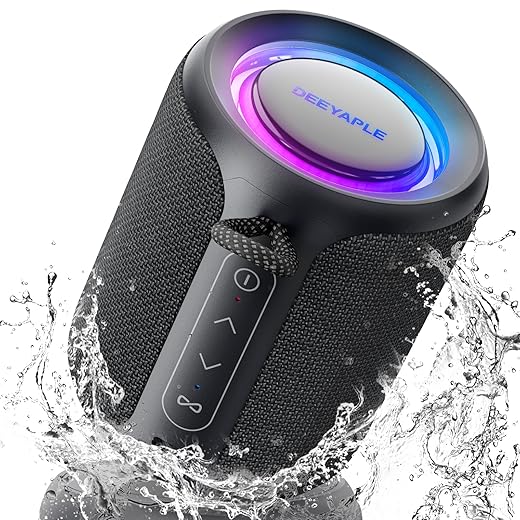
15W IP67 Bluetooth Speaker with Dynamic Lights
TWS stereo and Bluetooth 5.3 connectivity
We appreciate how this compact IP67 speaker pairs Bluetooth 5.3 stability with a 15W output and a 2500mAh battery that can last through a day of outdoor use. The dynamic light show and TWS pairing to a 30W combined output add party flair, though larger speakers will still win on deep bass and sustained loudness.
Amazon price updated April 23, 2026 2:31 pm
Prices and availability are accurate as of the last update but subject to change. I may earn a commission at no extra cost to you.

6

Test, compare, and decide: a practical checklist before you buy

Listen like you mean it — and don’t fall for showroom hiss. We give a checklist that actually predicts satisfaction.

Run controlled listening tests: play a deep subbass track (e.g., James Blake), a bass‑forward electronic cut (e.g., Daft Punk), and a bass‑light acoustic song to check balance.
Use the same source, enable volume normalization, and position the speaker where you’ll actually use it.
Listen for punch, decay, distortion at high volumes, bass clarity in dense mixes, and whether the speaker keeps tempo without smearing.
Measure perceived loudness and note the onset of distortion or grille rattles.
Compare against similarly priced competitors across budget, midrange, and premium tiers to understand tradeoffs.
Check expert frequency graphs and THD at reference SPLs, and cross‑check user reports for rattles or battery sag.
Prioritize return policies, warranty, and showroom or flexible shipping tests so we can swap units if real‑world bass disappoints.
Map our priority (deep, punchy bass vs portability vs battery life) to the features we identified earlier.

Compact Powerhouse
JBL Go 4 Ultra-Portable Waterproof Bluetooth Speaker
Palm-sized JBL Pro Sound with Auracast
We’re impressed that the Go 4 squeezes JBL Pro Sound and punchy bass into a palm‑sized, IP67 package with up to seven hours of battery life and an integrated carry loop. Its Auracast and multi‑speaker options give it an ecosystem edge for scaling sound, while recycled materials show a modest sustainability push in a crowded portable market.
Prices and availability are accurate as of the last update but subject to change. I may earn a commission at no extra cost to you.

Bringing it together

Weigh specs with hands‑on listening, prioritize design and DSP over raw wattage, choose an ecosystem that matches our daily life, use the checklist, try a speaker, and share your results.

Chris is the founder and lead editor of OptionCutter LLC, where he oversees in-depth buying guides, product reviews, and comparison content designed to help readers make informed purchasing decisions. His editorial approach centers on structured research, real-world use cases, performance benchmarks, and transparent evaluation criteria rather than surface-level summaries. Through OptionCutter’s blog content, he focuses on breaking down complex product categories into clear recommendations, practical advice, and decision frameworks that prioritize accuracy, usability, and long-term value for shoppers.


Newest Posts