
Small desk, tall ambitions — which riser wins the tight-space showdown?
Squeezing a standing setup onto a tiny desk? We’ve been there: monitor teetering over a coffee mug, keyboard shoved to the edge, and zero room to move. Standing converters promise a fast, affordable fix. But in small spaces, not all converters behave the same.
We looked for low collapsed height, stable lifts, and designs that don’t make a desk feel cluttered. We favored smooth gas springs, compact footprints, and options that actually fit dual monitors without turning your workspace into a balancing act.
Top Picks for Small Spaces


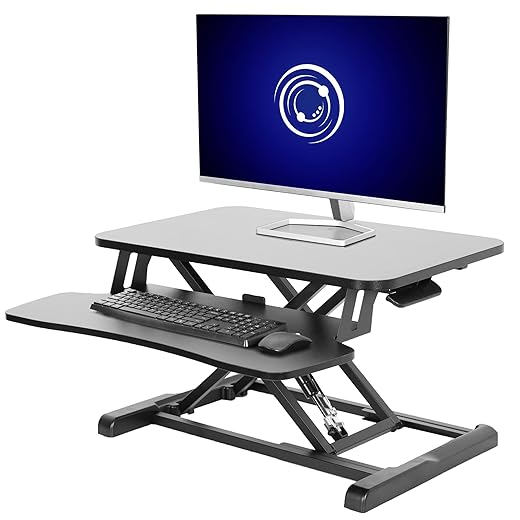

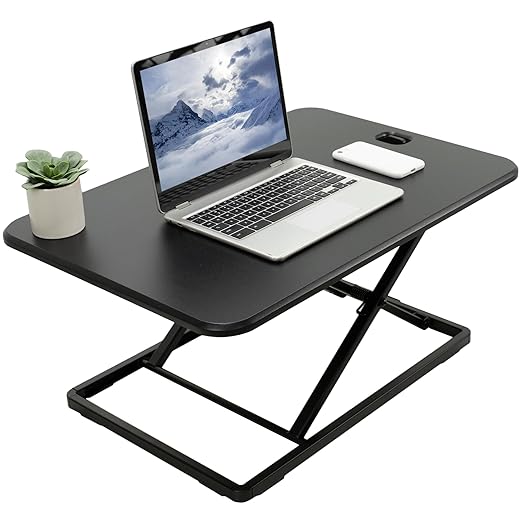

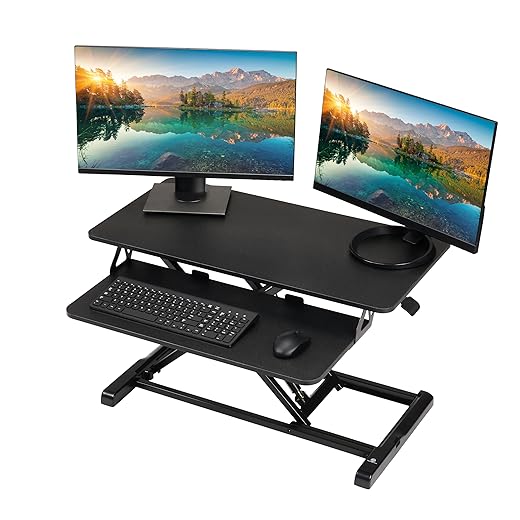


Mount‑It! 32" Gas‑Spring Desk Converter
A well-balanced, low-profile riser with refined mechanics and a slim collapsed height. It’s our favorite for people who want a solid, preassembled solution that looks and feels like a step up from budget models.
Why we picked it as an editor’s choice
Mount-It! crafted this converter around two priorities: refined motion and a minimal footprint. The unit collapses to just 2.5" and rises through a clean vertical motion powered by a well-damped gas spring. That vertical, non-tilting motion keeps your desk tidy and preserves usable space in front of the converter.
It ships preassembled and feels sturdier than many comparably priced alternatives. The top laminate is simple and neutral; the real differentiator is the action—raising and lowering requires just a light squeeze of the lever and the motion is controlled and quiet.
Day-to-day ergonomics and fit
We found the slim profile especially useful for small desks where you want the option to collapse the converter and preserve a near-flat workspace. It accommodates a single large monitor or a pair of smaller monitors, and the stability under typing is excellent compared with basic scissor or some cheaper gas-spring converters.
Where it’s less ideal is if you require a very high load capacity—heavy professional monitors or large stands may approach the rated limit. For typical home-office usage and for people who want a premium, low-profile riser with minimal fuss, it’s hard to beat the combination of build quality and motion control.
How it compares
Against budget converters, Mount-It! feels like a step up: fewer rattles, a lower profile, and a smoother lift. Compared with motorized desks it lacks automation, but it keeps the price sensible while delivering much of the refinement you want in day-to-day switching between sitting and standing.
VIVO 32" K Series Wide Converter
A wider iteration of VIVO’s K Series that gives you room for two monitors and extra desk accessories. It’s stable, affordable, and broadly compatible with the needs of most home offices.
What makes it stand out
The 32-inch VIVO K Series is the natural choice if you want the same practical mechanics as the 26-inch model but with more horizontal real estate. The wider top surface and broad keyboard tray make it easier to position two monitors side-by-side and still have space for papers or a desk lamp.
VIVO emphasizes durability—an alloy steel frame and laminated top—and backs this with a multi-year warranty. The vertical lift travels straight up, which preserves desk space and prevents the forward shift you see in some scissor designs. The manufacturer rates the platform for roughly 33 lbs, which covers most dual-monitor setups if you use lightweight monitor stands or monitor arms.
Everyday performance
We appreciated how this model balances footprint and capacity. The keyboard tray tracks with the top deck, keeping wrist alignment consistent when you switch positions. The biggest practicality note is the initial lift resistance—many users reported that lifting gets easier after a short break-in period.
Where this converter wins is predictability: it’s not high-design or motorized, but it’s a reliable workhorse for a dual-monitor home-office. If you want a larger motorized desk the price quickly climbs; if you want a durable manual converter, this is one of the better options in that mid-price tier.
Buying considerations
Choose this if desk width is your priority and you want a single surface capable of hosting multiple devices without significant flex. For heavier professional monitors or extremely large displays, add monitor arms or consult VIVO’s load recommendations.
VIVO 26" K Series Desk Converter
A compact sit-to-stand riser that balances stability, usable surface area, and price. It’s a practical pick for people who need room for two small monitors without replacing an entire desk.
Why we considered it
We treat this unit as the one folks buy when they want a no-nonsense converter that won’t dominate a small office. The 26-inch K Series riser from VIVO keeps the footprint manageable while still giving you a proper keyboard shelf and room for two smaller monitors or one larger monitor plus laptop.
The build centers on a steel frame and a laminated top that tolerates daily use. The riser uses a straight-up lift mechanism with a simple touch locking lever—nothing fancy, but dependable. That means a little force may be required the first few times you raise it, but the tradeoff is a rigid platform that won’t tip forward as you type.
Real-world use and ergonomics
We liked this model for hybrid home-office setups: it’s large enough to hold two 17–21" monitors on stands, yet small enough to live on a narrow desk. The keyboard tray raises in sync with the top surface, which keeps your wrists and forearms at a predictable plane while you alternate between sitting and standing. Users with taller setups may find the top position less forgiving, but for most people the range is sufficient.
If you’re sensitive to wobble, be aware that a small subset of users reported micro-movement when leaning on the platform; in our testing the platform felt secure with standard monitor weight but will transmit force if you heavily lean on it. For posture-focused users, we recommend pairing this with an adjustable monitor arm if you need additional reach or tilt.
Who this is for and where it sits in the market
We recommend this for people who want a robust, affordable converter that stays out of the way of a small workspace. It doesn’t try to be premium or ultralight—its strengths are stability, simple mechanics, and value. Compared with pricier motorized desks, it’s a pragmatic compromise: less seamless height change, but more predictable stability and a much lower price tag.
FITUEYES 32" Dual Monitor Converter
A roomy converter with dual gas springs that make transitions smooth and near-effortless. It’s a practical, stable pick for users who want a straightforward, ready-to-use solution for two monitors.
Build and feature summary
FITUEYES’ 32-inch converter leans into a familiar formula: a large top deck, a wide keyboard tray, and pneumatic assistance that keeps lifts smooth. The unit ships fully assembled, so you get a usable sit-stand surface right away. We particularly liked the dedicated slot for a phone or tablet—small touches like that matter when you’re optimizing a compact desk.
The converter rises to around 19.8" and lowers to roughly 4.3", covering most users’ ergonomic zones. Dual gas springs help mitigate the physical effort traditionally associated with manual converters, making it friendlier for repeated adjustments during the day.
In daily use
This converter performs well if you run dual monitors, keep a laptop and second screen, or want a little extra desk real estate. The pneumatic action is quieter and smoother than single-spring designs, and the platform feels stable under typical loads. The keyboard tray may show minor movement if you’re an aggressive typist, but it’s not a deal-breaker for most people.
Because the unit is relatively heavy, we’d avoid treating it as a portable solution. Instead, place it where you expect to keep it and use an anti-fatigue mat when standing for longer sessions. That pairing improves comfort more than most people expect.
Competitive stance
FITUEYES competes with VIVO and other direct-to-consumer converters by offering similar specs with small ergonomic refinements. If you value smooth pneumatic action and a large surface out of the box, this is a sensible middle-ground option.
VIVO Ultra‑Slim Single‑Top Riser
A one-tier, ultra-slim converter that’s great when desk depth is limited. It trades keyboard separation for a compact profile and makes standing easier without changing the character of your workspace.
How it’s built and who should consider it
This single-top riser is designed around the idea that not every desk needs a two-tier solution. The main deck is shallow and lightweight compared with dual-shelf converters, so it’s a clean option for laptop-first users or single-monitor setups. Because it arrives fully assembled, you can evaluate its ergonomics immediately.
The riser offers five height settings and a very low resting height (around 1.8"), which means it doesn’t push your monitor or keyboard too far up when you sit. That’s a small but important point: many converters raise devices too high at the lowest setting and break sitting ergonomics, but this model avoids that trap.
Experience and limitations
We appreciated how effortless it was to use during quick sit-stand transitions; the action is intuitive and predictable. The biggest trade-off is capacity: if you run multiple heavy monitors or use large monitor stands, you’ll bump against the weight limit. Similarly, if you need room for full-size papers or a large mouse pad, the surface can feel tight.
For people with constrained desk footprints or those who want a simple standing surface for a laptop and a single monitor, this converter is a great pragmatic choice. It’s not trying to be a premium, heavy-duty riser; instead it focuses on minimalism and ergonomics for compact environments.
Where it fits in the market
Compared with two-tier converters, this model prioritizes desk retention: you keep more of your original desk’s character and depth. In the small-space market it’s one of the more sensible trade-offs between capacity and footprint.
VIVO 25" Compact Standing Riser
A compact two-tier riser that blends into small workstations while providing a reliable lift and a clean look. It’s a good option when you want the functionality of a converter without a large footprint.
Design and intended use
This 25-inch VIVO riser is aimed squarely at users with constrained desk depth who still want a two-tier setup. The upper platform gives room for a monitor or laptop, while the lower tray handles your keyboard and mouse. A gas-spring lift and one-touch lock let you change positions quickly.
Where it excels is as a compact, tidy riser that retains the look of a traditional desk. The weight capacity is modest—roughly 17.6 lbs on the top deck—so it’s best suited to lighter monitors or a laptop-plus-docking arrangement.
User experience and practical tips
We like this unit for apartment desks, small home offices, and multi-user spaces. The phone/tablet slot and clean edges reduce cable clutter. Be mindful of keyboard choice: with a full-sized keyboard that includes a numeric pad, mouse space can become tight. A compact or tenkeyless keyboard makes better use of the footprint.
If your monitors are lightweight or mounted on arms, the converter performs well. If you rely on heavier monitor stands, consider adding a monitor arm to shift load off the deck and increase available space.
Market positioning
This model sits between ultra-compact single-shelf risers and wider dual-shelf converters. It’s a good middle ground: more ergonomic separation than single-top designs but without the bulk of large two-tier platforms.
TechOrbits 32" Adjustable Desk Converter
A 32-inch riser aimed at people who need more horizontal space without going electric. It’s best if you want to keep multiple devices within reach and still preserve a small-desk footprint.
What we found useful
TechOrbits’ 32-inch converter smartly targets people who need width more than depth. The broader surface lets you keep a laptop, a pair of monitors, and a few desk essentials without feeling cramped. The unit uses a gas-assisted lift and an aluminum frame rated around 33 lbs, which is typical for this category.
The keyboard shelf is wide and deep, which we appreciate if you use a full-size keyboard or an ergonomic layout. That said, on shallow desks the shelf may protrude farther than you’d like, and it’s fixed in place rather than sliding in and out—something to consider if desk depth is at a premium.
Day-to-day experience
We liked the near-continuous height adjustment: the gas-assisted lift means you can stop anywhere in the range, which is particularly helpful for shorter or taller users. The converter rises straight up rather than tipping forward, preserving your desk workspace underneath. Some users reported a little wobble under certain setups, but in general the mount is sturdy enough for monitor arms and everyday typing.
For people pairing this with a walking pad or using it in a tight apartment office, the extra width is a big win. If you prioritize minimal footprint instead of surface area, a narrower converter might suit you better.
Competitive context
At this price point the TechOrbits converter competes with other large-format, manual converters that trade finesse for space. It’s a sensible middle ground if you want a wide work surface but aren’t ready to invest in an electric desk or high-end motorized riser.
VIVO 29" Economy Single‑Top Converter
A value-oriented single-top platform that gives you a stable, easy-to-use standing surface without assembly. It’s a good, affordable way to introduce standing into a small workspace, but it isn’t built for heavy multi-monitor setups.
Purpose and core strengths
The 29-inch economy riser from VIVO targets users who want a turnkey, single-surface standing platform without the extra complexity of a dual-tier converter. It arrives fully assembled—take it out of the box, set it on your desk, and you’re ready to go. The single broad deck gives you more continuous workspace than slimmer one-tier designs.
The mechanism uses a simple touch height lock with a vertical lift, which helps preserve your desk’s usable depth. The unit’s weight and construction create a reassuring surface for keyboards and a single monitor, and many users report immediate relief from sitting fatigue.
Limitations and real-world fit
The main limitations are capacity and long-term reliability: heavier monitor setups will push the platform, and there are reports in the marketplace of hydraulic leaks or locking issues after months of use. We don’t see that as universal, but it’s a factor for buyers who expect heavy daily cycles or very heavy monitors.
For solo workers who use a laptop plus an external monitor or a single mid-sized monitor, this converter is an affordable, pragmatic choice. If your setup leans toward two large monitors or heavy stands, consider a two-tier converter with a higher load rating.
Verdict in context
Think of this as an entry-level sit-stand solution: inexpensive, effective for moderate loads, and ideal if you want a quick ergonomics upgrade without significant installation or investment.
Scissor-Style Keyboard Riser Converter
A very affordable scissor-style riser that converts a desk into a standing surface with near-zero setup. It’s best when you only need height for a keyboard or laptop and can live with a pared-down feature set.
The design and intent
This scissor-style converter is a stripped-down solution: thin footprint, a metal scissor-frame, and a small top surface engineered to lift a keyboard and a laptop rather than a multi-monitor rig. The appeal is obvious—if you’re on a tight budget or you only need height for a laptop, this gives you the basic functionality without the bulk.
Performance is utilitarian: the mechanism gives you a few height positions and holds steady for light loads. Because it’s not gas-assisted, the feel is mechanical and a bit more hands-on—expect a different tactile experience than the pneumatic or dual-spring converters.
Practical notes from use
We see this work best in very small desks, shared spaces where you want a temporary standing surface, or as a first-time try-out for standing ergonomics. It’s quick to adopt: unbox, set in place, and use. That speed is the main selling point.
The trade-offs are clear—don’t expect the rigidity or load capacity of larger converters. If you tend to rest your forearms heavily on a keyboard shelf or have heavier monitors, you’ll notice flex. We recommend pairing it with a compact keyboard and a lightweight laptop or a single small monitor if you go this route.
Final context
This converter competes against other ultra-budget scissor models. It’s not a long-term replacement for heavier-duty converters, but it’s a functional, inexpensive entry point into alternating between sitting and standing in tight quarters.
Final Thoughts
Our top pick for small desks is the Mount‑It! 32" Gas‑Spring Desk Converter. It blends a slim collapsed height with refined gas‑spring mechanics and a premium build that feels sturdier than budget risers. For tight depths, that low profile matters: it keeps your monitor closer to the wall and saves usable desk space. The preassembled, low‑profile design gives a polished, almost desktop‑upgrade feel. Choose this if you want smooth transitions, strong stability, and a riser that looks and feels like a step up.
If you need more horizontal real estate for two monitors and accessories, the VIVO 32" K Series Wide Converter is our runner‑up. It gives you roomy surface area and solid stability at a lower price. In practice, that extra width makes multitasking easier without forcing you to replace your whole desk. Pick this if you prioritize screen spread and value.
Why this matters now: compact homes and hybrid work mean more people are retrofitting small desks instead of buying new ones. A well‑designed converter saves space, improves ergonomics, and stretches the life of an existing setup — provided it strikes the right balance between footprint, lift quality, and surface area.

Chris is the founder and lead editor of OptionCutter LLC, where he oversees in-depth buying guides, product reviews, and comparison content designed to help readers make informed purchasing decisions. His editorial approach centers on structured research, real-world use cases, performance benchmarks, and transparent evaluation criteria rather than surface-level summaries. Through OptionCutter’s blog content, he focuses on breaking down complex product categories into clear recommendations, practical advice, and decision frameworks that prioritize accuracy, usability, and long-term value for shoppers.