
Because crying doesn’t care about walls—or Wi‑Fi passwords: which monitors actually go the distance?
You shouldn’t need a telescope to check the crib. We’ve stood in doorways, squinted at tiny screens, and rebooted apps in the middle of a feeding. That’s why range, reliability, and simple UX matter as much as camera quality.
We looked for gear that stays connected across a big house, respects privacy, and doesn’t demand constant tinkering. We favored local links and DECT audio for reliability, but also considered Wi‑Fi models for parents who want remote viewing and AI tools. Short list, long tests, clear tradeoffs.
Top Picks


HelloBaby HB6550‑2 Two‑Camera Non‑Wi‑Fi Monitor
We appreciated the one‑parent‑screen, two‑camera setup that avoids split‑screen compromise by offering single‑view switching. It’s a sensible, non‑Wi‑Fi multiroom option for families who want extra coverage without cloud tradeoffs.
Design and positioning
The HB6550‑2 is HelloBaby’s two‑camera takeaway: a single parent screen that handles two rooms without relying on Wi‑Fi. The company trades cloud features for a locked local link using 2.4GHz FHSS, which keeps video low‑latency and private. For busy households with two kids or for parents who want to monitor nursery and playroom, this approach is pragmatic.
What it does well
Why the tradeoffs matter
We often see split‑screen implementations that squeeze both views into two tiny tiles; HelloBaby opts to show one camera at a time to keep the image useful. That matters in practice—seeing a larger picture helps you judge sleep position and loose bedding more reliably. The non‑Wi‑Fi link also eliminates many of the privacy questions parents wrestle with when choosing cloud cameras.
Caveats
VTech DM221-2 DECT 6.0 Audio Monitor
We appreciate its secure DECT 6.0 link and long 1,000 ft range for audio-only monitoring. The feature set is intentionally simple—great for parents who want a dependable, privacy-first monitor without apps or cloud services.
What this is and who it’s for
We look at the VTech DM221-2 as a pragmatic, privacy-first audio monitor aimed at parents who want reliable sound monitoring without the complexity of apps or cloud connectivity. It uses DECT 6.0 to deliver relatively interference-free audio and includes two rechargeable parent units so both caregivers can listen in.
Key features and design notes
Why it matters now
We’ve seen the market split between cloud-connected video systems and offline audio units like this one. The DM221-2 matters because it keeps monitoring local and predictable: no app setup, no Wi‑Fi dependencies, and no cloud storage risk. For parents who prioritize privacy and battery-portability, that’s an appealing trade-off. In practice, the DECT link eliminates the hiss common with analog sets and remains surprisingly resilient through walls.
Limitations and practical takeaways
Overall, the DM221-2 is a straightforward, dependable choice when you want a no-frills monitor that simply works and keeps your family’s feed off the internet.
HelloBaby HB6550 5" No‑WiFi Video Monitor
We liked the 5-inch IPS display and the low-latency PTZ camera for everyday nursery checks without tying the feed to the cloud. Its long battery life and expandability to multiple cameras make it versatile for small multiroom households.
What we tested and why it stands out
The HelloBaby HB6550 is a class of non‑Wi‑Fi video monitors that aims to balance the clarity and flexibility of a camera with the privacy advantages of a closed system. Its 5" IPS screen gives you a larger, more useful view than pocketable screens, and the remote pan/tilt/zoom covers crib to corner without needing to climb a ladder.
Features that affect daily use
Ecosystem and real‑world behavior
We liked that HelloBaby prioritizes a plug‑and‑play experience: pre‑paired cameras, no app login, and low latency between camera and parent screen. That matters in the current market where many parents trade convenience for potential privacy risks with cloud cameras. The device’s expandability—supporting multiple cameras on one parent unit—is useful for families with two rooms or for grandparents who need a simple local monitor.
Tradeoffs you should know
VTech DM221 Single Parent Unit Audio Monitor
We found the DM221 to be a solid single‑parent‑unit sibling to VTech’s two‑unit sets: clear audio, DECT privacy, and vibration alerts. It’s an easy pick for families who want dependable listening without fuss.
Where this fits in our testing
The VTech DM221 is essentially the single parent‑unit variant of VTech’s long‑running DECT audio family. It focuses on two things: clarity and simplicity. For families that want a reliable voice feed and a few useful alerts (vibration, LEDs, night light), it nails those basics.
Day‑to‑day features and performance
Practical considerations
We appreciated how easy the DM221 is to set up: plug the baby unit in, power the parent unit, and the devices pair. That convenience is why VTech monitors remain ubiquitous in houses and for elder care. The lack of expansion to multiple parent units without buying a two‑pack is a deliberate cost tradeoff, so factor that into purchasing decisions.
A quick bottom line
If you want dependable, private audio monitoring without video or smart integrations, this is a sensible, well‑priced choice that performs consistently in typical home layouts.
Simyke Smart 1080p Wi‑Fi Baby Monitor
We found the combination of 1080p video, AI‑driven alerts, and a dual‑mode Wi‑Fi/no‑Wi‑Fi design compelling for tech‑forward parents. It offers advanced monitoring features but brings the usual cloud and privacy tradeoffs that come with app connectivity.
What this product aims to be
The Simyke smart monitor is pitched at parents who want a modern, connected camera with AI enhancements that go beyond raw video. It combines a 1080p camera with on‑device display use (no‑Wi‑Fi mode) and an app for remote viewing, bringing both flexibility and complexity into one package.
Notable features and how they behave
Competitive context and why it matters
We see this kind of hybrid product as an attempt to bridge the convenience of cloud cameras with the privacy of offline monitors. The AI features are useful in active households: cry detection and safety‑zone alerts can reduce constant checking. However, we also found that AI is only as good as its configuration—expect occasional false alerts and take time to tune sensitivity to your baby and room.
Practical advice and limitations
Overall, this monitor is a good fit for parents who want modern features and are comfortable managing an app and accounts in exchange for advanced alerts and remote viewing.
Baby Ganibs 4.3" PTZ Video Monitor
We were impressed by how much functionality this low‑cost monitor packs for the price — PTZ, night vision, ECO mode, and solid outdoor range. It’s a strong budget pick, but expect occasional noise or pairing quirks compared with higher‑end models.
Value proposition and target user
The Baby Ganibs monitor aims at price‑conscious shoppers who still want pan/tilt/zoom control and a portable parent display. It’s the kind of set you buy when you want more than a basic audio monitor but don’t want to pay for cloud services or app subscriptions.
Features that matter in daily use
How it stacks up in the current market
For the money, you get a lot: physical PTZ controls, a portable display, and a non‑Wi‑Fi FHSS connection that keeps latency low and the stream private. We saw real utility when using it outdoors with the antenna extended; for parents who like to garden or work in a detached garage, that extended range is genuinely useful.
Things to watch for
In short, this monitor punches above its weight on features and range, making it a pragmatic buy for budget‑minded families who want PTZ and portability without an app.
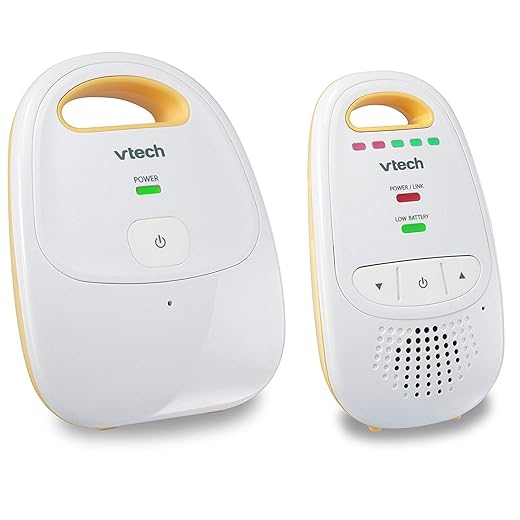
VTech DM111 Basic Long‑Range Audio Monitor
We see this as a no‑frills option for parents who want clear audio and an easy setup at a very low price. It’s small, dependable, and gets the job done when you don’t need video or smart features.
Who should consider the DM111
We think of the VTech DM111 as the baseline for families who want basic—but reliable—audio monitoring without learning an app or paying for bells and whistles. It’s a compact, plug‑and‑play audio monitor with digital transmission that reduces background noise and provides a clear feed across a typical house.
Practical features and behavior
Market context and why it’s still relevant
In an era dominated by camera-packed smart monitors, the DM111 is a reminder that many households only need reliable audio. It’s inexpensive to replace, simple to hand to grandparents, and useful for short‑term needs like naps or travel. That simplicity is its strength.
Limitations
Final Thoughts
For most families who want dependable long‑range video without the cloud tradeoffs, our top pick is the HelloBaby HB6550 — the two‑camera, non‑Wi‑Fi setup. Its single‑parent screen that lets you switch full view between cameras avoids the cramped split‑screen compromise. The direct radio link gives lower latency and more consistent range than most Wi‑Fi cameras, the PTZ camera and IPS display make everyday checks easy, and expandability means real multiroom coverage without tossing video to a server. In today’s market—where privacy worries and flaky home networks are common—this model nails the practical parts of monitoring that actually matter.
If you only need long‑range listening, the VTech DM221‑2 DECT 6.0 is the best audio option. It pairs a secure DECT link with roughly 1,000 ft of real‑world range, clear audio, and a fuss‑free parent unit. It’s small, reliable, and built for parents who want privacy and a long‑reach connection without apps or cloud services.
Honorable mention: tech‑forward parents who want remote access and AI alerts should look at the Simyke Smart 1080p Wi‑Fi camera. It adds face/motion alerts and remote viewing, but remember the usual cloud/privacy tradeoffs—and that Wi‑Fi range and reliability can’t match a purpose‑built non‑Wi‑Fi or DECT link for long houses. We recommend the HelloBaby HB6550 for local, long‑range video and the VTech DM221‑2 for long‑range audio; both prioritize reliability and real‑world usability over gimmicks.

Chris is the founder and lead editor of OptionCutter LLC, where he oversees in-depth buying guides, product reviews, and comparison content designed to help readers make informed purchasing decisions. His editorial approach centers on structured research, real-world use cases, performance benchmarks, and transparent evaluation criteria rather than surface-level summaries. Through OptionCutter’s blog content, he focuses on breaking down complex product categories into clear recommendations, practical advice, and decision frameworks that prioritize accuracy, usability, and long-term value for shoppers.