The TRAUSI TG08 is a $19-class smartwatch for people who want calls, notifications, and basic activity tracking at the lowest possible price—not a precision fitness watch.
Last updated: August 13, 2026. The seller lists a 1.83-inch touchscreen, Bluetooth calling, 120 sports modes, sleep and heart-rate tracking, music controls, and IP67 protection. That is a remarkable feature list for the money, but the low price comes with limited manufacturer documentation and no independently verified accuracy data.
The practical reason to buy it is convenience: glance at messages, answer a call from your wrist while your phone stays nearby, and keep a rough record of daily movement. If GPS accuracy, long-term software support, or trustworthy health trends matter, spend more on a watch with a documented sensor and app platform.
- Best for basic smartwatch features at the lowest possible price
- Large 1.83-inch screen and Bluetooth calling through a paired phone
- Seller claims—not independent testing—support the battery, IP67, and 120-mode figures
A lot of smartwatch for very little money

A basic phone companion with a big screen, calls, notifications, and general wellness tracking.
Choose the TG08 if the goal is inexpensive wrist notifications and simple activity summaries. Skip it if you need onboard GPS, medical-grade readings, a polished app ecosystem, or proven long-term support.
Our verdict on the TRAUSI TG08
The TG08 makes sense when price is the first, second, and third priority. It puts a large color screen, call controls, message alerts, timers, music controls, and basic activity summaries on your wrist for about the price of a replacement watchband. As a cheap first smartwatch or a work-and-gym watch you will not panic about scratching, the idea is easy to understand.
The catch is not one missing flagship feature. It is confidence. We found no full TRAUSI product manual, public sensor methodology, update policy, or official compatibility matrix for model TG08. The Amazon listing is the main specification source, so its battery, water-resistance, and tracking claims should be treated as seller claims until the exact unit and app prove otherwise.
TRAUSI TG08 specifications
| Brand and model | TRAUSI TG08 |
| Display | 1.83-inch color touchscreen |
| Sports modes | 120 labeled modes (seller claim) |
| Calling | Bluetooth calls through a paired phone |
| Notifications | Phone-app and message alerts |
| Wellness tracking | Heart rate, sleep, steps, and activity summaries; not medical measurements |
| Phone controls | Music, camera shutter, voice assistant, and find-phone functions |
| Water and dust protection | IP67 (seller claim) |
| Battery capacity | 350 mAh (seller claim) |
| Claimed active use | 5–7 days |
| Claimed standby | Up to 30 days |
| Phone compatibility | Android and iPhone, according to the listing; exact OS versions not published |
| Onboard GPS | No verified onboard-GPS specification |
| Cellular or eSIM | No |
| Amazon ASIN | B0G4CH1MP7 |
The TG08 figures above come from the current Amazon product listing and its product graphics. We did not find a complete TRAUSI manufacturer specification page or manual for this model, so the table labels seller claims instead of presenting them as independently verified facts.
What does a $19 smartwatch actually buy?
Mostly, it buys a second screen for your phone. The TG08 can surface notifications, control music, trigger the phone camera, run timers, and provide basic wrist-based activity summaries. Those are useful, visible features that do not require the watch to match a Garmin or Apple Watch sensor suite.
What the price does not buy is a well-documented platform. There is no verified onboard GPS specification, no cellular connection, and no published commitment to years of app or firmware updates. The value proposition is breadth today, not certainty five years from now.
Display, calls, and notifications
A 1.83-inch screen is generous for a low-cost rectangular watch. Larger text and touch targets should be easier to use than a narrow fitness band, but the listing does not publish resolution, peak brightness, glass type, or panel technology. We therefore cannot support claims that it is an IPS display or guarantee strong outdoor visibility.
Bluetooth calling does not turn the TG08 into a standalone phone. The watch acts as a remote speaker, microphone, and dialer while the paired phone supplies the cellular connection. Leave the phone behind or move outside Bluetooth range, and normal calls will not follow you on the watch. Notifications also depend on the companion app, Bluetooth connection, and phone permissions.
What do 120 sports modes really mean?
The number 120 describes selectable activity labels, not 120 different sensors or 120 independently validated algorithms. Modes can make the workout log easier to organize and may change which duration, heart-rate, or calorie fields appear, but the mode count alone says nothing about distance accuracy or training quality.
That distinction matters because the listing does not verify onboard GPS. For outdoor routes, pace, and distance, expect either phone-assisted location data or estimates based on motion and personal settings unless the companion app explicitly shows otherwise. Serious runners and cyclists should choose a watch with documented multi-system satellite positioning.
Heart-rate and sleep summaries can be useful for noticing broad personal patterns. They should not be used to diagnose a condition, adjust medication, or decide whether symptoms need care. The TG08 listing does not provide validation studies, sensor details, or regulatory clearance for medical use.
Battery life: plausible headline, unverified result
The listing claims a 350 mAh battery, 5–7 days of active use, and up to 30 days on standby. Those figures are possible only under a particular mix of screen time, calls, notifications, and tracking, and the seller does not publish the exact test method. Frequent Bluetooth calls, high brightness, vibration alerts, and workout sessions will shorten the interval.
Treat five to seven days as the seller’s target, not a guaranteed schedule. Battery capacity also declines with age, and low-cost models do not always have the long replacement-parts or charging-accessory support of larger wearable brands.
IP67 does not make it a swimming watch
IP ratings classify enclosure protection under defined laboratory conditions in the IEC 60529 standard. The TG08 seller claims IP67, but no independent test report or detailed TRAUSI use guidance was available for this review. That makes rain, sweat, and accidental splashes the sensible limit—not swimming, hot showers, diving, or high-pressure water.
TRAUSI TG08 vs. CMF Watch Pro 2 vs. Amazfit Bip 6
| Best use | Display | Positioning | Water rating | Claimed battery | ||
|---|---|---|---|---|---|---|
|
TRAUSI TG08 Lowest price | Basic phone companion | 1.83-inch color | No verified GPS | IP67 claim | 5–7 days | View product |

CMF Watch Pro 2 Branded step-up | Polished daily watch | 1.32-inch AMOLED | GPS-supported workouts | IP68 | Up to 11 days | View product |
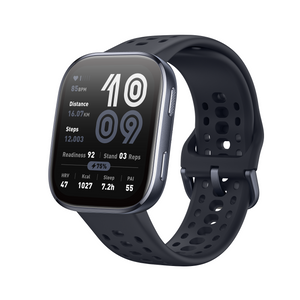
Amazfit Bip 6 Best fitness value | Fitness and GPS | 1.97-inch AMOLED | 5 satellite systems | 5 ATM | Up to 14 days | View product |
The CMF Watch Pro 2 is the middle step for buyers who want a named app platform and better documentation. CMF specifies a 1.32-inch AMOLED display, 466 × 466 resolution, IP68 protection, broad health tracking, and up to 11 days of typical use. Its official support pages also document phone compatibility and feature behavior, which is part of what the higher price buys.
The Amazfit Bip 6 is the stronger fitness upgrade. Amazfit specifies a 1.97-inch AMOLED display, five satellite positioning systems, 5 ATM water resistance, and up to 14 days of typical use. It costs several TG08s, but it is the better fit when routes, training data, app maturity, and a clearer support trail matter.
Research and evaluation method
Option Cutter evaluated the TG08 through the current Amazon listing, attached product data, listing graphics, official standards, and official documentation for the comparison watches. This update does not claim an Option Cutter hands-on test.
We separated seller claims from facts supported by official manufacturer documentation.
We checked what Bluetooth calling, 120 modes, IP67, and wellness tracking actually establish—and what they do not.
CMF and Amazfit specifications were taken from current official product and support pages.
Our recommendation weighs price, documentation, platform maturity, positioning, and health-data limits without inventing a score.
Price and availability can change. Seller claims, app behavior, and firmware features may also change after publication.
- Very low purchase price
- Large 1.83-inch touchscreen
- Bluetooth calling through a paired phone
- Phone notifications and music controls
- Broad list of activity labels
- Seller claims multi-day battery life
- Works with Android phones and iPhones according to the listing
- No verified onboard-GPS specification
- No published medical or fitness-accuracy validation
- Limited manufacturer documentation
- Unknown long-term app and firmware support
- IP67 claim is not a reason to swim with it
- Calls and most smart features depend on a nearby phone
- Battery claims lack a published test method
Is the TRAUSI TG08 worth buying?
- Choose the TG08 when the lowest price matters most.
- Choose the CMF Watch Pro 2 for a better-documented everyday smartwatch.
- Choose the Amazfit Bip 6 for onboard positioning and a stronger fitness platform.
The TRAUSI TG08 is worth considering when you want the cheapest possible way to put calls, notifications, timers, and basic wellness trends on your wrist. At roughly $19 when checked for this update, it delivers an unusually broad feature list for a very small investment.
Buy it with the right mental model: this is a phone companion and general wellness gadget, not a precision training instrument or medical device. The lack of verified onboard GPS, detailed documentation, and published accuracy evidence is the real cost. For casual use, that may be acceptable. For dependable fitness data and longer-term platform support, the Amazfit Bip 6 is the smarter upgrade.

TRAUSI TG08 FAQ
Is the TRAUSI TG08 worth buying?
It can be worth buying as a very cheap phone companion for notifications, Bluetooth calls, timers, and rough activity trends. It is not the right choice for precise training data, medical decisions, or buyers who expect a mature long-term software platform.
Can the TG08 make calls without a phone?
No. Its calling feature uses Bluetooth and the paired phone’s cellular connection. The phone needs to be nearby, connected, and able to place the call. The TG08 does not have verified cellular or eSIM service.
Does the TRAUSI TG08 have GPS?
We found no verified specification for onboard GPS. Route and distance features may depend on a paired phone or motion-based estimates. Choose a watch with documented satellite positioning if outdoor pace and distance matter.
Is the TG08 waterproof and safe for swimming?
The seller claims an IP67 rating, but we found no independent test report or detailed TRAUSI water-use guidance. Treat it as splash and rain resistant. Do not use it for swimming, diving, hot showers, or high-pressure water.
How long does the TG08 battery last?
The listing claims 5–7 days of active use and up to 30 days on standby from a 350 mAh battery. Actual life will vary with brightness, Bluetooth calls, notification volume, workout tracking, temperature, and battery age.
Does the TG08 work with iPhone and Android?
The listing says it works with Android phones and iPhones. It does not publish a complete supported-version matrix, so confirm the companion app’s current App Store or Google Play requirements before buying for an older phone.
Are the heart-rate and sleep readings accurate?
The TG08 may be useful for broad personal trends, but the listing provides no independent accuracy study or detailed sensor validation. Do not use its readings to diagnose a condition, change medication, or replace professional medical equipment.
What do the 120 sports modes do?
They provide many selectable activity labels and workout screens. The number does not mean the watch has 120 sensors or that every mode has a separately validated tracking algorithm. Mode count alone does not establish GPS, calorie, or heart-rate accuracy.
Sources and review policy
- Amazon listing for TRAUSI TG08, ASIN B0G4CH1MP7
- CMF Watch Pro 2 display specifications
- CMF Watch Pro 2 battery guidance
- CMF Watch Pro 2 IP68 guidance
- Amazfit Bip 6 official product and specifications
- IEC 60529: IP Code standard
Option Cutter independently researches the products it covers. Seller claims and manufacturer claims are identified by source. When you buy through our links, we may earn a commission at no additional cost to you.

Ayesha Aftab is Option Cutter's product review editor. She writes in-depth product reviews and buyer guides that focus on real-world performance—battery life, build quality, everyday usability.