

Gives your wall real cinematic color and sync — modular and immersive, but you’ll need the Lines starter kit and patience for app quirks.
One stubborn truth about modern living rooms: lighting makes everything feel either new or dated. We’ve tried smart bulbs, strips, and panels that promise cinematic color, only to end up with flat backlighting or a messy cable jungle. The Nanoleaf Lines LED Wall Lights (3-Line Expansion Pack) is pitched as a modular fix — diffuse RGBW bars that snap together, offer music and screen sync, and slot into Alexa and Google ecosystems — but remember: this is an expansion, so a Lines starter kit is required to run it.
In our testing we found the 3-line pack an instant room-transformer: vivid, diffuse color, satisfying geometric layouts, and sync features that genuinely add immersion to gaming and movies. That matters now because lighting has moved from decoration to part of the experience, but the trade-offs are real — flaky app pairing and finicky adhesive mounting turn what should be a seamless upgrade into a careful setup task. For anyone invested in a smart-lighting ecosystem, the Lines expansion extends Nanoleaf’s design language well; for everyone else, the dependency on the starter kit and occasional software quirks are worth weighing before you buy.
Nanoleaf Lines RGBW Expansion Pack (3 Lines)

We found the Lines expansion to be an instant room-transformer: it extends the modular aesthetic and deep color control that Nanoleaf is known for, while adding music and screen-sync flair that genuinely enhances gaming and movie nights. Caveats include reliance on a starter kit to run the expansion and occasional software connectivity quirks that require patience to resolve.
Introduction
We approached the Nanoleaf Lines Expansion Pack as a component, not a standalone product: it’s designed to plug into an existing Lines Smarter Kit (60° or 90°). In that role it performs exactly as you’d hope — adding three linear light bars that match the kit’s color fidelity and modular snap-fit design. Over several setups and scenes, we treated the pack like a building block for larger installations, and we walked away impressed by what a relatively small addition can do to a room’s atmosphere.
Design and materials
Nanoleaf Lines take a deliberate departure from hex panels and triangles toward a minimalist linear aesthetic. Each line is a slim rectangular bar with a matte diffuser that spreads color evenly; the minuscule profile reads more like architectural accent lighting than a novelty.


What matters here is the geometry: Lines invite long, linear designs—grids, rays, and orbital patterns—rather than tessellated mosaics. That matters because the visual impact scales differently: a single long run creates ambient wash, while clusters create focal, directional accents.
Light engine: color, animation and brightness
The Lines use a full RGBW LED engine, which gives us two advantages in practice: truer whites and richer pastels. Colors are vivid and gradients are smooth—transitions animate without the banding you sometimes see on cheaper strips.
Practical takeaway: if you want deep saturated hues for a streaming backdrop or cinema-toned ambiences for movie nights, Lines handle both convincingly.
Installation and expandability
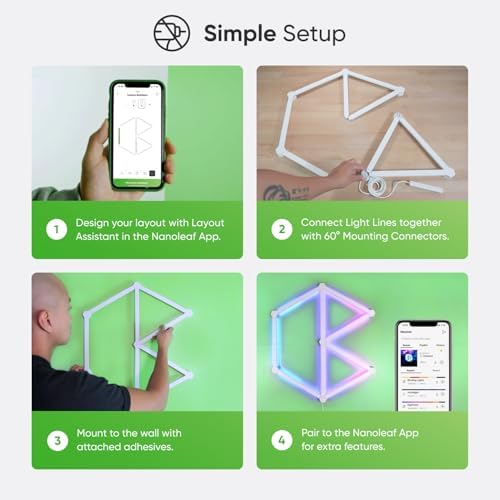
Installation is designed to be fast for people who plan iterative layouts. Nanoleaf includes adhesive anchor plates and snap connectors — no drilling required for most drywall installs — and the wiring is straightforward: a short cable links a run to the controller or to the next expansion.
We recommend planning the physical layout before sticking anything down: the snap joints have a little toleration, and misaligned anchors make perfectly straight lines look skewed. For renters, the mounting is reversible with the right adhesive remover and care, but expect some surface marks with repeated moves.
Smart features, app, and integrations
This expansion benefits from the broader Nanoleaf ecosystem: app scene creation, scheduling, and voice control via Alexa and Google Assistant. It also supports screen match and music sync modes that turn ambient lighting into reactive decor while you play or stream.
Where we raise a caution flag is software maturity. The app is powerful but occasionally fragile—pairing hiccups, cloud sync issues, and scene loss in rare cases. The physical controller helps mitigate that: once a scene is loaded to the device, you can cycle scenes and toggle music sync locally without opening the app.
Performance and reliability
We ran Lines through extended sessions: gaming, movie playback with screen match, and playlists with Rhythm engaged. Brightness sustained well with no apparent color shift, and the white channel handled dimmed warm whites without greenish casts. Power usage is modest relative to the light output; Nanoleaf quotes a solid lifespan for the diodes.
If you are already invested in other Nanoleaf products, expect some cross-product idiosyncrasies: not every device shares full feature parity, and certain thread-border-router behaviors don’t always translate into wider mesh benefits for unrelated Nanoleaf devices.
How it compares (short table)
| Product | Best for | Why choose it |
|---|---|---|
| Nanoleaf Lines (Expansion) | Expanding Lines layouts | Seamless visual language for linear designs |
| Nanoleaf Shapes | Creative tessellations | Great if you want modular polygons and denser canvases |
| LED light strips (generic) | Low cost accent lighting | Cheaper, but poorer color fidelity & app ecosystem |
Who should buy this expansion
And who shouldn’t
Practical setup checklist

Final thoughts
We see the Lines expansion as a smart, design-forward way to increase the visual and functional footprint of a Nanoleaf setup. When the app behaves and anchors are aligned, the result is a striking, professional-looking installation that elevates game rooms and streaming backgrounds. The trade-offs—starter-kit dependency and occasional software quirks—don’t outweigh the creative potential for users who value ambience and modularity. In the current market, where configurable smart lighting is crowded, Lines stand out by offering a linear aesthetic and performance that justify their price if you plan to grow the installation over time.
FAQ
Yes. This listing is for an Expansion Pack (3 Lines) only — it requires a Nanoleaf Lines Smarter Kit (60° or 90°) to provide the controller and power. Think of the expansion as additional building blocks rather than a standalone product.
Music sync uses the Nanoleaf Rhythm module (built into the Lines controller or available as an accessory) to analyze audio in real time and trigger color/animation responses. Screen Match captures colors from your display and mirrors dominant tones across the installation for immersive movie and gaming backdrops. Both modes are configured in the app and can be activated from the physical controller once saved.
Yes — once paired through the Nanoleaf app, the Lines support Alexa and Google Assistant for voice control. HomeKit support depends on your kit and firmware; many Lines kits are HomeKit-enabled but functionality can vary with updates. We recommend checking the product documentation and keeping firmware up to date.
Nanoleaf supplies adhesive anchor plates that stick well to flat, painted drywall. For painted or delicate surfaces we suggest testing a small area first or using removable adhesive alternatives. Repeated reinstallation may leave marks, so plan placement carefully if you rent.
There’s a practical limit driven by power and the physical layout. While the system is modular, each run needs reliable power delivery through connectors and a controller. For very large installations, follow Nanoleaf’s guidance on power distribution and consider additional controllers or power injectors to avoid voltage drop.
Start with firmware updates for your kit and the app. Use the physical controller to save and cycle scenes locally so you’re less dependent on cloud sync. If problems persist, a factory reset and re-pairing sometimes clears persistent issues; keep a note of your scene settings so you can recreate them if needed.

Chris is the founder and lead editor of OptionCutter LLC, where he oversees in-depth buying guides, product reviews, and comparison content designed to help readers make informed purchasing decisions. His editorial approach centers on structured research, real-world use cases, performance benchmarks, and transparent evaluation criteria rather than surface-level summaries. Through OptionCutter’s blog content, he focuses on breaking down complex product categories into clear recommendations, practical advice, and decision frameworks that prioritize accuracy, usability, and long-term value for shoppers.