

Why real battery life matters more than glossy specs
We cut through marketing hours and spin to show how to pick a multisport GPS watch that actually lasts in real use. We focus on user experience, hardware trade-offs, and ecosystem fit so your watch survives race day and travel.
What we need to decide with confidence
Read the fine print: advertised runtime vs real-world claims
Manufacturers brag in lab conditions — how do we translate that to our workouts?Read the fine print on battery specs before you decide. Manufacturers publish several metrics — GPS-only, mixed use, and standby — and each is measured under different, often idealized conditions.
Check these test variables we care about:
Compare watches by the baseline test details, not just “hours.” Two models with the same quoted runtime can behave very differently once you add music, notifications, or frequent route recalculations.

Match modes to use: GPS accuracy, logging rates, and power profiles
Would you trade sub-meter tracking for double the battery life? Let's quantify the cost.Match GPS mode to your sport. Choose between standard (1 Hz), high‑precision GNSS/multi‑band, and assisted/low‑power; each step up in precision multiplies power draw.
Set sampling intervals based on activity:
Consider assisted positioning (A‑GPS, sensor fusion) for city runs and hikes—we get reasonable tracks with big power savings.
Understand manufacturer power modes:
Pick the mode + interval you’ll actually use and predict endurance from that combination.
Hardware trade-offs: screen, sensors, and chipset
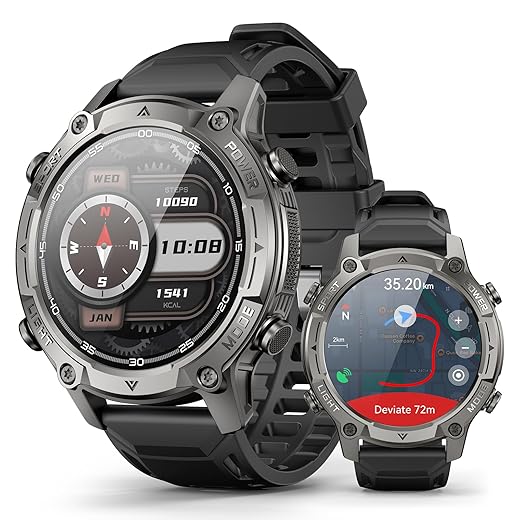
Bright screens and fancy sensors look great — but do they cost you your last mile?Compare display technology and make choices that match your priorities. AMOLED delivers rich maps and bright watch faces but chews battery; transflective and memory‑in‑pixel (MIP) screens give far better endurance in sunlight, which matters for multi‑day use. We’ve seen sport‑focused brands prioritize transflective/MIP for longevity while smartwatch‑first makers choose AMOLED for looks.
Evaluate sensors and GNSS choices. Continuous optical HR and multi‑band GNSS increase draw; a chest strap or lower sampling rate can cut hours off consumption. Barometers add useful elevation data with minimal cost.
Consider chipset efficiency and case design: newer, low‑power GNSS/SoCs and larger batteries in thicker bodies extend real life, while thin, fashionable cases limit capacity.
Software and ecosystem: why firmware, apps, and clouds drain or save power
Software isn’t neutral — background syncing, watch faces, and third-party apps can steal hours.Examine OS design and background processes: closed platforms that limit third‑party code (think Apple, some sport brands) constrain rogue apps that kill battery, while open systems let faces and plugins run wild.
Disable constant notification and sync chatter: filter push alerts on your phone, turn off live cloud syncing, and prefer manual or scheduled uploads to save hours.
Compare vendor update cadence and transparency: choose makers who publish changelogs and push optimizations — we’ve seen meaningful life gains after firmware patches.
Limit third‑party watch faces and high‑polling plugins: remove faces that update every minute or apps that poll GPS/HR continuously.
Prefer devices whose companion apps let you toggle background services and view per‑app drain so you can control real‑world power use.
Trust but verify: how we test battery life and read reviews
Not all tests are equal — here’s the practical checklist we use to judge claims.Define a repeatable protocol: we pick three activity profiles (30‑min run, 4‑hour ride, full‑day wear), lock a single GPS mode, set a consistent notification load, fix screen brightness, and run each scenario multiple times until the battery dies.
Run controlled field tests and note variance: we record averages and standard deviation, call out vendor modes that sound impressive but only apply in low‑power, low‑use cases.
Compare lab claims to long‑term user reports: we ignore one‑off glowing reviews and look for patterns across months — firmware updates often change the story.
Inspect battery graphs and export logs: we hunt for wakelocks, sync spikes, or sudden overnight drains that reveal hidden background activity.
Use community forums and changelogs: we treat active threads and fast vendor responses as reliability signals, not just raw hours.

Make the purchase decision: feature priorities and practical tips
Buy for the battery you need, not the feature you want — and squeeze more life from what you get.Decide your minimum GPS runtime and accept the accuracy trade-offs: we ask, do you need 30+ hours for an ultramarathon or 10–15 hours for long rides?
Prioritize must-have sensors and ecosystem fit: we pick optical HR and barometer for hill training, multi-band GNSS for precise pace, and strong phone-app mapping if we travel internationally.
Recommend feature combos by use-case:
Tune sampling rates, disable always-on display, limit notifications, and keep firmware updated to extend real life.
Check warranty length and return windows — we test batteries for weeks, so buy where you can return or get firm post-purchase support.
A practical verdict: pick for the experience that lasts
We recommend tested endurance inside our ecosystem, tune power settings to reclaim hours, and balance hardware, software, and use. Try your candidate, then report results, and help others choose with confidence.

Chris is the founder and lead editor of OptionCutter LLC, where he oversees in-depth buying guides, product reviews, and comparison content designed to help readers make informed purchasing decisions. His editorial approach centers on structured research, real-world use cases, performance benchmarks, and transparent evaluation criteria rather than surface-level summaries. Through OptionCutter’s blog content, he focuses on breaking down complex product categories into clear recommendations, practical advice, and decision frameworks that prioritize accuracy, usability, and long-term value for shoppers.