

Expansive, Atmos-forward sound and gamer-friendly features — but you’ll likely want a sub and rears to get the most out of it.
We’ve all sat through a movie night where the dialogue is clear but the explosions feel disappointingly small — most soundbars promise cinema-scale audio without the fuss of a full surround setup and then fall short. Living rooms need a solution that delivers real height and width without forcing you into an AV receiver and a tangle of wires.
Sony’s HT-A7000 7.1.2 aims to be that middle ground: a 500W Dolby Atmos soundbar with 360 Spatial Sound Mapping, robust onboard amplification, and wireless expansion options. In practice it crafts a remarkably wide, cinematic soundstage and plugs neatly into modern ecosystems with AirPlay 2, Chromecast, 8K/4K120 passthrough and eARC — but its large footprint, glossy top, and reliance on optional subs/rears for full low end mean it’s a best fit for people ready to commit to a high-end living-room setup rather than those seeking a compact, all-in-one upgrade.
Sony HT-A7000 7.1.2 Dolby Atmos Bar

We found this bar delivers an impressively wide, cinematic soundstage that holds up for movies, music, and gaming when properly configured. It’s feature-rich and expandable, but its size, price, and reliance on optional subs/rears mean it’s best for people committed to a high-end living-room setup.
Sony HT-A7000 7.1.2 Dolby Atmos Soundbar: Immersive Home Theater
Introduction
We approached the Sony HT-A7000 as a flagship soundbar designed to anchor a modern home theater without demanding a full AV receiver. Our testing focused on how it performs out of the box, how it integrates into living-room ecosystems, and what it takes to push it from “very good” to “exceptional.” Across films, music, and games the HT-A7000 aims to reproduce the scale and verticality of object-based formats like Dolby Atmos and DTS:X while letting you expand with wireless subs and rear speakers for fuller immersion.
What this unit is for (and who should consider it)
The HT-A7000 targets listeners who want Atmos-style height effects and broad sound staging but prefer a single cabinet over a multi-component system. It’s a fit for:
It’s less ideal for small rooms where the bar’s size dominates the furniture, or for buyers who expect reference-level bass without adding a subwoofer.
Key specs at a glance
| Specification | Highlights |
|---|---|
| Channels | 7.1.2 (with optional wireless rears/sub) |
| Power | 500W total (manufacturer rating) |
| Audio formats | Dolby Atmos, DTS:X, 360 Reality Audio |
| Connectivity | HDMI eARC, 2x HDMI passthrough (8K/4K120), Wi‑Fi, Bluetooth, AirPlay 2, Chromecast |
| Expandability | Compatible with Sony SA-SW5/SW3 subs and SA-RS-series rears |
Design and build: presence and tradeoffs
Out of the box the HT-A7000 makes a statement. It’s a long, substantial bar—meant to sit under large TVs or be wall-mounted. The enclosure uses high-quality materials, yet the wide glass-like top finish is reflective; in a bright room or with a wall-mounted TV that reflects, the bar can catch and mirror the picture. That’s an aesthetic tradeoff that’s worth knowing before you place it.

Setup, room calibration, and 360 Spatial Sound Mapping
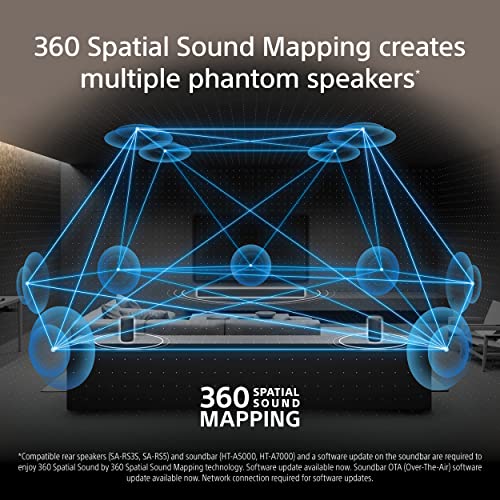
Sony ships the HT-A7000 with a set of room-optimization tools intended to make setup straightforward. Sound Field Optimization measures the room and adjusts timing and levels. The optional 360 Spatial Sound Mapping becomes more effective when you add Sony’s wireless rear speakers: the system maps virtual speaker positions and creates a wider sweet spot.
What matters: calibration helps a lot, but this bar is designed to be expanded. Many users report the clearest dialogue and deepest impact after adding at least a subwoofer. The onboard “Immersive Audio Enhancement” does a credible job upmixing non-Atmos sources when you don’t have rears.
Sound performance across use cases
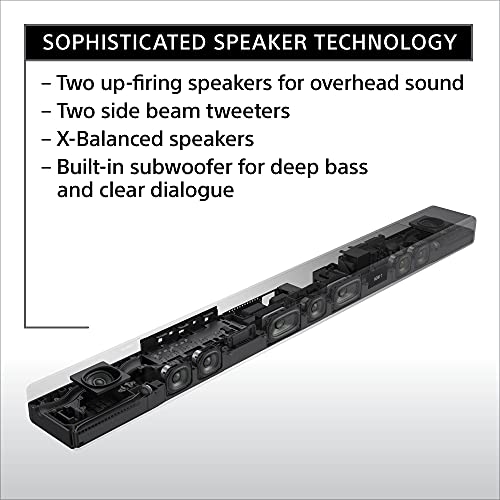
The HT-A7000’s strengths reveal themselves in dynamic material. For blockbuster movies we heard convincing height cues and a broad front soundstage that pushed sound above and around the listener. The Vertical Surround Engine and S‑Force Pro Front Surround work together to position effects; they don’t match ceiling speakers for absolute localization, but they paint a much larger scene than a typical stereo bar.

Dialogue and clarity
Dialogue intelligibility depends on placement and whether a subwoofer is used. When we tested the HT-A7000 alone, midrange clarity was very good, but certain mixes (or heavy bass content) can muddy voices. Adding a compatible subwoofer not only gives low‑end authority but can free the bar’s midrange to present crisper dialogue.
Connectivity, smart features, and ecosystem
Sony loaded the HT-A7000 with modern connectivity: Wi‑Fi for Chromecast/AirPlay/Spotify Connect, Bluetooth for quick phone pairing, and native compatibility with Alexa and Google Assistant. For TV-first users, the tightest integration is with Sony BRAVIA TVs, where controls and some auto-switching work more seamlessly.
Limitations and real-world caveats
There are a few practical points to watch for. The bar’s footprint is large and heavy, so placement and mounting are nontrivial. A handful of users report intermittent audio-sync issues depending on TV, source, and connection method—our advice is to favor eARC/HDMI for content that must be lip‑sync perfect. Also, the bar’s immersive algorithms can’t replace the tactile bass a subwoofer provides; we consider a high-quality subwoofer an almost-required add-on for movie lovers.
Expandability and value
Where the HT-A7000 shines is in its upgrade path. You can start with the bar and add SW3 or SW5 subwoofers and SA‑RS rear speakers later. That modularity lets you grow the system without starting from scratch. Cost-wise, the bar sits in the premium bracket; it’s a strong value if you plan to expand, but less compelling as an isolated purchase for casual TV listening.
Final thoughts
We think the Sony HT-A7000 is one of the most compelling single‑cabinet approaches to Atmos in its class. It balances advanced processing, modern connectivity, and expansion options in a way that suits serious listeners who don’t want a receiver-based setup. For the best experience you’ll prioritize an HDMI eARC connection, plan for a subwoofer, and accept the bar’s physical presence in the room. Do that and you’ll have a versatile, cinematic centerpiece for your living-room audio.
FAQs
You can enjoy Atmos object-based effects with just the bar thanks to Virtual Height processing and Sony’s Vertical Surround Engine, but the full 7.1.2 spatial experience—with deep, tactile bass and discrete surround imaging—requires adding a compatible wireless subwoofer (SW3/SW5) and rear speakers. We recommend the sub at minimum for movies.
For casual streaming Bluetooth is fine, but for lossless Atmos/DTS:X and rock-solid lip-sync we always prefer HDMI eARC. eARC passes higher-bandwidth formats and reduces latency issues that some users report over wireless or optical connections.
Sony’s Sound Field Optimization is helpful: it measures timing and levels and improves balance across listening positions. It noticeably widens the sweet spot, though it’s not a magic bullet—room acoustics and placement still matter. We suggest taking measurements as a starting point and doing small manual tweaks after calibration.
Yes—you can wall-mount it using the supplied template and bracket. The bar was designed with mounting in mind, though proximity to the wall and TV placement can affect the perceived height effects. We recommend testing listening positions after mounting and running the calibration routine.
Yes. The soundbar supports Chromecast, Apple AirPlay 2, Spotify Connect, and works with Alexa and Google Assistant. Integration is smoothest with Sony BRAVIA TVs, but the listing of services and voice features makes it flexible across ecosystems.
First, use HDMI eARC and ensure TV firmware is up to date. If issues persist, check the TV’s audio output settings and disable any double-upscaling or audio processing features. Restarting devices and applying the latest firmware to the bar can also resolve intermittent sync problems we’ve seen reported.
Absolutely. With 4K/120 passthrough and low-latency HDMI modes, it pairs well with PS5 and Xbox Series X for immersive audio. For the best experience keep your console connected via passthrough through the TV to eARC or directly to a passthrough HDMI port and prioritize eARC for high-bandwidth audio.
A dedicated receiver with floorstanding or separate height speakers will typically outperform any single-barrier solution in absolute dynamics and channel separation. The HT-A7000 trades some of that ultimate fidelity for convenience, space savings, and simpler setup. If you want the easiest path to immersive sound without an AV rack, this is a strong choice.

Chris is the founder and lead editor of OptionCutter LLC, where he oversees in-depth buying guides, product reviews, and comparison content designed to help readers make informed purchasing decisions. His editorial approach centers on structured research, real-world use cases, performance benchmarks, and transparent evaluation criteria rather than surface-level summaries. Through OptionCutter’s blog content, he focuses on breaking down complex product categories into clear recommendations, practical advice, and decision frameworks that prioritize accuracy, usability, and long-term value for shoppers.