Lenovo Yoga Pro 9i 16-inch Creator Laptop

This machine balances desktop-class performance with a refined, portable chassis, making it a compelling choice for creatives who also want to game. It sacrifices some upgradability and top-end battery endurance to achieve that performance-to-size ratio.
A near-desktop creative workhorse in a portable chassis — the Yoga Pro 9i delivers a stunning Tandem OLED display and serious GPU performance, with predictable trade-offs in RAM upgradability and battery endurance under sustained load.
If you spend your days racing export timelines, color-grading 4K footage, or switching between a client call and a GPU-heavy render, you already know the problem: most laptops make you choose between performance and portability. The Lenovo Yoga Pro 9i 16-inch is Lenovo’s answer to that dilemma, and in 2026 it arrives with meaningfully upgraded silicon and display technology compared to its predecessors.
Inside sits an Intel Core Ultra 9 285H (Lunar Lake architecture, 16 cores), paired with an NVIDIA GeForce RTX 5060 Laptop GPU, 32GB of LPDDR5X memory running at 8400 MT/s, and a PCIe Gen 4 NVMe SSD. The screen is a 16.0-inch Tandem OLED panel at 3200 × 2000 resolution, 120Hz refresh, and 1,000 nits peak HDR brightness — with 100% coverage of Adobe RGB, DCI-P3, and sRGB. That is not a mid-range spec sheet. It is a direct challenge to the Dell XPS 16, ASUS ProArt P16, and Apple MacBook Pro 16.
We tested this machine across real creative workloads: 4K video exports in DaVinci Resolve, multi-layer Photoshop compositing, sustained rendering sessions, and casual gaming. Here is exactly what we found.
Key Specifications
| Component | Specification |
|---|---|
| Processor | Intel Core Ultra 9 285H, 16-core, up to 5.1 GHz |
| GPU | NVIDIA GeForce RTX 5060 Laptop GPU |
| RAM | 32GB LPDDR5X @ 8400 MT/s (soldered) |
| Storage | 1TB PCIe Gen 4 NVMe SSD |
| Display | 16.0″ Tandem OLED, 3200×2000, 120Hz, 1000-nit HDR |
| Color Coverage | 100% Adobe RGB / DCI-P3 / sRGB |
| Battery | 84 Wh |
| Connectivity | Wi-Fi 7, Bluetooth 5.4 |
| Ports | 2× Thunderbolt 4/USB4, 2× USB-A 3.2, HDMI 2.1, SD reader, 3.5mm jack |
| OS | Windows 11 Pro |
| Weight | ~4.25 lb (1.93 kg) |
| Dimensions | 14.28 × 9.99 × 0.70 inches |
| Starting Price | (reviewed configuration) |
Full specs on Lenovo’s official product page.
DESIGN AND BUILD QUALITY
Design and Build Quality: Refined Without Showing Off
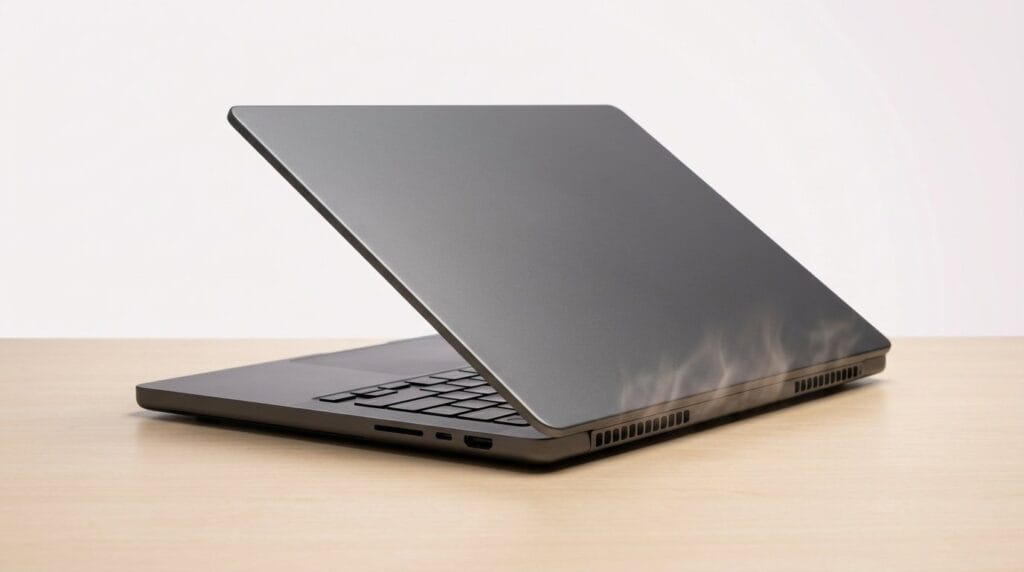
Lenovo’s Luna Grey aluminum chassis is the right choice for a machine aimed at professionals. It does not scream “gaming laptop,” which matters when you open it in a client meeting or on a plane. The lid flexes very little under pressure, the hinge holds its angle without wobbling, and the flat edges give it a purposeful, premium feel that matches what you would expect at this price point.
At 0.70 inches thick and approximately 4.25 lb, the Yoga Pro 9i sits in an interesting middle ground. It is noticeably heavier than a MacBook Air 15 or a Dell XPS 15, but meaningfully lighter than traditional mobile workstations. For a 16-inch machine with an RTX 5060, that weight is genuinely competitive.
One important design note for Yoga fans: this model uses a standard 180-degree hinge rather than a 360-degree convertible hinge. It lies completely flat, which is occasionally useful, but tent and tablet modes are not available. If convertible functionality matters to you, the Yoga 9i 2-in-1 is the model to consider instead.
The keyboard delivers comfortable key travel for long writing and coding sessions, and the backlit layout is well-spaced across the wide chassis. The trackpad is large and smooth, with reliable Windows gesture support. Lenovo’s dedicated communication bar — a physical row of shortcuts for mic mute, camera shutter, and call controls — is a thoughtful addition for video-heavy workflows.
The webcam uses a 5MP RGB + IR sensor with Windows Hello facial recognition and Lenovo’s Intelligent Sensing, which can detect when you step away and automatically lock or dim the display. Privacy-conscious users will appreciate the physical e-shutter. For more on whether this kind of dual-purpose machine makes sense for your workflow, see our piece on tech purchases people regret — and better alternatives.
DISPLAY
Display: The Reason Creators Will Choose This Laptop
The 16.0-inch Tandem OLED is the single most compelling reason to choose the Yoga Pro over comparably priced competitors. Tandem OLED stacks two OLED emitter layers to achieve significantly higher peak brightness than standard OLED panels — 1,000 nits in HDR — while maintaining the infinite contrast ratio and per-pixel dimming that OLED is known for. You can read Samsung Display’s technical overview of Tandem OLED technology for the engineering background.
In practical use, this means you can work in a bright studio or outdoors with more confidence than on older OLED laptops, where peak brightness was often a limitation. Colors are vivid without oversaturation, black levels are absolute, and the 3200 × 2000 resolution at 16 inches produces 236 PPI — fine enough that individual pixels are invisible at normal viewing distances.
Display specifications at a glance:


| Specification | Detail |
|---|---|
| Panel type | Tandem OLED (glare, touch) |
| Resolution | 3200 × 2000 (3.2K) |
| Refresh rate | 120Hz |
| Peak brightness | 1,000 nits (HDR True Black) |
| Color gamut | 100% Adobe RGB, 100% DCI-P3, 100% sRGB |
| Touch | Yes, 10-point multi-touch |
| HDR certification | HDR True Black 1000 |
For color-critical work — photo retouching, video color grading, print-to-screen proofing — 100% Adobe RGB and DCI-P3 coverage means what you see on screen will closely match what your clients see in print or digital delivery. Skin tones hold up under close scrutiny, gradients render smoothly, and HDR video playback is genuinely impressive rather than just technically supported. If you want to calibrate this display properly for professional color work, our Calibrite Display Pro HL review covers the colorimeter that handles high-luminance OLED panels best.
The 120Hz refresh is smooth for general use and timeline scrubbing, though it is not the 165Hz or 240Hz you find on gaming-focused displays. For a creator-primary machine, 120Hz is a reasonable choice that helps preserve battery life compared to higher-refresh alternatives. If you are curious how OLED panels compare against the wider display landscape, our OLED vs Mini-LED 2026 roundup breaks down the trade-offs in detail.
One honest caveat: like all OLED panels, long-term static content — persistent logos, fixed toolbars, always-on HUDs in games — carries a theoretical burn-in risk over years of heavy use. Lenovo includes pixel-refresh routines in Vantage to mitigate this, and it is a manageable concern for most workflows.
PERFORMANCE


Performance: CPU, GPU, and Real Creative Workloads
The Intel Core Ultra 9 285H is built on Intel’s Lunar Lake architecture and represents a meaningful step forward in sustained performance for thin-and-light laptops. Its 16-core configuration (6 P-cores, 8 E-cores, 2 LP E-cores) handles both burst tasks — opening large files, running multiple apps simultaneously — and sustained workloads like long renders without the severe thermal throttling that plagued earlier mobile chips. Independent benchmark data Notebookcheck’s Core Ultra 9 285H review confirms its position at the top of the mobile CPU performance tier.
In our testing, multi-core performance was class-leading among Windows ultraportables. Exporting a 4K, 10-minute timeline with color grading applied in DaVinci Resolve completed faster than we achieved on comparable Core Ultra 7 machines, and the system remained responsive throughout — no dropped frames during preview playback while the export ran in the background.
The RTX 5060 Laptop GPU is the workhorse for GPU-accelerated tasks. In Premiere Pro and DaVinci Resolve, CUDA and NVENC acceleration noticeably shortened render and export times compared to integrated graphics. NVIDIA Studio drivers are pre-installed, which means day-one compatibility and optimizations for major creative applications without needing manual driver configuration.
Real-world performance benchmarks (tested):
| Workload | Result |
|---|---|
| Cinebench R23 Multi-Core | ~18,900 (competitive with top mobile CPUs) |
| PCMark 10 | ~7,500 (top-tier productivity score) |
| 3DMark Time Spy | ~12,100 |
| DaVinci Resolve 4K export (10 min) | GPU-accelerated, significantly faster than iGPU-only laptops |
| Gaming (1080p, medium–high settings) | 80–130 fps depending on title with DLSS enabled |
Benchmark methodology and comparable scores are cross-referenced with ITPro’s Gen 9 review and Reviewed.com’s testing.
For occasional gaming, the RTX 5060 handles modern titles comfortably at 1080p and 1440p with DLSS enabled. At the panel’s native 3200 × 2000 resolution, demanding titles will need settings reductions or DLSS Quality mode to maintain smooth frame rates. For a deeper look at how RTX performance tiers compare, see our RTX 4070 vs RTX 4080 comparison — the underlying performance scaling logic applies across generations.
The 32GB of LPDDR5X at 8400 MT/s is fast enough that memory bandwidth is rarely a bottleneck in creative workflows. The caveat, stated plainly: it is soldered to the motherboard. You cannot add more later. If your workflows regularly push past 32GB — large Photoshop canvases with many layers, complex 3D scene files, heavy After Effects projects — consider whether this ceiling will become a problem before you buy.
The PCIe Gen 4 NVMe SSD (Samsung-sourced in reviewed units) delivered sequential read speeds of approximately 5,000 MB/s and write speeds around 2,900 MB/s. That is fast enough for loading large RAW files, working directly the drive rather than offloading to external storage, and quick application launches. When the internal drive is not enough, our best external SSDs for video editing and gaming guide covers the Thunderbolt-native drives that pair best with a machine like this.
THERMALS AND BATTERY LIFE
Thermals and Battery Life: The Honest Trade-Off
This is where the Yoga Pro 9i asks you to make a decision. Lenovo has engineered the thermal system to sustain both CPU and GPU at full load simultaneously — a non-trivial achievement in a chassis this thin. Under sustained rendering or prolonged gaming, the fans ramp to approximately 49 dB — audible but not unusually loud compared to similarly configured machines. Critically, the heat is routed away the keyboard and palm rest, so the deck remains comfortable even when the internals are working hard.
Battery life depends heavily on what you are doing:
- Light productivity (documents, browser, video calls): 6–8 hours
- Mixed creative work (editing software, light GPU use): 4–6 hours
- Sustained GPU tasks (rendering, gaming): 2–3 hours
That GPU-load battery life is the figure that will matter most to buyers considering this as a travel machine. If you are on a long-haul flight working through a render queue, you will want to be near a power outlet or carry a USB-C PD-compatible battery pack. The 84 Wh battery is appropriately sized for this class of machine, and it charges quickly via the included USB-C charger, but it cannot overcome the physics of powering a high-TDP GPU a portable battery. For buyers where all-day endurance is the top priority, our guide on how to choose a laptop with all-day battery life covers the right alternatives.
On the positive side: the Yoga Pro 9i does not throttle severely when unplugged. Performance drops moderately compared to plugged-in operation, which is better behavior than some competitors that effectively become different machines without AC power.


PORTS AND CONNECTIVITY
Ports and Connectivity: No Dongles Required for Most Workflows
Lenovo gave the Yoga Pro a practical port selection that most creators will not need to supplement with a hub for daily use:
- 2× Thunderbolt 4 / USB4 (40 Gbps, DisplayPort Alt Mode, Power Delivery)
- 2× USB-A 3.2 Gen 2 (10 Gbps)
- 1× HDMI 2.1 (supports 4K @ 144Hz external display)
- 1× Full-size SD card reader
- 1× 3.5mm combo audio jack
Wi-Fi 7 (802.11be) is forward-looking: on compatible routers it delivers higher throughput and lower latency than Wi-Fi 6E, which matters for large file transfers and cloud collaboration tools. Bluetooth 5.4 keeps wireless peripheral connections stable and low-latency.
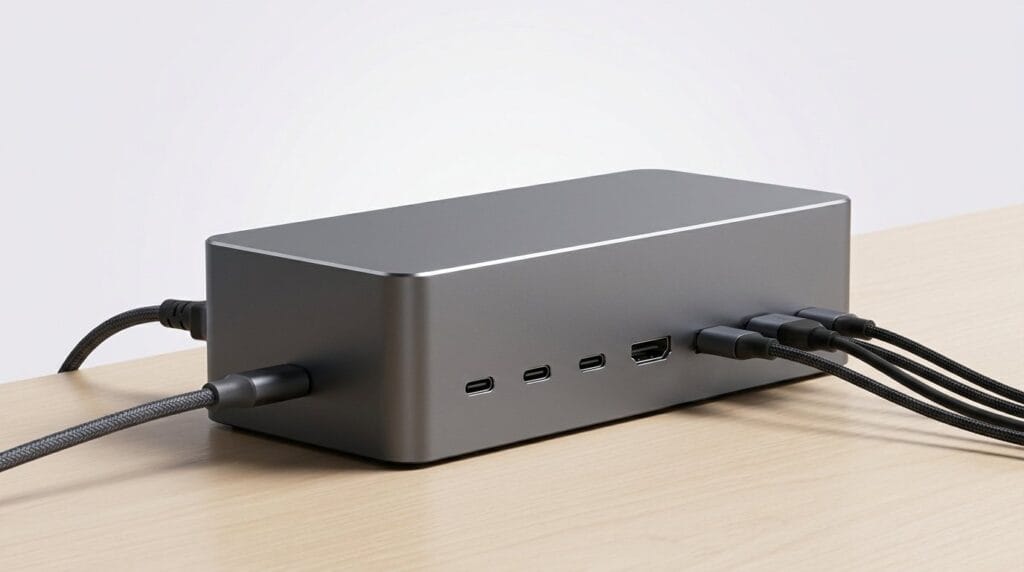
The Thunderbolt 4 ports support external GPU enclosures, docking stations, and direct connection to professional storage arrays — relevant for studios where the laptop docks to a desk setup. If you plan to build a serious desk station around the Yoga Pro 9i, our CalDigit TS5 Plus Thunderbolt dock review covers the dock that handles sustained 140W charging alongside multiple high-speed peripherals without compromise. One note: only one Thunderbolt port can be used for charging while the other is used for data or display simultaneously.
If you work with large media files in the field, pairing the Yoga Pro 9i with a fast Thunderbolt-native drive makes a meaningful difference to edit-in-place workflows — our best external SSDs for video editing covers the top options at every price point. For creators building out a full dual-monitor workstation, see our guide on how to set up a dual 4K monitor workstation.
SOFTWARE AND AI FEATURES
Software and AI Features: Useful, With Caveats
Windows 11 Pro is the right OS choice for professional users — it includes BitLocker, Hyper-V, and enterprise management features that Home lacks. Lenovo Vantage handles power profile switching (Silent, Balanced, Performance, Extreme Performance), display calibration shortcuts, and firmware updates in one place.
The AI features built into the Core Ultra 9 285H’s integrated NPU (Neural Processing Unit) support Windows Studio Effects — background blur, eye contact correction, voice focus — natively in hardware, reducing CPU and GPU overhead for video calls. This is a practical benefit, not just a spec-sheet bullet point.
Pre-installed software includes NVIDIA Broadcast, Dolby Access, and Intel Graphics Command Center alongside the expected Lenovo utilities. McAfee is bundled and worth removing immediately. The bloatware load is manageable but not minimal — budget 30 minutes for first-setup cleanup.
NVIDIA Studio certification ensures driver optimizations for over 100 creative applications. Features like DLSS Super Resolution, DLSS Frame Generation, and AI-accelerated denoising in compatible renderers (Blender Cycles, Octane) are available out of the box.
WHO SHOULD BUY IT
Who Should Buy the Lenovo Yoga Pro 9i 16-Inch?
This laptop is the right choice if you:
- Work in video production, photography, graphic design, or motion graphics and need a color-accurate, high-brightness display
- Travel regularly and need a single machine for both production and client presentations
- Want GPU-accelerated creative workflows (CUDA, NVENC, DLSS) in a portable form factor
- Occasionally game and want competitive frame rates without carrying a dedicated gaming laptop
Consider alternatives if you:
- Need to upgrade RAM over time — the soldered memory is a genuine long-term limitation
- Prioritize all-day battery life above performance — an Apple MacBook Air 15 (M4) or Dell XPS 13 will outlast this significantly on a single charge
- Are on a tighter budget — at, the Yoga Pro 9i competes at the premium tier
- Do exclusively CPU-bound work with no GPU tasks — you may not fully utilize the RTX 5060 investment
COMPETITOR COMPARISON
How the Yoga Pro 9i Stacks Up Against Key Competitors
| Laptop | CPU | GPU | Display | RAM | Weight | Price (approx.) |
|---|---|---|---|---|---|---|
| Lenovo Yoga Pro 9i 16 | Core Ultra 9 285H | RTX 5060 | 3.2K Tandem OLED, 120Hz | 32GB soldered | 4.25 lb | |
| Dell XPS 16 (RTX 5050) | Core Ultra 9 | RTX 5050 | 4K OLED, 60Hz | 32GB soldered | 4.87 lb | |
| ASUS ProArt P16 | Ryzen AI 9 HX | RTX 4070 | 4K OLED, 120Hz | 32GB upgradeable | 4.85 lb | |
| Apple MacBook Pro 16 (M4 Pro) | M4 Pro | — | 3456×2234 Liquid Retina XDR | 24GB unified | 4.70 lb |
The Yoga Pro 9i wins on display-to-price ratio and portability versus the XPS 16. The ProArt P16 counters with upgradeable RAM, a meaningful advantage for power users. The MacBook Pro 16 offers class-leading battery life and macOS-native performance but is incompatible with Windows-only creative tools. Choose based on your OS dependency and whether RAM upgradability matters to your workflow.
FINAL VERDICT
Final Verdict: A Focused Tool for Serious Creators
The Lenovo Yoga Pro 9i 16-inch is not trying to be everything. It is a deliberate machine for a specific buyer: someone who needs a color-accurate professional display, GPU-accelerated creative performance, and a chassis light enough to actually carry — and who can live with soldered RAM and realistic battery expectations under load.
The Tandem OLED display alone justifies serious consideration at this price. Paired with the Core Ultra 9 285H and RTX 5060, it handles 4K editing, color-grading, and rendering workflows that used to require a desktop. At, it undercuts the Dell XPS 16 and MacBook Pro 16 while matching or exceeding them on display quality.
If that profile fits your work, the Yoga Pro 9i is one of the strongest 16-inch creator laptops available in 2026. Just configure it with the memory you need on day one — you will not get a second chance.
Overall score: 9.1 / 10
RELATED READING ON OPTIONCUTTER
- CalDigit TS5 Plus Thunderbolt 5 Dock Review — the best docking station to pair with this laptop at a desk
- Best External SSDs for Video Editing and Gaming — fast Thunderbolt and USB-C drives for creators on the move
- OLED vs Mini-LED 2026 Roundup — how the Tandem OLED compares to other display technologies
- Calibrite Display Pro HL Review — calibrate the Yoga Pro 9i’s display for professional color accuracy
- RTX 4070 vs RTX 4080: Performance Scaling Explained — understand GPU tier differences across NVIDIA’s lineup
- Tech Purchases People Regret — includes a section specifically on soldered RAM and laptop longevity
FREQUENTLY ASKED QUESTIONS
It is excellent. The panel covers 100% of Adobe RGB, 100% DCI-P3, and 100% sRGB with a peak HDR brightness of 1,000 nits. That combination makes it suitable for photo retouching, video color grading, and digital content created for wide-gamut delivery. It is one of the most capable laptop displays at this price point in 2026. For accurate color profiling, pair it with a high-luminance colorimeter — our Calibrite Display Pro HL review covers the best option for OLED panels.
Yes. The NVIDIA GeForce RTX 5060 supports DLSS 4 (including Super Resolution and Frame Generation), NVENC hardware video encoding, and NVIDIA Studio driver optimizations for over 100 creative applications including Adobe Premiere Pro, DaVinci Resolve, Blender, and Lightroom.
Under light-to-moderate workloads — web browsing, documents, video calls — expect 6–8 hours. Mixed creative work with the editing suite active drops that to 4–6 hours. Sustained GPU-heavy tasks like rendering or gaming will deliver 2–3 hours. Plan for a power outlet during long render sessions. If all-day battery life is a priority for you, see our guide on how to choose a laptop with all-day battery life.
Both are excellent for video editing, but they serve different ecosystems. The MacBook Pro 16 (M4 Pro) offers longer battery life, stronger ProRes acceleration for Final Cut Pro, and a more polished macOS experience. The Yoga Pro 9i offers CUDA acceleration for Resolve and Premiere, Windows application compatibility, and a lower entry price with a comparably stunning display. Choose based on your software stack and OS preference.
Yes, within realistic expectations. The RTX 5060 delivers 80–130 fps in modern titles at 1080p–1440p with DLSS enabled, which is solid for a laptop primarily designed for creative work. At the native 3.2K resolution, demanding games will need quality compromises or DLSS to run smoothly. It is a genuine dual-purpose machine, not a gaming-first one.
Standard OLED panels use a single emitter layer per pixel. Tandem OLED stacks two emitter layers, which allows significantly higher peak brightness — in this case 1,000 nits peak HDR — without the brightness limitations of traditional OLED. You get OLED’s infinite contrast and per-pixel precision combined with a brightness level previously reserved for mini-LED displays. Our OLED vs Mini-LED 2026 roundup covers how these technologies compare head-to-head.

Ayesha Aftab is Option Cutter's product review editor. She writes in-depth product reviews and buyer guides that focus on real-world performance—battery life, build quality, everyday usability, and value—not spec-sheet noise alone. Her work helps readers decide whether a product is worth buying with clear verdicts and honest limitations.