We weigh whether a full‑featured smartwatch or a no‑frills fitness tracker fits your life — because beyond step counts and notifications, design, battery life, and how each device plays with your phone decide whether you buy into an ecosystem or keep a simpler, longer‑lasting companion.
We compare renewed Apple Watch Series 9 (GPS, 45mm) and Series 8 (GPS, 45mm) sold on Amazon in real-world daily use. We focus on daily experience, design, sensors, software integration, and value to recommend which renewed watch fits different users.
Premium Companion

Value Apple

Apple Watch 9
- Very bright Always‑On display with strong outdoors visibility
- Advanced health sensors (ECG, SpO2, temperature) and improved responsiveness
- Seamless integration with iPhone and mature watchOS app ecosystem
- Polished construction with multiple case finishes and a wide band ecosystem
- Battery still limited to roughly a day in typical use
- Premium features and price — even refurbished — aren’t ideal for non‑iPhone users
Apple Watch 8
- Strong set of health features (ECG, SpO2, temperature) at a lower cost point
- Good integration with iPhone and mature app ecosystem
- Refined design and comfortable sport band options
- Battery life remains roughly a day and can feel limiting
- Older chip and slightly less responsive than the newest model
Feature Comparison
| Premium Companion Apple Watch 9 | VS | Value Apple Apple Watch 8 |
|---|---|---|
9 / 10 | Design & Build |
8.5 / 10 |
9.5 / 10 | Health & Fitness Tracking |
9 / 10 |
8 / 10 | Battery Life |
7 / 10 |
9.5 / 10 | Ecosystem & Apps |
8.5 / 10 |
$209.00 | Current price |
$165.00 |
| Buy for $209.00 | Buy for $165.00 |
Top Things to Check Before Buying a Smartwatch: The Ultimate Buyer’s Guide
Design, display, and wearability: what changes feel different every day
We examine how the two 45mm renewed watches feel on the wrist and read in real-world use. That includes case finish and tolerances for renewed units, weight and strap comfort, display size and visibility (including Series 9’s brighter panel), haptics and crown feedback, and how the always‑on experience compares. We explain why small ergonomics differences matter: a watch you barely notice all day drives fitness tracking adherence and reduces friction when using glanceable notifications and timers.
Case, finish, and renewed tolerances
Both renewed aluminum cases keep Apple’s clean, rounded aesthetic, but inspect renewed listings for hairline marks and band wear. In our experience the machining and clasp tolerances remain tight; cosmetic flaws are usually superficial, not structural. If you’re picky, ask the seller for close-ups and warranty details before buying — browse our product reviews..


Weight, strap comfort, and daily wear
The Series 9 feels a touch lighter on wrist (listed ~3.8 oz vs. ~4.6 oz for Series 8), and that translates to less awareness during long days or sleep tracking. The stock Midnight sport band is the same soft, flexible silicone across both models and remains comfortable for runs and showers.
Display, haptics, and always‑on use
The practical difference is the Series 9’s much brighter panel (Apple advertises up to 2,000 nits). Outdoors, the always‑on face stays readable without wildly angling your wrist; Series 8 is bright indoors but can dim in sun. Series 9’s S9 chip also makes animations and the Digital Crown feel marginally snappier, and the new Double Tap reduces screen touching — a small but meaningful ergonomics win.


Health, sensors, and performance: are the upgrades meaningful?
What the S9 SiP actually brings
The headline: Series 9’s S9 SiP gives more on‑device horsepower and slightly smarter sensor processing. That matters for background inference (sleep stage scoring, fall/crash detection) and for features like Double Tap and faster app transitions.


Core health sensors: mostly the same suite
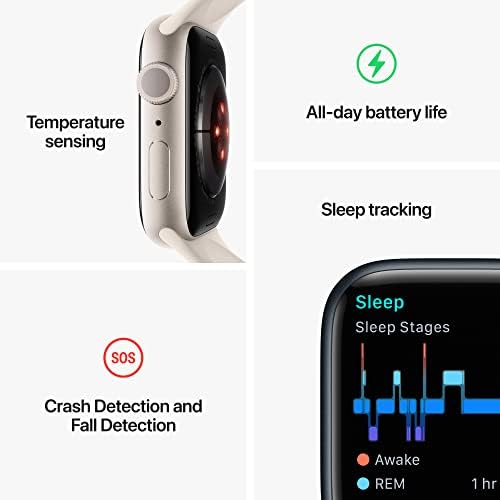
Both renewed watches share the same core sensors that matter to most buyers
Practically, that means health feature parity: you won’t lose ECG or cycle insights by choosing Series 8.

Real‑world tracking: incremental, not revolutionary
We see marginal gains with Series 9
If you’re a casual exerciser or want reliable health safety features, Series 8 already covers it. Serious athletes might appreciate the extra responsiveness of the S9, but it’s not a different class of sensor fidelity.
Responsiveness, Siri, and daily reliability
Series 9 launches apps faster, makes Siri more usable offline, and reduces input friction with Double Tap — all of which lower friction during workouts and quick checks. For renewed units, expect battery life close to Apple’s ~18‑hour claim only if the battery health is good; ask the seller for battery cycle and warranty details.
Comparison: Smartwatches vs Fitness Trackers
Software, ecosystem, and the practical user experience
watchOS parity and Series 9–only features
Both Series 9 and Series 8 run the same {L(‘/shop/wearable-technology/apple-watch/’,’watchOS’)} and share core apps, complications, and Apple services. The tangible differences come down to a few hardware‑tied features: Double Tap (the tap‑to‑control gesture) and the S9’s on‑device neural processing for faster local inference are exclusive to Series 9. For day‑to‑day use that means one extra shortcut (Double Tap) and smoother interactions in a handful of apps.
On‑device Siri, privacy, and responsiveness
The S9 moves more Siri processing on device. We notice faster dictation, near‑instant voice queries, and fewer round trips to Apple servers — that’s both speed and privacy improvement. Series 8 still has Siri and dictation, but it’s slower and more cloud‑dependent. Practically: Series 9 makes quick voice actions and replies feel like background muscle; Series 8 is fine if you don’t lean on voice for short tasks.
Continuity and third‑party apps
Both watches are equally tight with iPhone handoff, Fitness syncing, Wallet, Home automations, and unlocking Apple devices. Third‑party apps run on either model, but the S9’s extra snappiness reduces app launch lag and makes apps that do local processing more usable. Storage parity (both 32GB on these renewed units) keeps media and apps equal.
Software longevity
Apple supports watches for many years; Series 8 will get several more major watchOS releases, but Series 9—being newer—bought us an extra update window. If future OS support matters, that extra year or two of updates is the main longevity argument for Series 9.
Buying renewed on Amazon: pragmatic checklist
We boil it down to responsiveness and privacy: Series 9 makes the software feel fresher; Series 8 gives nearly the same {L(‘/shop/wearable-technology/smartwatches/’,’ecosystem’)} experience at a lower price if you can live without Double Tap and on‑device Siri speed.
Price, value, and competitive context: is the premium worth it?
Sticker math: the renewed delta
On Amazon right now the renewed 45mm Series 9 lists for about $199 and the renewed 45mm Series 8 about $169 — a roughly $30 difference. That small gap makes the purchase decision less about sticker shock and more about which incremental features matter to you.
Renewed savings and trade‑in realities
Buying renewed cuts the new‑unit premium substantially, but don’t expect Apple trade‑in parity: trade‑in credit for used watches is variable and often lower than refurb discounts. We recommend confirming battery health/cycle count and AppleCare eligibility before buying; AppleCare can be a valuable hedge if the seller’s warranty is short.
Upgrade calculus: what $30 buys you
The extra spend buys S9 silicon, Double Tap, and snappier on‑device Siri responsiveness — tangible UX upgrades that make everyday interactions feel quicker. It does not meaningfully change battery life or add new health sensors compared with Series 8. If you value speed, privacy, and a marginally longer software window, that $30 is reasonable.
Competitive context: Garmin and Fitbit
If your priority is multi‑day battery life, advanced training metrics, or detailed physiological data for serious workouts, consider Garmin, Coros, or even Fitbit’s higher‑end models. They typically deliver several days to weeks of battery and richer training analytics; Apple remains superior for ecosystem integration and general smart features.
When to choose which
Frequently asked questions
Which is better, Smartwatch or Fitness Tracker?
There is no universal winner: Smartwatch fits some buyers and Fitness Tracker fits others. We compare specs, daily use, and trade-offs in this guide so you can match the pick to your budget and workflow, not a single spec sheet.
What is the main difference between Smartwatch and Fitness Tracker?
Smartwatch and Fitness Tracker target overlapping but not identical use cases. The sections above break down design, performance, ecosystem, and value so you can see where each product pulls ahead and where it compromises.
Should I buy Smartwatch or Fitness Tracker first?
Buy the product that removes your biggest daily friction first. If Smartwatch solves your primary pain point, start there; if Fitness Tracker is the bottleneck in how you actually work or play, prioritize it. Many households add the other later.
Is Smartwatch worth it over Fitness Tracker?
Smartwatch is worth the premium over Fitness Tracker when you will use the features that justify the price—extra performance, build quality, or ecosystem lock-in. If those extras go unused, Fitness Tracker usually delivers better value.
Can Smartwatch replace Fitness Tracker?
For some users, yes; for others, no. Smartwatch can cover most tasks Fitness Tracker handles, but gaps in compatibility, accessories, or specialized workflows may still matter. Use our comparison table and verdict to see which gaps apply to you.
Who should choose Smartwatch vs Fitness Tracker?
Choose Smartwatch if its strengths match how you will use it every day; choose Fitness Tracker if you need its specific advantages or a lower entry price. When in doubt, favor the option that fixes your most frequent frustration—not the highest spec on paper.
Final verdict: which renewed Apple Watch should you buy?
We pick the renewed Apple Watch Series 9 as our overall winner for snappier performance, a brighter display, and future-proof silicon that improves daily responsiveness and app longevity.
If price gap is large, Series 8 is the better value for health tracking and battery. Always factor renewed warranty and return policies — browse our product comparisons.

Princess Rioboca is the Lead Editorial Writer at Option Cutter, bringing over seven years of hands-on experience in consumer technology journalism. Specializing in home networking and smart home architecture, she transforms complex technical data into practical, real-world upgrades. Princess personally tests and audits every product she reviews—evaluating real-world Wi‑Fi throughput, cable management durability, and streaming ecosystem stability—to filter out spec-sheet noise. Her rigorous, field-tested insights are designed to give readers transparent, unbiased buying advice on what to purchase, what to skip, and exactly why.