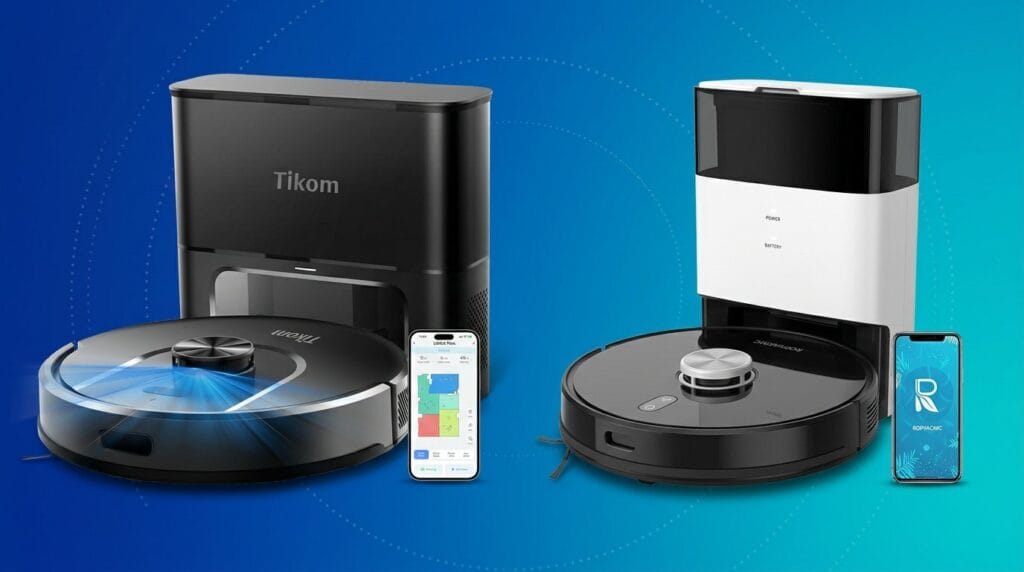
We pit autonomous robot vacuums against handheld cordless models to show which actually saves us time, fits our homes’ design and smart ecosystems, and — spoiler — why the market’s move to smarter sensors and swappable batteries changes what “cleaner” even means.
Surprisingly, we pit the Roomba s9+ + Braava Jet m6 bundle against the Dyson V11 Origin to decide which cleans better in real homes. We test performance, daily usability, ecosystem features, and trade-offs that matter.
Hands Free

Portable Power

Roomba s9+ Bundle
- True hands-off operation with automatic dirt disposal and coordinated vacuum + mop sequencing
- Excellent mapping and navigation for targeted room-by-room cleans and keep-out zones
- Very effective on pet hair and edges with PowerBoost suction and specialized corner brush
- Integrates with smart assistants and app scheduling for set-and-forget cleaning
- High upfront cost for the bundle and recurring expense for replacement base bags/pads
- More complex setup and occasional mapping glitches across two linked robots
Dyson V11 Origin
- Very strong suction for a cordless stick — performs well on carpets and hard floors
- Converts to a handheld for cars, stairs, and upholstery with purpose-built tools
- LCD feedback and anti-tangle tools make usage and maintenance more transparent
- Limited runtime relative to continuous robot operation, especially in higher power modes
- Requires manual push, docking, and bin emptying — less hands-off than robots
Feature Comparison
| Hands Free iRobot Roomba s9+ & Braava jet m6 Bundle | VS | Portable Power Dyson V11 Origin Cordless Vacuum Cleaner |
|---|---|---|
Robot vacuum + robot mop bundle | Product Type |
Cordless stick vacuum (convertible handheld) |
Hands-off whole-home floor care, pet owners | Best For |
Deep spot cleaning and quick whole-home touchups |
40x (relative to older Roomba series) | Suction Power |
185 AW peak suction |
Up to 120 minutes (vacuum) | Runtime (claimed) |
Up to 60 minutes (Eco); much less on Boost |
Yes | Recharge & Resume |
No |
Clean Base automatic dirt disposal (up to ~60 days) | Auto Empty |
No — manual bin emptying required |
Large base bag with small robot dust bin | Dust Collection Capacity |
Clear bin (typical stick capacity) |
Cartridge filter (robot filtration) | Filtration |
Whole-machine HEPA-style filtration (captures fine particles) |
Moderate to loud on boost modes | Noise Level |
Moderate (motor noise varies by mode) |
Robots ~8.15 lbs each; base is heavier | Weight |
Around 6–7 lbs depending on configuration |
Alexa, Google Assistant, iRobot Home app | Smart Home Integration |
No voice control; MyDyson app support and guides |
vSLAM, Smart Maps, Keep Out Zones, room-specific cleaning | Mapping & Navigation |
User-directed — no automated mapping |
Auto, scheduled, spot, precision jet spray (mop) | Cleaning Modes |
Eco, Auto, Boost; handheld mode |
Braava jet m6, Clean Base, brushes, chargers | Accessories Included |
Motorbar head, crevice tool, hair screw tool, dock |
Replace base bags, filters, mop pads; brush upkeep | Maintenance (ongoing) |
Bin emptying, filter washing, brush cleaning |
1 year limited | Warranty |
2 year limited |
$$$ (bundle) | Price |
$$ |
$1,177.98 | Current price |
$565.00 |
| Buy for $1,177.98 | Buy for $565.00 |
Cleaning Performance: Suction, Coverage, and Real-World Results
Suction and carpets
We started by measuring how much grit and pet hair each vacuum system actually lifts. The Dyson V11’s 185AW peak and motorbar head dug embedded dirt and hair out of short and medium pile in a single pass, and its three power modes let us escalate to Boost for visibly better extraction on demand. The V11 also converts to handheld for concentrated brushwork on stairs and upholstery — tasks the robot can’t replicate.


Hard floors and mopping
On finished floors, the Roomba s9+ + Braava jet m6 bundle shifted the balance. The s9+ reliably picks up loose debris across wide areas on recurring runs, and the m6’s precision jet plus vibrating mop pad removed sticky spots and dried spills that a vacuum alone won’t. The two‑device division turns intensive manual scrubs into automated maintenance.


Edges, coverage, and missed spots
Edge and corner performance favored the robot vacuum—its Corner Brush geometry and vSLAM mapping produced cleaner perimeters than what we managed with the Dyson’s handheld edges. The s9+ also systematically revisits missed zones and returns to recharge, completing large rooms without supervision. That said, it’s slower and can struggle with very deep pile and tightly wedged fibers that the V11’s direct suction pulls free in one pass.
Noise, runtime, and workflow
The cordless stick is louder but finishes quickly; battery limits mean we choose when to deep‑clean. The robot operates quietly over longer cycles, empties itself, and keeps baseline cleanliness day-to-day. In short: cordless = targeted, high‑power fixes; robot combo = continuous, low‑effort maintenance.
Usability & Design: Hands-on Feel, Maintenance, and Daily Workflow
Hands‑on feel and daily workflow
We evaluated how each machine fits into an ordinary week. The Roomba s9+ and Braava jet m6 are built to be invisible: set smart maps, create keep‑out zones, and let the s9+ vacuum then dock to the Clean Base for weeks‑long emptying while the m6 follows a scheduled mop cycle. That hands‑off continuity matters when you want consistent floors with minimal intervention.


Immediate control: Dyson’s on‑demand ergonomics
The Dyson V11 gives us agency. It converts to a handheld in seconds, its LCD tells us remaining runtime and blockages, and the tool set (crevice, mini‑motorbar, anti‑tangle screw) makes spot jobs — stairs, upholstery, cars — fast and surgical. Emptying the V11’s bin requires manual action and can be messier than the s9+’s sealed disposal, but replacement parts and filters are cheaper and easier to source.


Maintenance rhythms, integrations, and lifecycle costs
Maintenance is different but predictable
Both platforms link to smart homes, but iRobot’s mapping rewards set‑and‑forget schedules while Dyson expects user initiation for deep cleans. Storage also matters: the V11 tucks away; the iRobot duo demands docking space but returns the favor with automated emptying. Which design wins depends on whether you prefer occasional, high‑control interventions or continuous, low‑effort maintenance.
Ecosystem & Smart Features: Mapping, Scheduling, and Privacy
Why we treat software as hardware
We treated ecosystem features as first‑class attributes in our product reviews because true automation depends on software as much as suction. If a robot can’t reliably know where to go, its hardware advantages are squandered.
Mapping and multi‑device coordination
iRobot’s mapping is the standout. The s9+ builds accurate, roomized Smart Maps quickly; we can name rooms, set Keep‑Out and clean‑only areas, and run targeted jobs. Imprint Link means the Braava jet m6 picks up where the s9+ leaves off, so a vacuum → mop sequence runs automatically without our intervention — that workflow mirrors how we actually clean and saves time.
Scheduling, autonomy, and app UX
Dyson’s ecosystem is leaner and more hardware focused. The V11’s app (MyDyson) gives runtime reporting, maintenance alerts, and firmware updates, but scheduling and autonomy are mostly human‑driven. iRobot’s app suggests personalized schedules and orchestrates multi‑room, multi‑robot routines. That extra automation is powerful, but iRobot locks some advanced features (multi‑floor maps, Smart Maps staging) behind subscriptions.
Voice, updates, and longevity
Both platforms work with Alexa and Google Assistant for basic voice starts and stops. Dyson’s firmware updates have modestly improved suction tuning and battery management, which matters because the product can get better without a new model. iRobot’s routines integrate more tightly with home automation because of spatial awareness.
Privacy and control
Maps and usage logs expose home layouts. We prefer platforms that offer clear controls, export/delete options, and local‑first data minimization. For low‑touch households, the iRobot bundle is a software‑driven step forward. For users who want deterministic, manual control and fewer cloud dependencies, the Dyson V11 is more attractive.
Value & Competitive Context: Price, Alternatives, and Who Should Buy Which
Price vs. ongoing cost
We put price and competitive context front and center because these two sit at different ends of the cleaning spectrum. At roughly $755, the Roomba s9+ + Braava jet m6 bundle is a premium, multi‑device purchase: higher upfront, plus recurring costs for Clean Base bags, mop pads, and occasional replacement parts. Those consumables add up, but they buy genuine hands‑off time — the vacuum empties itself and the mop runs on a schedule without our intervention.
The Dyson V11 is about $470 and gives more raw suction per dollar. Its ongoing costs are limited to filters and occasional brush or battery service, but it requires our time to run, push, and empty. That tradeoff — money for automation vs. money for power and control — is what matters most.
Competitive alternatives matter
Hybrid robot + mop setups are increasingly common. Roborock and Ecovacs now offer integrated vacuum‑and‑mop robots at lower price points and with strong mapping stacks, narrowing the gap on functionality. Dyson’s lineage also moves forward: newer cordless models (V15, etc.) push battery tech and cleaning heads, further shrinking the robot’s advantage in raw floor care.
Who should buy which
Frequently asked questions
Which is better, Robot Vacuum or Cordless Vacuum?
There is no universal winner: Robot Vacuum fits some buyers and Cordless Vacuum fits others. We compare specs, daily use, and trade-offs in this guide so you can match the pick to your budget and workflow, not a single spec sheet.
What is the main difference between Robot Vacuum and Cordless Vacuum?
Robot Vacuum and Cordless Vacuum target overlapping but not identical use cases. The sections above break down design, performance, ecosystem, and value so you can see where each product pulls ahead and where it compromises.
Should I buy Robot Vacuum or Cordless Vacuum first?
Buy the product that removes your biggest daily friction first. If Robot Vacuum solves your primary pain point, start there; if Cordless Vacuum is the bottleneck in how you actually work or play, prioritize it. Many households add the other later.
Is Robot Vacuum worth it over Cordless Vacuum?
Robot Vacuum is worth the premium over Cordless Vacuum when you will use the features that justify the price—extra performance, build quality, or ecosystem lock-in. If those extras go unused, Cordless Vacuum usually delivers better value.
Can Robot Vacuum replace Cordless Vacuum?
For some users, yes; for others, no. Robot Vacuum can cover most tasks Cordless Vacuum handles, but gaps in compatibility, accessories, or specialized workflows may still matter. Use our comparison table and verdict to see which gaps apply to you.
Who should choose Robot Vacuum vs Cordless Vacuum?
Choose Robot Vacuum if its strengths match how you will use it every day; choose Cordless Vacuum if you need its specific advantages or a lower entry price. When in doubt, favor the option that fixes your most frequent frustration—not the highest spec on paper.
Final Verdict: Which Cleans Better for Which Household?
We pick the Roomba s9+ and Braava Jet m6 as the winner for households wanting continuous, low-effort cleanliness, superior perimeter coverage, smart mapping and integrated scheduling; the design and ecosystem justify the premium.
Choose the Dyson V11 for powerful, on-demand deep cleans, portability and lower upfront cost; better for hands-on, rapid spot cleaning.

Princess Rioboca is the Lead Editorial Writer at Option Cutter, bringing over seven years of hands-on experience in consumer technology journalism. Specializing in home networking and smart home architecture, she transforms complex technical data into practical, real-world upgrades. Princess personally tests and audits every product she reviews—evaluating real-world Wi‑Fi throughput, cable management durability, and streaming ecosystem stability—to filter out spec-sheet noise. Her rigorous, field-tested insights are designed to give readers transparent, unbiased buying advice on what to purchase, what to skip, and exactly why.