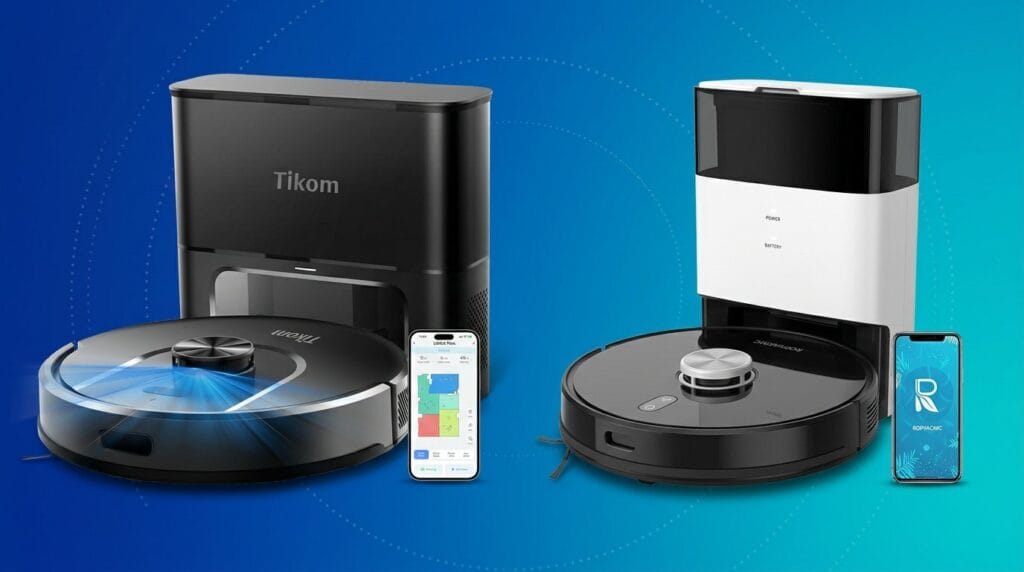
We peel back why pricier robot vacuum basics often buy calmer mornings, smarter maps, and stronger app ecosystems — and whether those perks actually matter to our floors, our time, and the crowded market of knockoffs.
We compare the Eufy 11S Max and Roborock Qrevo to pinpoint practical differences between budget and premium robot vacuums. We focus on design, day-to-day user experience, ecosystem fit, and real value—so you can choose what truly matters for your home.
Small Spaces

Whole Home

eufy 11S Max
Roborock QV 35A
- Extremely strong 8000Pa suction and effective tangle-free brushes
- PreciSense LiDAR mapping with multi-floor support and precise routing
- All-in-one dock: self-emptying, mop washing/drying, and auto-refill features
- Long runtime (about 180 minutes) and extensive app integration
- Higher price and large docking footprint that needs dedicated space
- Only supports 2.4 GHz Wi‑Fi and requires periodic dock maintenance
Feature Comparison
| Small Spaces eufy 11S Max | VS | Whole Home Roborock QV 35A |
|---|---|---|
6.5 / 10 | Suction & Cleaning |
9.5 / 10 |
4 / 10 | Navigation & Mapping |
9.5 / 10 |
6.5 / 10 | Battery & Runtime |
9 / 10 |
5 / 10 | Maintenance & Ecosystem |
9 / 10 |
$159.99 | Current price |
$399.99 |
| Buy for $159.99 | Buy for $399.99 |
Design and Build: Form Factor, Noise, and Durability
Form factor and fit
We look first at how the machines physically live in a home. The eufy 11S Max is built around a clear design trade-off: a super-thin 2.85″ profile and a 12.8″ cleaning path that lets it slip under low furniture and into tight gaps. At about 6.3 lbs it’s easy to move and store, and the tempered glass top feels surprisingly solid for the price.


By contrast, the Roborock Qrevo is a bigger, heavier package designed around capabilities rather than stealth. The robot plus its all-in-one dock needs a dedicated floor area; the dock’s tall tanks and mechanics account for most of the footprint. That extra bulk buys you mopping, self-emptying and water-handling systems that the eufy simply doesn’t attempt.


Noise and real‑world operation
The eufy leans into a quieter, low-profile robot vacuum experience—its operating sound is comparable to a kitchen microwave and tolerable for daytime runs. The Qrevo uses much stronger motors (and an 8000Pa spec) and will be louder at peak suction, though Roborock’s tuning keeps noise reasonable during routine passes. Longer runs on the Qrevo (about 180 minutes) versus eufy (100 minutes) also change when you need to hear it.
Brushes, filters, and dust management
The 11S Max uses a single side brush and a washable filter with a 600 mL bin—simple and user-servicable but limited on corners and long-hair pickup. The Qrevo’s anti‑tangle side brush and full‑rubber main brush plus a sealed 2.7L self‑emptying bag drastically reduce hands‑on dust handling and hair wrap.
Durability and maintenance touchpoints
Simplicity helps the eufy: fewer motors, no pumps, and basic replaceable parts mean straightforward, low-cost upkeep. The Qrevo’s dock adds maintenance (dirty‑water tank, mop wash hardware, pumps, and bag replacements), and more moving parts can mean more failure modes—but also fewer daily chores. Routine maintenance checklist:
Cleaning Performance: Suction, Mopping, and Real-World Results
Suction and carpet performance
We tested how each robot vacuum actually pulls dirt out of fibers, not just what the sticker says. The eufy 11S Max is precise: its BoostIQ steps up suction for short bursts and it does an excellent job on hard floors and low‑to‑medium pile rugs. It moves methodically and leaves few visible crumbs after one pass, but it struggles to extract deeply embedded grit from thicker carpets.
The Roborock Qrevo, with an advertised 8000Pa (pascal pressure units), feels noticeably stronger on rugs and deep seams. That extra suction plus its aggressive rubber main brush lifts ground‑in dirt and pet dander in a single pass more often than the eufy. The difference matters if you have pets or high-traffic area rugs.
Edge cleaning and hair pickup
Edge and hair performance is where robot vacuum hardware design pays off. The 11S Max’s single side brush is tidy and quiet but leaves hair loops and dust in corners and along baseboards. The Qrevo’s anti‑tangle side brush and rubber spiral main brush actively prevent wrap and reach edges better, cutting the time we spend cutting hair from bristles.
Mopping and sticky messes
The eufy is a vacuum-only robot—effective for crumbs but irrelevant for spills. The Qrevo’s twin 200RPM spinning mop basics and auto‑wash dock transform it into a hybrid: it scrubs dried spots, auto-washes pads, and lifts pads away from carpets with a 10mm lift. In practice the Qrevo turns sticky‑floor maintenance from an afternoon task into something largely automated.
Day‑to‑day maintenance cadence
Those trade-offs explain why budget models still suit simple homes, while the Qrevo’s kit matters for pet owners and anyone who wants low‑touch floor care.
Smart Features & Ecosystem: Mapping, Apps, and Integration
We dig into navigation, obstacle avoidance, and how each vacuum fits into a connected home. The Qrevo upgrades obstacle avoidance and offers mapping and auto-mop washing through its dock—useful for hands-off routines. Eufy’s simpler approach emphasizes straightforward scheduling and basic remote controls. We assess mapping accuracy, app UX, voice-assistant support, firmware update cadence, and ecosystem lock-in. For buyers, these details dictate whether a robot becomes a set-and-forget appliance or one that requires ongoing micromanagement and patched software to improve over time.
Navigation & obstacle avoidance
The Qrevo uses PreciSense LiDAR robotic mapping plus Reactive Tech to build real-time maps and steer around cords, shoes, and chair legs. That combination means fewer stalls and more efficient, repeatable coverage. The eufy 11S Max relies on infrared and basic bump/drop sensors — competent for open rooms but blind to finer obstacles and virtual boundaries.
Mapping, control, and the app experience
Roborock’s app gives us room-by-room maps, no‑go zones, suction/water control, and multi-floor memory — the features that let a robot truly be “set and forget.” It also triggers over-the-air updates and diagnostic tools. The eufy 11S Max has no Wi‑Fi or app support: scheduling and modes are handled on-device or with the included remote, so there’s no mapping or remote diagnostics.
Integration, updates, and lock‑in
Qrevo works with voice assistants and third‑party integrations, but keep in mind dock-dependent features (auto-refill, pad washing) lean on Roborock’s ecosystem — there’s some lock‑in and a 2.4GHz Wi‑Fi limitation. The eufy’s lack of connectivity avoids cloud‑service issues and privacy fuss, but also means no OTA fixes, no smart automations, and no remote monitoring.
Value, Maintenance, and Long-Term Costs
We outline total vacuum ownership costs beyond sticker price. Upfront savings with the eufy can be offset by more frequent manual maintenance and fewer automated conveniences. The Roborock’s all‑in‑one dock and more complex parts mean higher initial cost and potentially pricier consumables, but less daily intervention. Below we break down what actually adds up over years so you can decide whether premium convenience is worth it.
Replacement parts & routine consumables
The 11S Max is mechanically simple: washable filter, a single side brush, and a basic main brush. Parts are cheap and easy to swap, so out‑of‑warranty fixes are often DIY-friendly.The Qrevo uses rubberized anti‑tangle brushes, washable filters, and spinning mop heads that wear. Parts cost more and some modules (rotating mop) are pricier to replace.
Dock consumables and maintenance
The Roborock dock adds convenience — self‑empty bags, auto‑refill and mop‑wash — but those consumables and the dirty‑water tank need service. Replacement dust bags and mop pads are recurring buys; using the official cleaning solution may be recommended.
Warranty, support, and repairs
Eufy’s unit is simpler and often cheaper to repair yourself; eufy lists a 12‑month warranty. Roborock typically provides manufacturer support and parts availability, but complex dock repairs may require authorized service and higher labor costs. Out‑of‑warranty dock or motor work can be the largest single repair expense.
Long‑term value & resale
If you prize time saved, the Roborock’s hands‑off features will likely offset higher consumable costs within a year or two. If you want a low‑cost, low‑complexity unit and don’t mind emptying and occasional manual mopping, the eufy keeps ownership costs minimal but also holds lower resale value.
Frequently asked questions
Which is better, Robot Vacuum Budget or Premium?
There is no universal winner: Robot Vacuum Budget fits some buyers and Premium fits others. We compare specs, daily use, and trade-offs in this guide so you can match the pick to your budget and workflow, not a single spec sheet.
What is the main difference between Robot Vacuum Budget and Premium?
Robot Vacuum Budget and Premium target overlapping but not identical use cases. The sections above break down design, performance, ecosystem, and value so you can see where each product pulls ahead and where it compromises.
Should I buy Robot Vacuum Budget or Premium first?
Buy the product that removes your biggest daily friction first. If Robot Vacuum Budget solves your primary pain point, start there; if Premium is the bottleneck in how you actually work or play, prioritize it. Many households add the other later.
Is Robot Vacuum Budget worth it over Premium?
Robot Vacuum Budget is worth the premium over Premium when you will use the features that justify the price—extra performance, build quality, or ecosystem lock-in. If those extras go unused, Premium usually delivers better value.
Can Robot Vacuum Budget replace Premium?
For some users, yes; for others, no. Robot Vacuum Budget can cover most tasks Premium handles, but gaps in compatibility, accessories, or specialized workflows may still matter. Use our comparison table and verdict to see which gaps apply to you.
Who should choose Robot Vacuum Budget vs Premium?
Choose Robot Vacuum Budget if its strengths match how you will use it every day; choose Premium if you need its specific advantages or a lower entry price. When in doubt, favor the option that fixes your most frequent frustration—not the highest spec on paper.
Final Verdict: Which Should You Buy?
We declare the Roborock Qrevo the overall pick in our product reviews for performance, navigation, and integrated mopping; the Eufy 11S Max is our budget pick for quiet, slim design and value. Ready to upgrade your cleaning today?

Princess Rioboca is the Lead Editorial Writer at Option Cutter, bringing over seven years of hands-on experience in consumer technology journalism. Specializing in home networking and smart home architecture, she transforms complex technical data into practical, real-world upgrades. Princess personally tests and audits every product she reviews—evaluating real-world Wi‑Fi throughput, cable management durability, and streaming ecosystem stability—to filter out spec-sheet noise. Her rigorous, field-tested insights are designed to give readers transparent, unbiased buying advice on what to purchase, what to skip, and exactly why.