We put mesh systems and single routers through real‑world tests to see if mesh’s seamless whole‑home coverage actually outclasses a high‑end router’s raw speed and simpler setup — and why that trade‑off now reshapes device ecosystems, home design choices, and how much future‑proofing we really need.
Network turf war? We pit the NETGEAR Orbi 770 mesh kit against ASUS RT‑BE86U Wi‑Fi 7 router, testing real‑world speed, coverage, ecosystem in this comparison, and features so we can recommend based on home size, latency needs, and how much control you want.
Whole-home Coverage

Standalone Performer

Orbi 770 Mesh
- Why You’ll Love It
- Exceptional whole‑home coverage with the included satellites
- Very high Wi‑Fi 7 throughput (up to 11 Gbps) for demanding streaming and gaming
- Tri‑band design with enhanced backhaul preserves speed under load
- Refined industrial design and strong antenna performance for wide distribution
- Solid ecosystem for expanding a mesh deployment
- Drawbacks
- Premium price compared with single‑router alternatives
- Some users report app/firmware quirks and occasional stability issues
- Advanced parental controls and protections push toward a paid subscription
ASUS BE86U Router
- Why You’ll Love It
- Very strong Wi‑Fi 7 performance for a single‑router setup
- 10G WAN/LAN and multiple 2.5G ports for high‑capacity wired backhaul
- Stable standalone performance with rich firmware features (AI WAN, AiMesh)
- Subscription‑free network security and comprehensive VPN options
- Drawbacks
- Single‑router footprint gives less consistent coverage in very large homes
- Occasional firmware quirks and update behavior can require troubleshooting
Feature Comparison
| Whole-home Coverage NETGEAR Orbi 770 WiFi 7 Mesh System | VS | Standalone Performer ASUS RT-BE86U WiFi 7 Dual-Band Router |
|---|---|---|
Wi‑Fi 7 (802.11be) | Wi‑Fi standard |
Wi‑Fi 7 (802.11be) |
Tri‑band (2.4GHz + 5GHz + 5GHz backhaul) | Bands |
Dual‑band (2.4GHz + 5GHz) with MLO support |
Up to 11 Gbps | Max theoretical throughput |
Up to 6.8 Gbps (6800 Mbps) |
Dedicated tri‑band enhanced wireless backhaul (supports wired) | Backhaul type |
Multi‑Link Operation (MLO) and supports wired backhaul |
1 x 2.5G Internet port on router + multiple Gigabit LAN ports (router + satellites) | Ethernet ports (WAN/LAN) |
1 x 10G WAN/LAN + 4 x 2.5G LAN ports |
No | 10G port |
Yes |
Up to 8,000 sq. ft. (3‑pack) | Suggested coverage |
Up to ~3,500 sq. ft. (single router) |
Up to ~100 devices | Max supported devices |
Approximately 150 devices |
Yes | Mesh‑capable |
Yes |
Automatic firmware updates; Advanced Router Protection available | Security features |
Subscription‑free network security; comprehensive VPN features |
Advanced controls behind optional subscription | Parental controls (subscription) |
Included without subscription |
Orbi mobile app and web UI | App management |
ASUSWRT 5.0 web UI and mobile app |
Sleek tower units with internal high‑performance antennas | Antenna / Design |
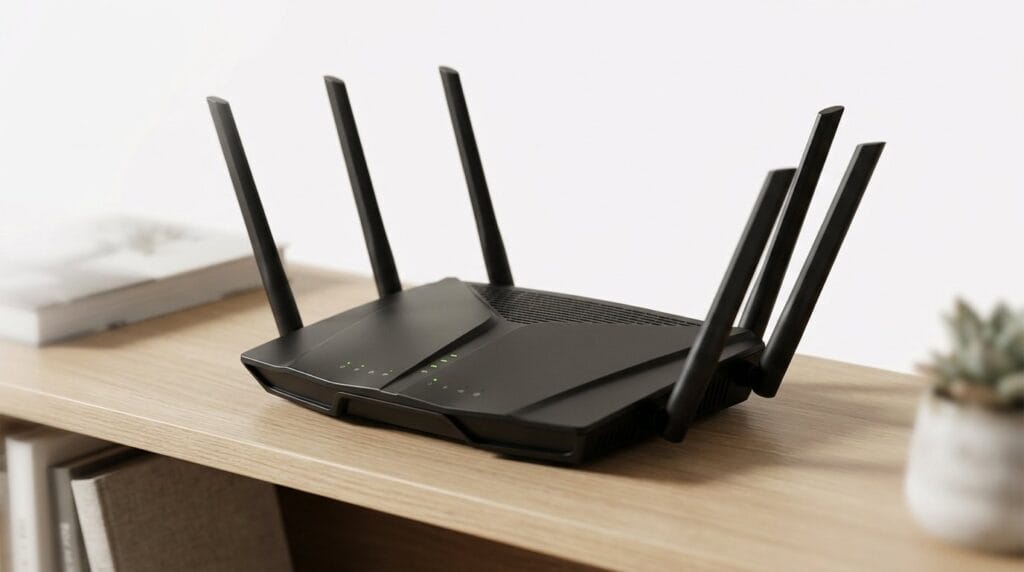
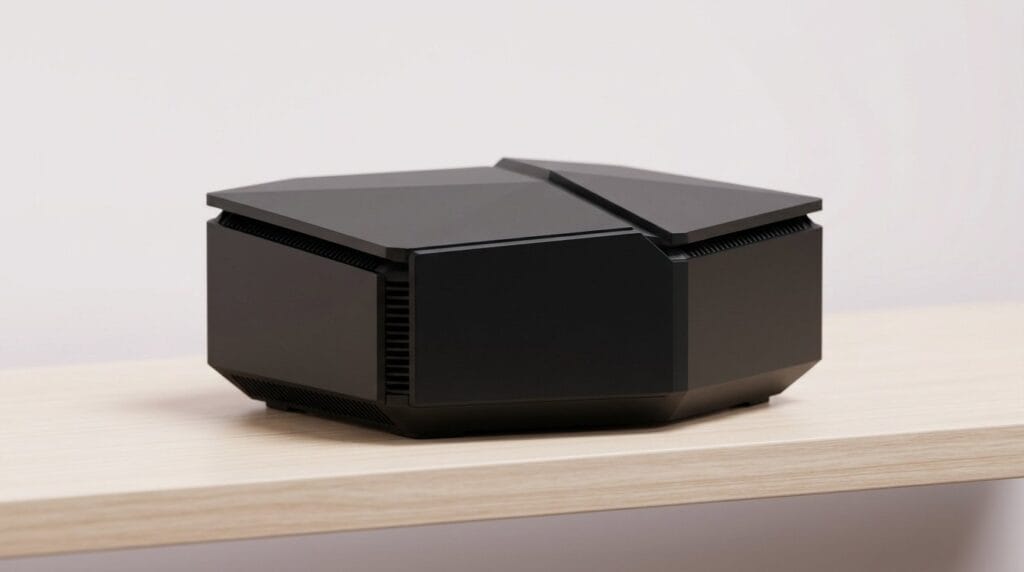
Desktop router with external antennas and active cooling |
Router approx 9.88 x 5.28 x 3.95 in (package varies) | Weight & Dimensions |
12.4 x 9.3 x 3.5 inches |
$$$ | Price |
$$ |
$699.87 | Current price |
$229.99 |
| Buy for $699.87 | Buy for $229.99 |
Performance and coverage: Throughput, latency, and real-world reach
We dig into raw throughput, sustained multi‑device performance on a router, and latency under load. For the Orbi 770 we assess tri‑band Wi‑Fi 7 mesh backhaul, claimed 11 Gbps aggregate speeds, and the practical coverage of a 3‑piece kit (up to 8,000 sq ft). For the ASUS RT‑BE86U we test dual‑band Wi‑Fi 7 peak speeds, 4096‑QAM and MLO behavior, and how a high‑performance single router holds up in dense‑device scenarios. We explain why tri‑band mesh matters for whole‑home coverage, and when a powerful single router still outperforms in latency‑sensitive tasks like gaming or video calls.
NETGEAR Orbi 770 — tri‑band mesh for breadth
The Orbi 770’s selling point is scale: a dedicated third radio for mesh backhaul means the satellites can talk to the router without stealing client bandwidth. NETGEAR’s 11 Gbps aggregate is theoretical, but the tri‑band design translates to much higher sustained multi‑room throughput than a single dual‑band unit when many devices are spread across a house. Latency is slightly higher on wireless hops than a wired switch, but the enhanced backhaul keeps ping and jitter acceptably low for streaming and casual gaming across rooms.


ASUS RT‑BE86U — single powerhouse for low latency
The ASUS is a rules‑of‑thumb counter: it pushes higher per‑device speeds on its dual bands (up to ~6800 Mbps combined) thanks to 4096‑QAM modulation and MLO. With a 10G WAN/LAN and multiple 2.5G ports, you can wire backhaul or connect a gaming PC directly for the lowest latency and most stable throughput. In dense‑device scenarios within a single floor or open plan, the RT‑BE86U often shows lower jitter and faster response times than a mesh with wireless hops.


Which handles what better
We favor tri‑band mesh for sprawling homes; a high‑end single router still wins for latency‑sensitive tasks if you can centralize or wire key devices.
Setup, design, and ecosystem: Living with each system day to day
Initial setup and everyday management
We found the Orbi 770 is very much a plug‑and‑play experience: power the router, plug the satellites where you need coverage, follow the Orbi app wizard, and devices hand off smoothly as you move around. The app simplifies common tasks but steers you toward NETGEAR’s subscription services for premium protections and some parental controls. That convenience matters if you want a working whole‑home network fast without fuss.


The ASUS RT‑BE86U expects more engagement. ASUSWRT 5.0 and the mobile app give far deeper controls out of the box — AI WAN detection, granular VPN and QoS toggles, Guest Network Pro — and security features that don’t gate behind a paywall. Setup is straightforward, but power users will appreciate the web GUI for tweaking performance.


Physical design and placement
Orbi’s satellites are designed to live around the house: tall, stable, and discreet. That makes placement intuitive — closer to dead zones, away from obstructions — with the built‑in backhaul reducing the need for expensive wiring. The RT‑BE86U is a single, desk‑or‑shelf router with a smaller footprint but expects you to centralize it or wire additional nodes for full‑home coverage.
Expandability and long‑term ecosystem
Why it matters: Orbi minimizes setup friction for whole‑home coverage; ASUS rewards those who want granular control, DIY expansion, and subscription‑free security — both valid long‑term strategies depending on how hands‑on you want to be.
Features that matter: Security, VPN, QoS, and gaming
We compare the practical feature sets that change everyday experience. The Orbi 770 advertises built‑in security features and a simple mesh management model; the ASUS RT‑BE86U highlights subscription‑free network security, comprehensive VPN options, Guest Network Pro, and advanced QoS for gaming. Below we explain what actually matters and why.
Security and firmware
Orbi leans into automated protection: automatic firmware updates and NETGEAR’s Advanced Router Protection ecosystem streamline security for users who don’t want to babysit settings. ASUS gives you subscription‑free protections and more visible controls in the GUI — good if you prefer to see and tweak what’s happening.
VPN and remote work
ASUS wins for remote access: full VPN server/client support, easy instant‑VPN connections, and more granular routing rules make it our pick for reliable remote work and secure home‑office access. Orbi covers basic protections well, but NETGEAR tends to gate advanced VPN and parental features behind paid tiers.
QoS and gaming
ASUS’s advanced QoS and gaming toolbox (packet prioritization, per‑device rules) give us lower jitter and predictable latency for competitive play. Orbi’s tri‑band backhaul helps maintain throughput across many devices, which is better for family streaming scenarios where simplicity matters more than per‑session tuning.
Wireless tech that changes experience
Ports and ISP choices
ASUS’s 10G WAN/LAN and multiple 2.5G ports future‑proof high‑speed ISPs and let us use wired multi‑gig backhaul. Orbi’s 2.5G WAN port is a solid step up from 1G for faster ISPs, but tri‑band wireless backhaul reduces the need for cables.
Tradeoff: Orbi reduces friction with automation and seamless mesh; ASUS gives us granular controls, VPN flexibility, and gaming QoS if we’re willing to manage them.
Price, value, and who should buy which
Cost comparison: upfront and expandability
Upfront, the NETGEAR Orbi 770 three‑pack lands around $600 and includes a router plus two satellites—coverage and simplicity bundled. The ASUS RT‑BE86U is about $220 as a standalone router; to match Orbi’s whole‑home reach you’ll need at least one or two AiMesh nodes, which pushes the total toward the same ballpark depending on which nodes you buy. That math matters: Orbi buys you a ready‑made mesh; ASUS gives a lower entry price and modular, often cheaper expansion over time.
Value factors that change total cost
Who should buy which
We weigh not just price, but how much time and expertise you’ll spend tuning the network—paying for convenience with Orbi, or for control and ports with ASUS.
Frequently asked questions
Which is better, Mesh Wi-Fi or Single Router?
There is no universal winner: Mesh Wi-Fi fits some buyers and Single Router fits others. We compare specs, daily use, and trade-offs in this guide so you can match the pick to your budget and workflow, not a single spec sheet.
What is the main difference between Mesh Wi-Fi and Single Router?
Mesh Wi-Fi and Single Router target overlapping but not identical use cases. The sections above break down design, performance, ecosystem, and value so you can see where each product pulls ahead and where it compromises.
Should I buy Mesh Wi-Fi or Single Router first?
Buy the product that removes your biggest daily friction first. If Mesh Wi-Fi solves your primary pain point, start there; if Single Router is the bottleneck in how you actually work or play, prioritize it. Many households add the other later.
Is Mesh Wi-Fi worth it over Single Router?
Mesh Wi-Fi is worth the premium over Single Router when you will use the features that justify the price—extra performance, build quality, or ecosystem lock-in. If those extras go unused, Single Router usually delivers better value.
Can Mesh Wi-Fi replace Single Router?
For some users, yes; for others, no. Mesh Wi-Fi can cover most tasks Single Router handles, but gaps in compatibility, accessories, or specialized workflows may still matter. Use our comparison table and verdict to see which gaps apply to you.
Who should choose Mesh Wi-Fi vs Single Router?
Choose Mesh Wi-Fi if its strengths match how you will use it every day; choose Single Router if you need its specific advantages or a lower entry price. When in doubt, favor the option that fixes your most frequent frustration—not the highest spec on paper.
Final verdict
We pick the NETGEAR Orbi 770 as our overall winner for most homes. Its plug-and-play mesh design delivers reliable, consistent coverage, effortless device handoff, and simple app management — an experience that reduces headaches and scales predictably across large houses. In a market where Wi‑Fi 7 is still new, Orbi’s ecosystem and dedicated backhaul make real-world coverage the headline feature that matters. Its industrial design and multi-gig port balance futureproofing with simple everyday management, which matters as ISPs push faster plans.
That said, power users and competitive gamers should consider the ASUS RT‑BE86U. It rewards hands-on tuning with deep QoS, AiMesh expandability, subscription-free security, and VPN flexibility — features that convert raw throughput into low-latency, controllable performance. Bottom line: choose Orbi for coverage-first ease; choose ASUS for control-first performance. Ready to upgrade to Wi‑Fi 7? Which matters to your household?

Princess Rioboca is the Lead Editorial Writer at Option Cutter, bringing over seven years of hands-on experience in consumer technology journalism. Specializing in home networking and smart home architecture, she transforms complex technical data into practical, real-world upgrades. Princess personally tests and audits every product she reviews—evaluating real-world Wi‑Fi throughput, cable management durability, and streaming ecosystem stability—to filter out spec-sheet noise. Her rigorous, field-tested insights are designed to give readers transparent, unbiased buying advice on what to purchase, what to skip, and exactly why.