
The small change that makes every meeting feel intentional
We obsess over cameras, backgrounds, and lighting as if presence is only visual. But what actually shapes a call is sound. A single, inexpensive hardware upgrade — a dedicated USB/Bluetooth speakerphone — quietly lifts clarity, presence, and workflow in ways a better webcam cannot.
This upgrade is hidden because it asks for almost no attention but delivers big impact. It’s compact, design-minded, and sits between headset and laptop audio. We’ll explain how these devices work, how they compare to built-ins and USB mics, and why ecosystem compatibility matters. Our aim is practical: show where a speakerphone fits in modern setups and how to pick one that keeps meetings efficient and more human naturally.

Why audio, not video, is the overlooked multiplier
Voice over pixels
We spend hours tweaking webcams and virtual backgrounds because image quality is visible and gratifying. But in practice, what makes a meeting feel smooth and useful is audio. When we can hear every syllable, meetings move faster, decisions land, and fewer people politely nod and then follow up with “Can you resend that?” Good audio is the connective tissue of collaboration — it’s where attention, trust, and rhythm live.
What actually derails a call
Three audio properties determine whether a call feels productive: intelligibility, latency, and room acoustics. Intelligibility affects whether participants understand details and feel confident enough to act. Latency — even a couple hundred milliseconds — breaks conversational turn-taking and turns a discussion into a staccato Q&A. Room acoustics (echo, reverb, background noise) furthers cognitive load; we tire faster because our brains are doing extra work to parse muffled words. The familiar pains — talking over each other, misheard action items, and meeting fatigue — nearly always trace back to one of these audio culprits.

The market neglected the obvious
The last decade saw an arms race in webcams and conferencing apps: higher megapixels, AI backgrounds, and face framing. Hardware makers chased visible wins because they sell easily. Meanwhile, audio plodded along — laptop mics improved a little, headsets remained niche, and many small offices accepted mediocre sound as unavoidable. That left a practical opening: a small, intentional audio upgrade now returns outsized improvements in meeting quality.
Immediate, practical fixes we can use today
We find that addressing these basics—before upgrading cameras—turns awkward, exhausting calls into crisp, efficient conversations.
What a dedicated speakerphone actually does — inside and out
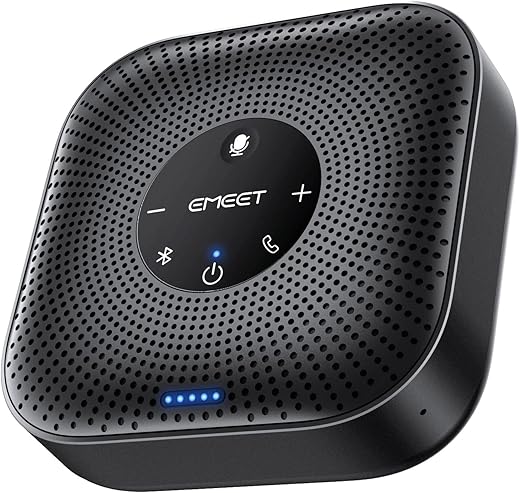
We’ve said audio matters; now let’s look under the hood. A dedicated USB/Bluetooth speakerphone isn’t just “a mic and a tiny speaker.” It’s a purpose-built signal chain and user interface designed to solve the real annoyances we hit in everyday Zoom calls: people sounding distant, rooms echoing, and awkward mute fumbling.
Microphone arrays and beamforming
Unlike a laptop’s single, omnidirectional mic that treats every sound equally, speakerphones use multiple microphones arranged around a puck. Those arrays let the device do beamforming: it electronically focuses pickup toward the active talker and away from incidental noise. The result is clearer speech from people who stand up, walk to a whiteboard, or lean back on the couch — without everyone needing a headset.
DSP: noise reduction and echo cancellation
Behind the scenes, digital signal processing (DSP) removes what we don’t want and preserves what we do. Common DSP functions:

Full‑duplex and speaker design
Full‑duplex lets both sides talk naturally, without the “ducking” or one-way behavior older devices exhibit. That capability depends on both mic processing and a speaker that reproduces voice frequencies accurately at low-to-moderate volumes. Good speakerphones preserve tonal balance for the 300–3,000 Hz range where speech intelligibility lives; cheap speakers either thin out voices or boom bass that makes speech muddy.
Industrial design and ergonomics
Hardware decisions shape daily use. We focus on:
Practical tips to get the most from one
Next, we’ll put these features into context and compare how speakerphones actually stack up against laptop mics, headsets, and standalone USB microphones.
How speakerphones stack up against built-ins, headsets, and USB mics
We want to give you a practical, side‑by‑side sense of where speakerphones live in the trade‑off space — and when another solution still makes more sense.
Head‑to‑head snapshot
Use cases — what we actually do
One‑on‑one calls in a small room
Collaborative team meetings
Presentation mode
Travel and mobile work
Accessibility and etiquette implications
We find that for many hybrid scenarios — quick team huddles, ad‑hoc whiteboarding, and small meeting rooms — the speakerphone hits the pragmatic sweet spot between ease, social presence, and intelligibility.
Ecosystem compatibility and the software side of good calls
We’ve talked about why a dedicated speakerphone matters physically. Now we move from hardware to integration: how these devices actually behave in the messy real world of apps, OSes, and IT policies.
USB vs Bluetooth — reliability, latency, and real life trade-offs
Practical tip: test both in the environment you’ll use. If call stability matters — recurring client meetings, board calls — pick USB. If portability is priority, pick Bluetooth but expect occasional reconnects.
Platform features that matter day-to-day
Apps and OSes influence whether a speakerphone feels “plug‑and‑play” or “plug‑and‑pray.” Watch for:
Vendor ecosystems: apps, firmware, and fleet management
Good speakerphones come with more than plastic and mics these days. Companion apps (Jabra Direct/Jabra Xpress, Poly Lens, Logitech Sync) let us update firmware, tweak EQ, and push settings at scale. For teams, cloud management matters — zero‑touch provisioning, scheduled firmware windows, and security controls make a huge operational difference.
Why we prefer standards-friendly devices: USB Audio Class, Bluetooth profiles (HFP/HSP/A2DP), and SIP/OTA support mean cross‑platform predictability. Closed systems can lock features behind proprietary drivers or cloud services that don’t play well with MDMs or network rules.
Enterprise considerations (short checklist)
Next, we’ll turn this compatibility checklist into buying and placement decisions so you get the most reliable call every time.
How to choose, place, and get the most from one
We’ve covered why compatibility matters; now we make buying and setup stupid-simple. Below are the decision rules and setup moves we actually use when we want every call to sound deliberately good.
Match device to your use case
Think in real-world terms — room size, participants, mobility, budget, and primary device — and prioritize these features:
Placement & acoustic quick wins
Small moves yield big returns.
Three quick workflows we use
Troubleshooting cheat-sheet
With these pick-and-place rules, you can buy one device and immediately notice the difference. Next, we’ll round up why that small buy matters.
A small buy, a noticeably better call
We think a dedicated speakerphone is the highest-ROI, lowest-friction upgrade you can make for modern meetings. It fixes the two biggest invisible problems — capture and playback — by using purpose-built mics and speakers that bring voices forward without the artifacts and distance-smoothing of laptop arrays, and by delivering consistent playback so everyone hears the same balance. It also simplifies sharing: plug-and-play connectivity and platform-friendly USB/BT profiles mean fewer settings fights and faster handoffs.
Try one in your usual meeting and judge by how much conversational friction it removes. In a market crowded with marginal gains, this is a practical hardware win that changes how meetings feel and flow. Give it a week.

Chris is the founder and lead editor of OptionCutter LLC, where he oversees in-depth buying guides, product reviews, and comparison content designed to help readers make informed purchasing decisions. His editorial approach centers on structured research, real-world use cases, performance benchmarks, and transparent evaluation criteria rather than surface-level summaries. Through OptionCutter’s blog content, he focuses on breaking down complex product categories into clear recommendations, practical advice, and decision frameworks that prioritize accuracy, usability, and long-term value for shoppers.