Why our laptop batteries seem to die faster than they used to
We’ve all sat with a new laptop and watched the battery estimate sink from 10 hours to 4 in months. Modern machines pack more power, but real run time often falls short of marketing. The causes are layered: long-term battery wear and confusing capacity numbers; hardware and design choices that prioritize thinness and performance over endurance; software, drivers, and ecosystem behaviors that quietly consume cycles; and the peripherals and settings we forget to audit.
In this product reviews piece we break each factor down, test common drains, and give practical tweaks. Our goal: clear explanations that help us buy smarter, tune systems, and know when replacement is the right call.



Battery basics and long-term wear: what the numbers mean for real use
Capacity: mAh vs Wh and what they actually tell us
When manufacturers list battery size they either use milliamp-hours mah. For laptops, Wh is the useful number because it accounts for voltage: Wh = (mAh × V) / 1000. Most thin laptops sit between ~40–70 Wh. In practical terms that number divided by your average power draw gives run time: a 50 Wh pack at a sustained 10 W draw runs ~5 hours; at 25 W it’s only ~2 hours.
Charge cycles and inevitable degradation
Batteries age with cycles. A “cycle” is roughly one full 0→100% equivalent (two half discharges = one cycle). Most modern Li-ion laptop cells are rated to around 300–1000 cycles before they reach ~80% of original capacity—Apple tends toward the higher end (about 1000 cycles), many Windows vendors rate 300–500. That 80% figure is usually where usable battery life starts to feel noticeably worse for everyday users.
Chemistry and temperature: why some laptops last longer
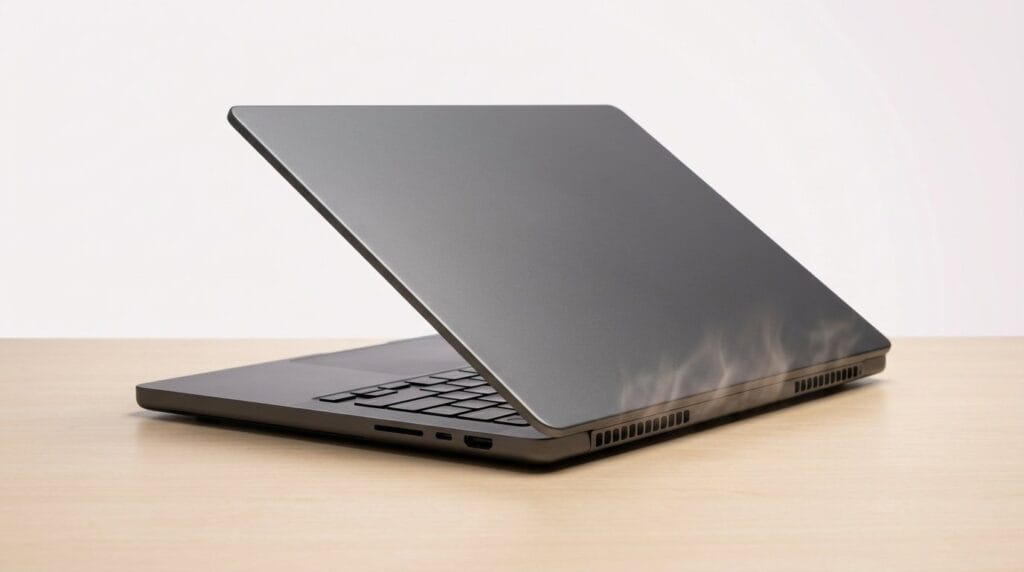
“Lithium-ion” is a catch‑all. Variations in cell chemistry and pack design—cathode material, cell density, thermal management—change longevity and discharge behavior. Ultraportables sacrifice space for thinner cells; gaming laptops use high-density packs but run hotter, accelerating wear. Heat is the silent enemy: keeping a laptop cool does more for long-term life than obsessing over one extra recharge.
Translating specs to real-world expectations
Lab claims often assume ideal conditions: 150 nits brightness, paused background activity, local video playback. In everyday browsing with Wi‑Fi, tabs, and occasional streaming, power draw is higher. Quick comparisons:
Practical, immediate takeaways
These basics let us interpret marketing claims and choose a laptop that matches how we actually use it—rather than the idealized lab where manufacturers measure battery life.
Hardware and design choices that quietly sap runtime
When we look past the spec sheet, a lot of the runtime math comes down to hardware decisions manufacturers make—often to hit a look or performance target. Those choices change how long a laptop lasts in the real world, and not always in obvious ways.
Displays: brightness, resolution, refresh rate, and panel tech
The screen is often the single biggest power consumer. Higher resolution means more pixels to drive; higher refresh rates mean the panel and GPU are working harder even for the same content. oled can be a mixed bag: power-efficient for dark UIs and video with lots of black, but hungry for bright wallpapers and white web pages. Brightness is the simplest multiplier — every extra step up the slider costs useful minutes.
Actionable tips
Processors and power envelopes
CPUs differ not just in clock speed but in architecture and how vendors set power limits (TDP, PL1/PL2). “Desktop-like” laptop chips can boost hard for a short time and then pull heavy power continuously in a thin chassis. Efficiency-first chips (Apple M-series, Intel U-series, AMD Ryzen U) give far better real-world battery life because they deliver acceptable performance at lower sustained wattage. The tricky bit: manufacturers tune cooling and firmware.
Discrete GPUs and thermal headroom
A dedicated GPU will eat battery even when it’s not doing obvious heavy lifting—background compositing, accelerated tabs, and certain apps can keep it awake. Gaming laptops accept big batteries and massive fans to deliver hours of gaming at high power; thin gaming machines trade battery size or thermal headroom and end up with shorter real-world runtimes.
Quick checks
Thinness, cooling, and market trade-offs
Design sells: thinner, lighter machines with tiny bezels and premium materials are what consumers click “buy” on, so brands accept smaller batteries and tighter cooling. That makes sense commercially, but it means we get less headroom for sustained performance and faster thermal-induced battery wear. When battery life matters more than bragging rights, our best bet is a slightly thicker model, a larger Wh rating, or an efficiency-oriented CPU rather than peak clocks.
Software, drivers, and ecosystem integration: how the OS and apps affect battery life
We investigate the software side: how the OS, background processes, poorly optimized apps, and drivers can turn a capable battery into a poor one. Tight hardware‑software integration — think Apple’s M‑series chips running macOS — usually delivers better efficiency because the OS, firmware, and silicon are designed together. By contrast, the fragmented Windows and Linux ecosystems must support a huge range of drivers and peripherals, which increases the odds of a misbehaving component keeping the machine awake or spiking power.
Common software culprits we see in the field
Where ecosystem choices matter
Platform policies and app stores influence developer behavior. App sandboxing and stricter review (App Store, Microsoft Store) make it easier for the platform to limit rogue power use. Apple’s control of hardware and drivers reduces variability — that’s why an M1 MacBook Air often outlasts many Windows Ultrabooks in similar tasks. On Windows, two laptops with the same CPU can still have very different battery life depending on firmware and driver tuning (Dell XPS 13 vs an OEM budget clone).
How we diagnose and act — quick, practical steps
Next we’ll take those software observations into the physical world and look at the small peripherals and settings that quietly drain runtime.
Peripherals, connectivity, and settings: the subtle drains we often ignore
We love thin laptops, dongle life, and always‑connected workflows — but those conveniences add up. In real use the little things we plug in or leave on (and the settings we never touch) can shave hours off a day’s runtime. Here’s what to watch and how to test it.
External displays and hubs: a hidden power tax
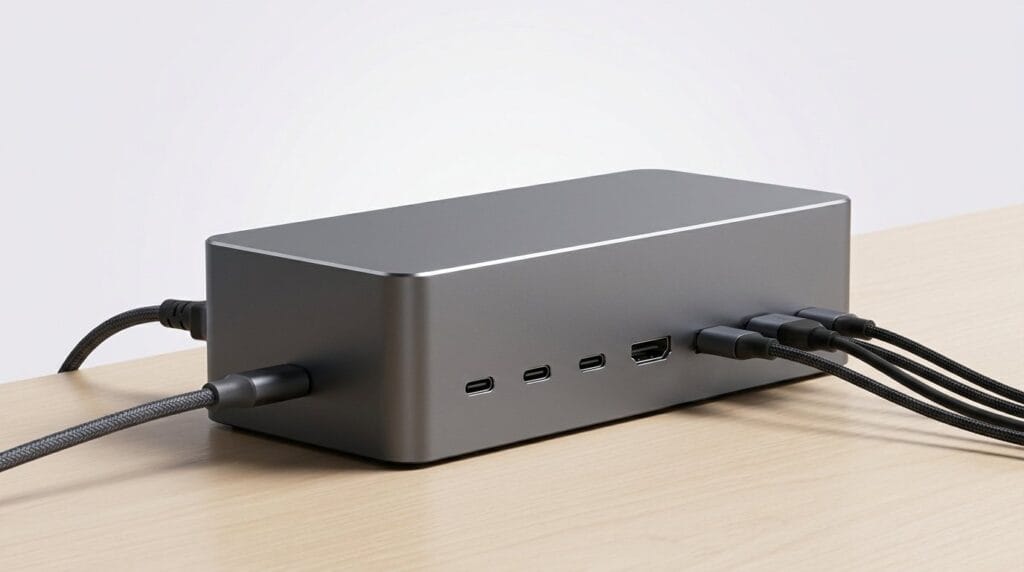
An external monitor forces the GPU and display pipeline to work harder; even a modest 24‑inch IPS can add 5–20W depending on brightness and resolution. USB‑C hubs and docking stations that power multiple drives, a gigabit NIC, and a monitor can draw both from the wall and your laptop’s battery when the adapter isn’t plugged in. Our cafe test — MacBook connected to a 27‑inch 1440p monitor through a bus‑powered hub — turned a usual 9‑hour day into about 5.

Bluetooth and USB peripherals
Bluetooth mice and earbuds are convenient but they keep radios awake and wake the system more often. A Logitech MX Master 3 or AirPods Pro doesn’t sip much by itself, but dozens of paired devices, continuous audio streaming, and active microphone access add measurable drain. Bus‑powered SSDs (Samsung T7) and web cams can consume 1–7W each while active; unplug them when idle.
Networks that never rest
Roaming Wi‑Fi, active hotspots, and persistent cellular modems constantly scan and reconnect. That background scanning prevents deep sleep states and triggers CPU work. On Windows we’ve seen “Wi‑Fi scanning” processes spike wake events; on macOS AirDrop/Continuity services can do similar. Turn off scanning or disable WWAN when not needed.
Settings that eat hours
Screen brightness and refresh rate are the biggest user‑controlled factors. Moving from 100% to 50% brightness often doubles your usable time. A 120Hz or 144Hz panel can feel buttery but costs 10–20% more power than 60Hz; use adaptive refresh when you can. Keyboard backlights, aggressive cloud sync, continuous indexing, and “always on” ambient mics all chip away at uptime.
Quick tests and practical fixes
A final note: “battery calibration” is largely myth for modern Li‑ion cells; avoid deep discharges. Fast‑charge is handy, but frequent high‑temp, high‑power charging can accelerate capacity loss — a trade‑off between convenience and longevity we need to manage deliberately.
Testing, tweaks, and replacement: what we can do about it
We want a practical, repeatable playbook — the kind we’d use in our lab before recommending any big change. Below are our test methods, priority tweaks, and decision rules for repair or replacement, plus buying lessons that cut through marketing noise.
How we run repeatable battery tests
Start simple and keep variables controlled so results are comparable across days and devices.
This gives us numbers that reflect real life — not just a YouTube loop.
Immediate tweaks that move the needle
Tackle low‑effort, high‑impact changes first.
Repair, battery replacement, or admit design limits?
We weigh cost, risk, and expected gain.

Buying strategy for the next laptop
Choose platforms with efficient SoCs (Apple M‑series, Intel Evo with low‑power U processors, AMD Ryzen U), robust thermal design, and good software support. Consider repairability — Framework and some Lenovo ThinkPads score high — and factor replaceable batteries into the total cost of ownership. If your work is GPU‑heavy, move up to a 14–16″ chassis with larger battery rather than forcing a thin 13″ to do the job.
Next, we’ll wrap these recommendations into a practical verdict on balancing performance, design, and battery life.
A practical verdict: balancing performance, design, and battery life
We’ve shown that battery life isn’t a single number but the product of many trade-offs: cell chemistry and capacity, chassis and thermal design, component choice, OS power policies, app behavior, and how tightly a vendor integrates hardware and software. Those choices explain why two laptops with similar specs can feel nothing alike in real use. In today’s market—where thinness and peak performance often win design contests—understanding those trade-offs matters more than raw milliamp-hours.
Checklist: 1) run our simple mixed‑use battery test, 2) tune display brightness, background apps, and power profiles, 3) prefer devices with efficient SoCs and active thermal headroom, 4) replace aged batteries when capacity falls below ~80%. Test to verify claims.
Frequently asked questions
What is the main point of “Why Your Laptop Battery Drains So Fast”?
This piece explains where why your laptop battery drains so fast matters in real buying decisions—not just headline specs. We focus on trade-offs, who benefits most, and what to verify before you spend.
Who should read this why your laptop battery drains so fast guide?
Read it if you are actively shopping, upgrading, or trying to separate marketing claims from day-to-day use. Skip it if you already own the gear and are not planning a change this season.
What changed recently around why your laptop battery drains so fast?
Prices, firmware, and feature tiers shift quickly in this category. We call out what is new enough to affect your decision and what is incremental hype you can safely ignore.
How should I use this editorial when buying?
Treat it as context before you compare models: note the risks and priorities here, then cross-check specs and current pricing on the picks that match how you actually use the product.
What is easy to get wrong about why your laptop battery drains so fast?
Buyers often overweight one spec—brightness, speed, or brand—and underweight fit for their room, ecosystem, or warranty support. We flag the mismatch we see most often in reader questions.
Where should I go next after reading?
Use the related comparisons and top picks linked near the end of this article for model-level shortlists, then confirm return policies and compatibility with the devices you already own.

Iqra Jumar is Option Cutter's editorial writer. She writes practical editorials and buyer guides that focus on real-world upgrades—better Wi‑Fi, cleaner cable setups, smarter streaming, and everyday fixes—not spec-sheet noise alone. Her work helps readers decide what to change now, what to skip, and why.