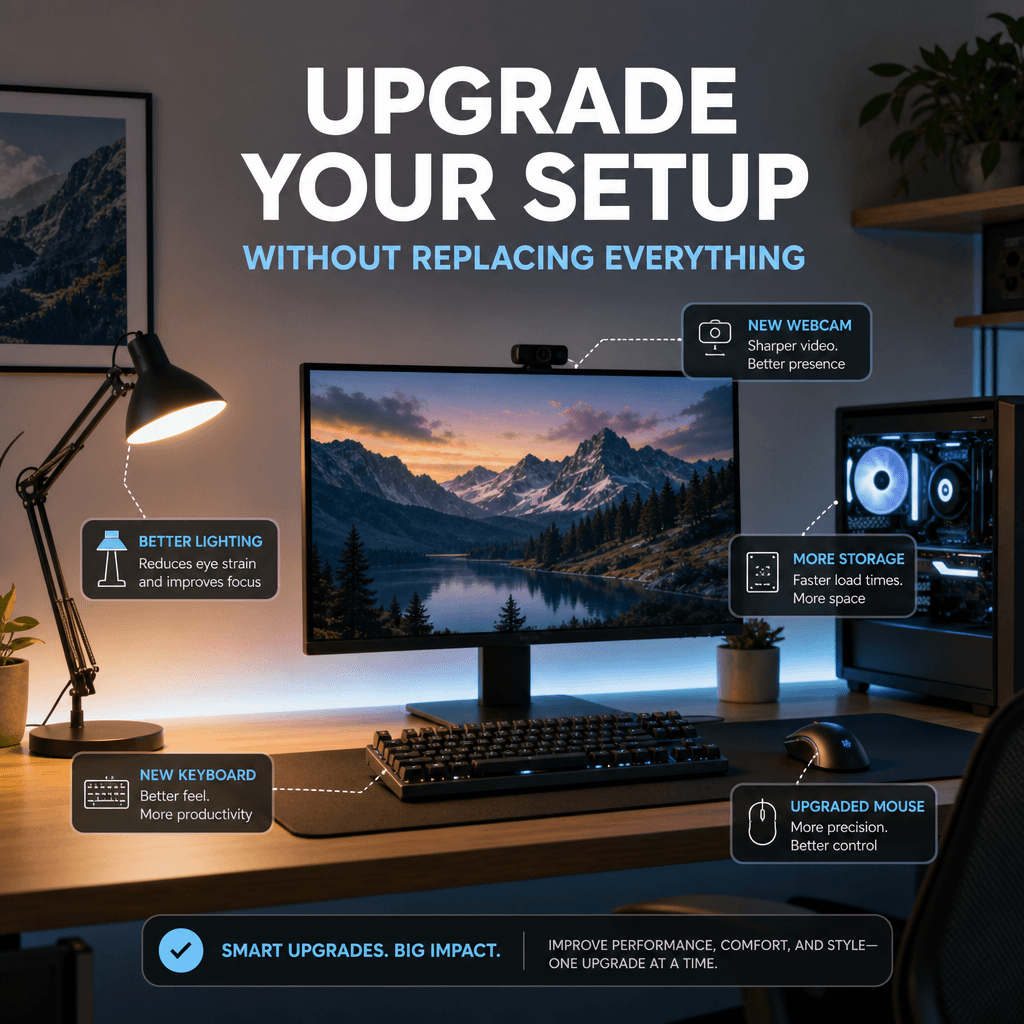
We put budget and premium monitors through real-world workflows—do pricier panels actually double our productivity or just give us nicer bezels, and what those trade-offs mean for design, ecosystem fit, and future-proofing in today’s crowded market?
We’ve all upgraded monitors hoping for clearer work, smoother gaming, or better streaming in our product comparisons. We compare a budget-focused 24-inch AOC and Dell’s higher-end 27-inch 4K resolution to show how design, performance, and connectivity change — and what actually matters for us now.
Budget Favorite

4K Productivity

AOC 24B35H3 Monitor
- 120Hz IPS panel delivers smooth motion for the price
- Wide viewing angles and good sRGB coverage for everyday color work
- Eye-care features (Flicker-Free, Low Blue Light) and VESA compatibility
- Very affordable — strong value for casual gaming and office use
- Limited port selection (single HDMI + VGA) and no USB-C power delivery
- Basic ergonomic adjustments (tilt only) and no built-in speakers
Dell S2725QC 4K
- Sharp 4K panel with strong perceived detail and HDR readiness
- USB-C with up to 65W power delivery simplifies modern laptop workflows
- Good color performance (99% sRGB) and ComfortView to reduce eye strain
- Integrated audio and refined industrial design that fits desktop setups
- Higher price means less compelling value for strictly casual users
- Not a specialized pro-color monitor for HDR mastering or wide P3 workflows
Feature Comparison
| Budget Favorite AOC 24B35H3 24-inch IPS 120Hz Monitor | VS | 4K Productivity Dell 27 Plus S2725QC 27-inch 4K Monitor |
|---|---|---|
24 inches | Screen size |
27 inches |
1920 x 1080 (Full HD) | Resolution |
3840 x 2160 (4K UHD) |
IPS | Panel type |
IPS |
120Hz | Refresh rate |
120Hz |
Adaptive Sync (FreeSync compatible) | Adaptive sync |
AMD FreeSync Premium |
100% sRGB (manufacturer claim) | Color gamut |
99% sRGB (manufacturer claim) |
Typical 1000:1 | Contrast ratio |
1500:1 (manufacturer spec) |
HDR ready (basic) | HDR support |
HDR ready (with improved contrast handling) |
Typical 4–8 ms (grey-to-grey, manufacturer range) | Response time |
Ultra-low 0.03 ms (as marketed for pixel transitions) |
≈ 250 cd/m² (typical) | Brightness (typical) |
≈ 350–400 cd/m² (typical) |
HDMI, VGA, 3.5mm audio out | Ports |
USB-C (65W PD), HDMI, (additional ports depend on configuration) |
None | USB-C power delivery |
Up to 65W |
No built-in speakers | Speakers |
Integrated speakers (re-engineered audio) |
Tilt-only; VESA compatible | Stand type |
Adjustable stand; VESA compatible |
Yes | VESA mount |
Yes |
$$ | Price |
$$$ |
Eco-friendly design, lower power draw | Energy efficiency |
ComfortView Plus reduces blue light while keeping color accuracy |
Budget gaming, general productivity | Target use |
4K productivity, content consumption, laptop docking |
$80.49 | Current price |
$315.99 |
| Buy for $80.49 | Buy for $315.99 |
Watch This Before You Buy a Monitor: Essential Tips
Design and ergonomics: small, simple, or slick — how build affects daily use
AOC 24B35H3 — compact and practical
The AOC is built around a 24‑inch, space-conscious footprint: shallow depth, modest weight, and a tilt‑only stand that keeps your desk uncluttered. Materials are basic matte plastic, which keeps cost and weight down but feels utilitarian next to premium models. VESA support is included, so we can quickly swap the tilt stand for an arm to gain height and swivel — a necessary move if you plan multi‑monitor layouts or sit/stand desks.


Dell S2725QC — bigger, sleeker, and more integrated
Dell’s 27‑inch 4K panel brings a larger footprint and a noticeably refined stand and finish. The base is firmer and the monitor dresses better on a well‑set desk; thinner bezels help a two‑up or three‑up configuration feel more seamless. USB‑C with up to 65W power delivery and integrated speakers mean fewer adapters and one‑cable laptop setups, which materially improves cable routing and daily tidiness for mobile workers.


Why these design differences matter
Image quality and performance: resolution, color, and motion where it counts
Resolution and perceived sharpness
The math is simple: the AOC’s 24″ 1080p panel is about 92 pixels per inch (ppi); the Dell’s 27″ 4K jumps to roughly 163 ppi. That difference isn’t academic — text and UI elements look noticeably crisper on the Dell, and you get more usable desktop real estate for timelines, sidebars, and reference windows without cramming. The AOC is fine for spreadsheets and casual editing, but we lose fine detail for pixel-level photo work.


Color accuracy and HDR
AOC advertises full sRGB coverage, Dell lists 99% sRGB — in practice both deliver accurate, punchy colors for web and SDR workflows. Where Dell tries to pull ahead is HDR readiness and a 1500:1 contrast claim; that can give slightly richer images on compatible content. But neither monitor has the sustained peak brightness or local dimming that produces true HDR highlights, so don’t expect the cinematic HDR jump you see on premium HDR displays.
Contrast, black levels, and real-world depth
Typical IPS panel blacks stay gray compared with VA/OLED; Dell’s higher contrast claim should translate to deeper blacks and better perceived depth in dim scenes, but results vary by unit. The AOC will show slightly shallower blacks and less “pop,” which is acceptable for bright-room productivity.
Motion, sync, and input lag
Both gaming monitors run 120Hz. AOC’s adaptive sync gives tear‑free play across a range; Dell’s AMD FreeSync Premium adds LFC and more consistent VRR behavior at low framerates. In our experience, both feel responsive for casual and competitive play, but Dell’s VRR pedigree and lower latency tuning give it the edge for fast-paced multiplayer.
Practical takeaway


Features, ports, and ecosystem integration: who plugs into what
Ports and the single‑cable workflow
We start with the practical: the AOC gives you HDMI and legacy VGA — simple and broadly compatible, but limited. The Dell brings USB‑C with up to 65W power delivery plus typical display inputs. That single‑cable setup matters: with the Dell you can carry one cable for video, data, and laptop charging; with the AOC you’ll need separate power and possibly adapters for modern laptops.
Audio, contrast, and media convenience
Built‑in speakers on the Dell are a real desk convenience for conference calls and casual media; they won’t replace a desktop sound system but beat the AOC’s absence of speakers (AOC offers a 3.5mm out). Dell’s 1500:1 contrast and ComfortView give richer-looking video and a less tiring experience in long sessions — useful for streaming and mixed creative work.
Compatibility with consoles, older PCs, and docks
The AOC’s HDMI + VGA means immediate plug‑and‑play for consoles, older desktops, and school lab machines. The Dell’s USB‑C favors modern laptops and docks; you can still use HDMI adapters for consoles, but the Dell targets contemporary workflows.
Calibration, firmware, and software ecosystem
Dell provides a stronger software and firmware story (factory profiling, ComfortView, and Display Manager) that eases color setup and multi‑monitor management. The AOC’s controls are more basic — fine for general use, but we’d recommend a hardware colorimeter if you do color‑critical work.
Who plugs into what (quick guide)
Value, longevity, and who should buy which monitor
Price-to-performance
At roughly $85 for the AOC versus about $280 for the Dell, the math is simple: the AOC gives more refresh-rate-for-your-dollar, and the Dell delivers density and connectivity you can’t get at that price. We see the AOC as a pragmatic upgrade for students and casual gamers who want 120Hz fluidity without a powerful GPU. The Dell is worth the premium if you need 4K detail, better contrast, and single-cable convenience.
Warranty and support expectations
Dell has a stronger track record for after‑sales support, firmware updates, and optional extended warranties; that matters if you rely on a monitor for client work. AOC’s support is adequate for typical home use, but you should expect more limited service options and a lower resale safety net.
Power use and expected lifespan
The 24″ 1080p AOC will draw noticeably less power in normal use and is cheaper to replace if damaged. The Dell’s 27″ 4K panel consumes more power, but adds a 65W USB‑C power budget that consolidates your laptop charger. Both use IPS panels with similar durability; however, the Dell’s higher pixel density and feature set make it more future‑proof for evolving workflows.
Resale, upgrade paths, and who should buy
Frequently asked questions
Which is better, Budget Monitor or Premium Monitor?
There is no universal winner: Budget Monitor fits some buyers and Premium Monitor fits others. We compare specs, daily use, and trade-offs in this guide so you can match the pick to your budget and workflow, not a single spec sheet.
What is the main difference between Budget Monitor and Premium Monitor?
Budget Monitor and Premium Monitor target overlapping but not identical use cases. The sections above break down design, performance, ecosystem, and value so you can see where each product pulls ahead and where it compromises.
Should I buy Budget Monitor or Premium Monitor first?
Buy the product that removes your biggest daily friction first. If Budget Monitor solves your primary pain point, start there; if Premium Monitor is the bottleneck in how you actually work or play, prioritize it. Many households add the other later.
Is Budget Monitor worth it over Premium Monitor?
Budget Monitor is worth the premium over Premium Monitor when you will use the features that justify the price—extra performance, build quality, or ecosystem lock-in. If those extras go unused, Premium Monitor usually delivers better value.
Can Budget Monitor replace Premium Monitor?
For some users, yes; for others, no. Budget Monitor can cover most tasks Premium Monitor handles, but gaps in compatibility, accessories, or specialized workflows may still matter. Use our comparison table and verdict to see which gaps apply to you.
Who should choose Budget Monitor vs Premium Monitor?
Choose Budget Monitor if its strengths match how you will use it every day; choose Premium Monitor if you need its specific advantages or a lower entry price. When in doubt, favor the option that fixes your most frequent frustration—not the highest spec on paper.
Final verdict
We pick the Dell as our overall winner for modern work and media: 4K clarity, accurate color, and USB‑C integrate seamlessly into contemporary laptops.
Still, the AOC is our pick for compact, refresh‑focused, budget builds where price and 120Hz matter.

Princess Rioboca is the Lead Editorial Writer at Option Cutter, bringing over seven years of hands-on experience in consumer technology journalism. Specializing in home networking and smart home architecture, she transforms complex technical data into practical, real-world upgrades. Princess personally tests and audits every product she reviews—evaluating real-world Wi‑Fi throughput, cable management durability, and streaming ecosystem stability—to filter out spec-sheet noise. Her rigorous, field-tested insights are designed to give readers transparent, unbiased buying advice on what to purchase, what to skip, and exactly why.