
We break down why size isn’t the story here—it’s about device fit, speed tiers, and ecosystem trade-offs that shape our everyday photography, storage flexibility, and upgrade choices in a market that still can’t agree on one card standard.
Tiny cards, big consequences — choose wisely. We compare SanDisk’s 64GB Extreme PRO SDXC and 64GB Extreme microSDXC (with adapter) to help us pick the right card for our kits and workflows, focusing on real-world performance, compatibility, and value today.
Pro Photography
We find the card’s combination of high sustained write speeds and industry-grade read performance makes it a workhorse for photographers and videographers who need reliable 4K capture and fast offloads. Its rugged build and SanDisk’s ecosystem of readers and software tighten the workflow, though you’ll need a compatible reader to consistently hit the headline transfer numbers.
Mobile Performance
We appreciate how this card balances high sequential read rates with A2-optimized app responsiveness, which matters for phones, action cams and handheld consoles. In a market where versatility matters, it’s a smart, lower-cost way to get 4K-ready storage and broad device compatibility without paying for the top-tier pro SD card.
SanDisk Extreme PRO
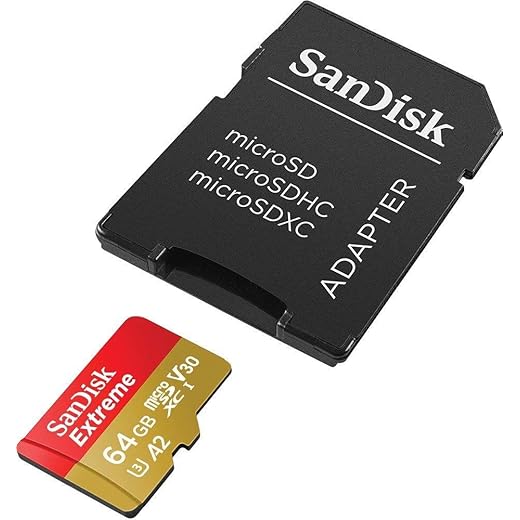
SanDisk Extreme microSD
SanDisk Extreme PRO
SanDisk Extreme microSD
SanDisk Extreme PRO
SanDisk Extreme microSD
Form factor and device compatibility: which fits your kit?
We break down how physical size dictates everyday use. SD cards remain the default for DSLRs, mirrorless cameras, and many laptops; microSD fits phones, tablets, drones, and action cams. The microSD bundle includes an adapter, which gives us flexibility but adds an extra mechanical join and potential failure point. We explain slot availability across modern devices, when an adapter is a practical bridge, and why choosing the native form factor often reduces friction in workflows (fewer adapters, faster transfers via dedicated readers).
Native fit: where the SD card wins
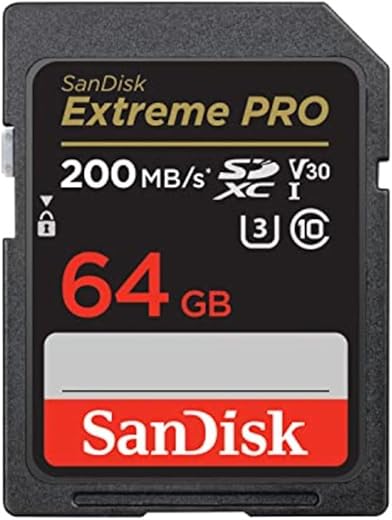
Full-size SD cards are the standard for stills and pro video rigs. If you shoot with DSLRs, mirrorless bodies, pro camcorders, or use an SD-enabled laptop, the SanDisk Extreme PRO 64GB SDXC is the straightforward choice — it plugs in directly, works with dedicated SD UHS-I readers, and avoids adapter-related slowdowns or tiny-part loss.


Micro-first kits and the adapter trade-off
MicroSD is the go-to for phones, tablets with expandable storage, drones, action cameras, and small handhelds. The SanDisk Extreme 64GB microSDXC ships with a full-size SD adapter, so we can slide the tiny card into an SD slot when needed — handy for multi-device workflows — but that adapter is an extra mechanical join that can fail or add contact resistance over time.


Practical compatibility checklist
Choosing the native form factor usually reduces friction: fewer adapters, simpler storage management, and better chances of hitting rated transfer speeds with a proper reader.
Feature Comparison

Performance in practice: sustained writes, read speed, and app responsiveness
Sustained writes and burst shooting
Both cards meet the baseline for reliable 4K capture (U3, V30), so neither will drop frames for continuous 4K video. Where they diverge is burst photography and buffer clearing. The SanDisk Extreme PRO SDXC advertises up to 90 MB/s write versus the microSD’s 60 MB/s. That gap matters when you’re emptying a camera buffer after long RAW bursts — the SD card will clear roughly 50% faster, so you’ll be ready to shoot again sooner.


Read speed and offloading large libraries
Read speed directly affects how long it takes to copy large video/photo libraries. The SD card claims up to 200 MB/s, the microSD up to 160 MB/s. On paper, a full 64 GB card copies in ~5:20 at 200 MB/s and ~6:40 at 160 MB/s — a modest but tangible saving when you offload multiple cards every shoot. Caveat: to hit either figure you need a high-quality USB 3.x or SanDisk Professional reader and a host that supports those speeds.
App responsiveness and random I/O (A2)
The microSD’s A2 rating is meaningful for phones, tablets, or handhelds running apps from external storage. It specifies higher random IOPS (SanDisk lists ~4000/2000 read/write), so apps load faster and small-file tasks feel snappier. That advantage is irrelevant in most cameras and desktop workflows.
Real-world limits: host, reader, and perceived speed
UHS‑I has a common spec ceiling (~104 MB/s), and SanDisk uses proprietary tech to exceed that in compatible hosts. In many cameras and phones the controller won’t push either card to its max — which means the perceptible difference may be minimal for casual users.
Key takeaways:
Design, durability, and ecosystem integration
We evaluate build quality, resilience, and how each card fits into real workflows. The Extreme PRO SDXC is dressed like a pro tool — a full‑size, robust SD body with a tactile feel and specs aimed at repeatable studio/field use. The Extreme microSDXC trades ruggedness for versatility: tiny, A2‑rated for app performance, and shipped with a full‑size adapter to cover more devices.
Physical build and ruggedness
Both cards advertise the same practical protections — temperature‑proof, water‑proof, shock‑proof, and X‑ray‑proof — so you can expect similar survival under everyday abuse. Where they differ in practice:
If you plan to run a microSD inside an SD adapter on a drone, we recommend using the camera’s native microSD slot or a locked, high‑quality adapter; loose fit can produce intermittent contacts during heavy vibration.
Ecosystem: readers, software, and warranty
SanDisk’s ecosystem matters for peak performance and long‑term reliability. QuickFlow tech on the Extreme PRO reaches advertised 200 MB/s only with quality readers (SanDisk Professional PRO‑READER or equivalent USB 3.x readers). The microSD’s A2 rating is useful for phones and handhelds that run apps from external storage.
Both cards ship with lifetime limited warranty terms (registration sometimes required) and official SanDisk utilities for management/recovery — helpful if you depend on predictable support. Third‑party readers, camera compatibility lists, and case choices are mature for both formats, but if speed ceilings or shock resistance are mission‑critical, pairing the SD card with SanDisk’s pro readers and a solid workflow gives more consistent results.
Price, value, and which card to buy for common scenarios
Street price and buying context
We checked current retail pricing: the SanDisk Extreme PRO 64GB SDXC runs around $35; the SanDisk Extreme 64GB microSDXC with adapter is about $28. Both are widely available on Amazon and in camera/phone retailers. The microSD undercuts the SD by roughly $5–10 depending on sales, and it ships with a full‑size adapter — an immediate utility boost.
Is the microSD’s extra worth the savings?
If your workflow is phone‑ or handheld‑centric, yes. The microSD’s A2 rating delivers measurable app and file‑access responsiveness on Android devices and some action cameras. The included adapter expands device compatibility without buying another card. But if you’re primarily shooting with a DSLR/mirrorless that needs long burst buffers and the fastest offloads, the Extreme PRO SD’s higher sustained writes (up to ~90 MB/s) and higher advertised offload ceiling (200 MB/s with a good reader) justify the premium.
Practical buying guidance
Quick checklist — match priority to card
Final verdict: match card to device and workflow
We recommend choosing by primary device and workflow. Pick the SanDisk 64GB Extreme PRO SDXC if you prioritize reliable sustained writes and native SD compatibility for camera workflows; sustained‑write profile, rugged design and faster handling of 4K clips make it the clear winner for camera‑first pros and photographers who rely on DSLRs, mirrorless bodies and capture pipelines.
Choose the SanDisk 64GB Extreme microSDXC (with adapter) if you need mobile versatility, A2 app performance, or plan to reuse card across phones, drones and action cams — it wins for mobile‑first users valuing flexibility.

Chris is the founder and lead editor of OptionCutter LLC, where he oversees in-depth buying guides, product reviews, and comparison content designed to help readers make informed purchasing decisions. His editorial approach centers on structured research, real-world use cases, performance benchmarks, and transparent evaluation criteria rather than surface-level summaries. Through OptionCutter’s blog content, he focuses on breaking down complex product categories into clear recommendations, practical advice, and decision frameworks that prioritize accuracy, usability, and long-term value for shoppers.