We peel back the trade-offs—are open‑backs’ spacious soundstage and airy comfort worth sacrificing isolation and portability, or do closed‑backs’ punch, noise control, and ecosystem compatibility make them the smarter pick for most listeners?
We choose curiosity. We frame core tradeoffs between open- and closed-back headphones, and introduce two contenders, the open-ish beyerdynamic DT 990 Pro (250 Ω) and the closed Audio‑Technica ATH‑M50x, setting expectations for sound, comfort, and real-world use, workflow and portability.
Studio Reference

Isolation Workhorse

DT 990 Pro
- Expansive, natural open soundstage excellent for spatial imaging
- Detailed, reference-leaning frequency response that reveals mix issues
- Comfortable velour pads and a durable, serviceable build
- High impedance gives clean headroom on studio-grade outputs
- Handcrafted quality with long-term serviceability
- Open-back design leaks sound and offers virtually no isolation
- 250 Ω spec may need a dedicated amp for portable use
- Bass is less boosted—may not satisfy listeners wanting heavy low-end
ATH-M50x Studio Monitor
- Punchy, well-controlled bass and a clear midrange useful for tracking
- Strong passive isolation makes them versatile in loud environments
- Detachable cables and foldable design improve portability and durability
- Consistent, reliable tonal signature favored by many engineers and creators
- Comfortable clamping and durable construction for long sessions
- Narrower soundstage and less spatial openness than open-back models
- Slight low-end emphasis can mask subtle mix details for critical mastering
- Build and materials vary by region (minor finish inconsistencies possible)
Feature Comparison
| Studio Reference DT 990 Pro | VS | Isolation Workhorse ATH-M50x Studio Monitor |
|---|---|---|
9.5 / 10 | Soundstage |
6.5 / 10 |
9 / 10 | Accuracy / Neutrality |
8 / 10 |
8.5 / 10 | Comfort & Build |
8 / 10 |
3 / 10 | Isolation / Leakage |
8.5 / 10 |
$199.99 | Current price |
$159.00 |
| Buy for $199.99 | Buy for $159.00 |
Open-Back vs. Closed-Back Headphones: Which Is Best for You?
Sound signature and technical performance: imaging, bass, and detail
Overall tonal character
We hear these two headphones as opposite takes on the same goal: clarity. The beyerdynamic DT 990 Pro is airy and open, with a wide-stage presentation and an emphasis in the upper mids and treble that makes spatial cues and micro-details pop. The Audio‑Technica ATH‑M50x is the pragmatic alternative: closed, forward, and bass-forward enough to sound punchy on tracks and during tracking sessions.
DT 990 Pro — airy, wide, revealing
The DT 990’s open-back design creates a larger perceived soundstage and very clear lateral imaging. Treble energy is elevated, which helps reveal sibilance, room reflections, and digital artifacts — exactly what we want when we’re hunting for small mix issues. Its transient response is fast enough to keep percussion articulate, but the bass is leaner and less boosted than typical closed cans; that helps preserve perceived detail at low frequencies.


ATH‑M50x — tight, punchy, controlled
The M50x trades stage width for focus. Imaging feels more “in‑head” in high-fidelity listening, but the low end is tighter and more pronounced, giving mixes an immediate sense of rhythm and weight. That controlled bass and slightly recessed treble mean fewer false positives for sibilance, and a more forgiving listen when you need to make production choices quickly. Transients are solid and satisfying for tracking and monitoring in untreated rooms.


Driver behaviour, impedance, and source synergy
Why it matters today
In a world where portable DACs and streaming are common, the M50x is the more versatile plug-and-play choice. For critical mixing and mastering, the DT 990’s broader staging and treble detail give us a clearer reference — provided we use proper amplification. Practically: choose the DT 990 for revealing, spatial reference work; pick the M50x when you need reliability, isolation, and a punchy sound on the go.
Design, comfort, and materials: long sessions and durability
DT 990 Pro — velour, light weight, serviceable
We find the DT 990 Pro built around comfort-first choices: plush velour earpads, a relatively light overall weight, and an open-back frame that reduces heat and pressure on the ears during marathon sessions. The 250 g shell and forgiving clamping make it kinder for long mixing or listening days, and every major part is replaceable — headband, pads, even drivers — which matters when you expect years of studio use.


ATH‑M50x — tighter clamp, detachable cables, portable design
The M50x takes the opposite route: denser clamping for passive isolation, firm leatherette pads that seal, and swiveling earcups for one-ear monitoring. The detachable cables and fold-flat hinges are practical for mobile producers and traveling editors. That clamp gives better isolation in loud rooms but can feel less forgiving over eight-hour sessions for some users.
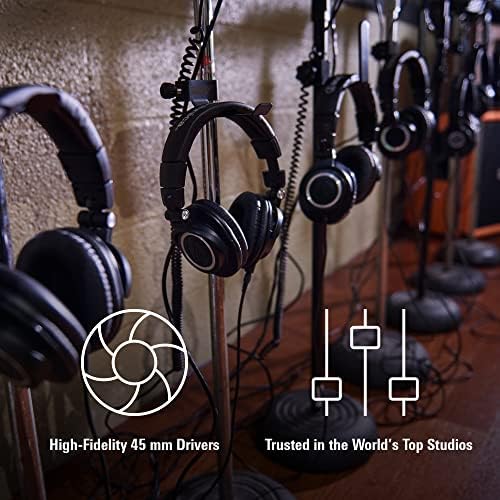

Quick design callouts — what matters day to day
In a market leaning toward hybrid, portable-focused models, the DT 990 is our studio comfort pick; the M50x is the pragmatic choice for creators who move between desks, deskside mixers, and on-the-go work.
Workflow fit and ecosystem integration: studio, streaming, and portable setups
We map each headphone to real-world workflows so you can pick by where you actually work, not by spec sheets.
Studio mixing and mastering
For critical listening, the DT 990 Pro is the obvious studio tool: its open-back, wide soundstage and revealing highs expose spatial cues and mix flaws. That makes it better for imaging and detailed editing, but it also exaggerates room/air and needs a clean, powerful output (250 Ω) to perform as intended. The M50x is more forgiving — tighter, bass-forward, and less airy — which helps when you need a quick reference but can mask subtle issues during mastering.
Content creation and streaming
Isolation and mic bleed matter here. The ATH‑M50x’s closed cups, solid clamp, and good studio isolation reduce bleed into live mics and keep room noise out of recordings. Detachable cables and swivel cups also make monitoring while producing or hosting easier. The DT 990’s open design leaks and will force you to rely on a close-talk mic and treated room — not ideal for live-streaming setups without careful mic technique.
Portable listening and source matching
The M50x is designed to travel: foldable, detachable cables, and friendly impedance for phones and laptops. The DT 990 is desk-first — lightweight and comfy, but its 250 Ω rating demands a headphone amp for full dynamics, which limits mobile use.
Contemporary creators often juggle both worlds; if you split time between a treated desk and on‑the‑go editing, we recommend a closed, portable primary (M50x) and a dedicated open reference (DT 990) at the desk rather than one do‑it‑all pair — browse our product comparisons.
Practical considerations: isolation, portability, price, and long-term value
We address isolation, leakage, portability, and price-to-performance head-on. The ATH‑M50x is built to block sound and work in public or noisy rooms; the DT 990 gives you space and air at the expense of isolation. Below we break down the practical trade-offs that determine total cost of ownership today.
Isolation and leakage
The M50x’s closed cups provide strong passive isolation — less bleed to mics and fewer complaints on planes or in cafés. The DT 990’s open-back design radiates sound outward and admits room noise, which is excellent in a treated studio but makes it impractical for commuting, shared offices, or live-streaming without careful mic technique.
Portability and day-to-day use
The M50x is foldable, has detachable cables, and is phone-friendly thanks to low impedance — it’s the easy, grab-and-go option. The DT 990 is lightweight and comfy for long desk sessions, but the 250 Ω model is a desk-first headphone: it needs a proper amp for dynamics and volume, and it doesn’t fold or isolate for travel.
Amp requirements, aftermarket pads, and hidden costs
The 250 Ω DT 990 will often demand a headphone amp/DAC to reach its potential; expect to spend roughly $50–$200 for a decent portable amp or $100–$400 for a solid desktop DAC/amp. Both headphones have replaceable pads; aftermarket pads or cables run $20–$60 and are worth budgeting for comfort or longevity.
Warranty, support, and resale
We value serviceability: beyerdynamic’s modular parts and replaceable components extend usable life, lowering long-term cost. The M50x’s mainstream popularity translates to consistent resale demand and easy accessory sourcing. Both brands offer solid support, but the DT 990’s serviceable design gives it an edge if you plan to keep and maintain headphones for years.
Frequently asked questions
Which is better, Open-Back or Closed-Back Headphones?
There is no universal winner: Open-Back fits some buyers and Closed-Back Headphones fits others. We compare specs, daily use, and trade-offs in this guide so you can match the pick to your budget and workflow, not a single spec sheet.
What is the main difference between Open-Back and Closed-Back Headphones?
Open-Back and Closed-Back Headphones target overlapping but not identical use cases. The sections above break down design, performance, ecosystem, and value so you can see where each product pulls ahead and where it compromises.
Should I buy Open-Back or Closed-Back Headphones first?
Buy the product that removes your biggest daily friction first. If Open-Back solves your primary pain point, start there; if Closed-Back Headphones is the bottleneck in how you actually work or play, prioritize it. Many households add the other later.
Is Open-Back worth it over Closed-Back Headphones?
Open-Back is worth the premium over Closed-Back Headphones when you will use the features that justify the price—extra performance, build quality, or ecosystem lock-in. If those extras go unused, Closed-Back Headphones usually delivers better value.
Can Open-Back replace Closed-Back Headphones?
For some users, yes; for others, no. Open-Back can cover most tasks Closed-Back Headphones handles, but gaps in compatibility, accessories, or specialized workflows may still matter. Use our comparison table and verdict to see which gaps apply to you.
Who should choose Open-Back vs Closed-Back Headphones?
Choose Open-Back if its strengths match how you will use it every day; choose Closed-Back Headphones if you need its specific advantages or a lower entry price. When in doubt, favor the option that fixes your most frequent frustration—not the highest spec on paper.
Final verdict — which one we’d pick and why
We pick the ATH‑M50x as our winner for most users: its closed design, rugged foldable build, and tighter low end make it far more versatile than the DT 990’s airy, bright reference tuning.
DT 990 for home mixing and airy detail; ATH‑M50x for tracking, travel, noisy rooms — checklist: mixing=DT990; isolation=ATH‑M50x.

Princess Rioboca is the Lead Editorial Writer at Option Cutter, bringing over seven years of hands-on experience in consumer technology journalism. Specializing in home networking and smart home architecture, she transforms complex technical data into practical, real-world upgrades. Princess personally tests and audits every product she reviews—evaluating real-world Wi‑Fi throughput, cable management durability, and streaming ecosystem stability—to filter out spec-sheet noise. Her rigorous, field-tested insights are designed to give readers transparent, unbiased buying advice on what to purchase, what to skip, and exactly why.