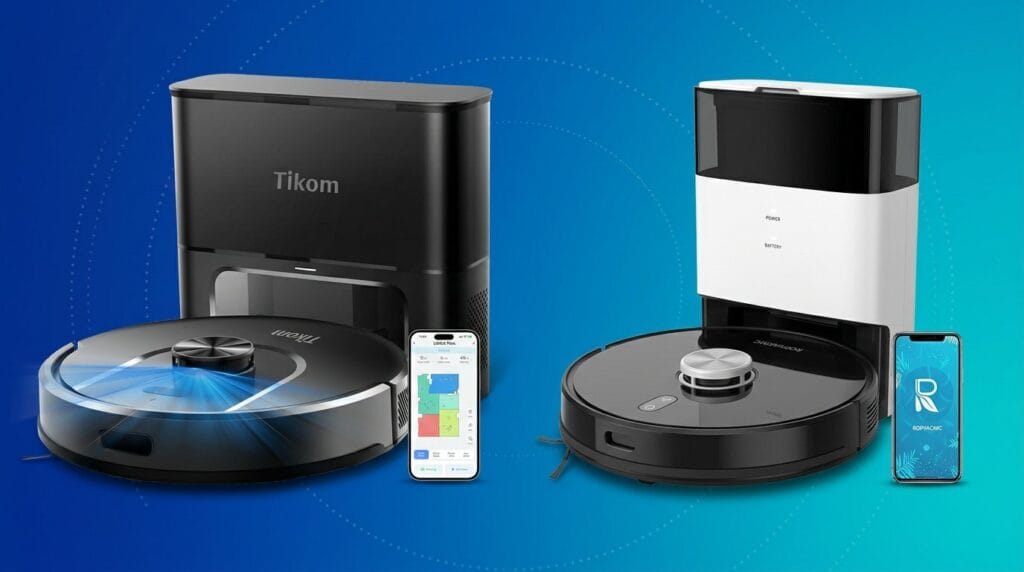
We put the Roborock S8 Pro Ultra and iRobot Roomba j7+ head‑to‑head to find out which delivers smarter cleaning, sleeker design, and tighter ecosystem integration — and whether Roborock’s aggressive feature set can finally dethrone iRobot’s polished, everyday reliability.
We compare the Roborock S8 Pro Ultra and iRobot Roomba j7+ to help you choose which premium robot suits our homes and routines, focusing on cleaning power, smart features, daily usability, and long-term ownership so you can decide faster today.
Complete Autonomy

Smart Avoidance

Roborock S8 Pro
- Very strong suction (6000Pa) and dual-rubber brushes cut hair tangles
- All-in-one dock that self-washes, dries, refills and self-empties for long autonomy
- Powerful sonic VibraRise mopping with liftable mop to protect carpets
- Long runtime (up to ~180 minutes) and robust LiDAR + 3D obstacle avoidance
- All-in-one dock is large and adds cost and footprint
- Self-emptying module can clog occasionally and needs occasional maintenance
Roomba j7+
- PrecisionVision camera and software that reliably detects and avoids objects (including pet waste)
- Well-integrated Clean Base automatic dirt disposal with enclosed bag system
- Imprint Smart Mapping and iRobot OS provide room-level control and smart suggestions
- Solid vacuuming performance with dual multi-surface rubber brushes and edge cleaning
- No mopping capability — vacuum only
- Higher price point and ongoing bag replacement costs; base-cycle noise can be intrusive
Roborock S8 vs S8+ vs S8 Pro Ultra: Ultimate Hands-On Comparison
Feature Comparison
| Complete Autonomy Roborock S8 Pro | VS | Smart Avoidance Roomba j7+ |
|---|---|---|
9.4 / 10 | Cleaning performance |
8.2 / 10 |
9 / 10 | Navigation & obstacle avoidance |
9.2 / 10 |
9.8 / 10 | Mopping / wet cleaning |
2 / 10 |
9 / 10 | Battery & runtime |
8.6 / 10 |
$399.99 | Current price |
$794.95 |
| Buy for $399.99 | Buy for $794.95 |
Design, build, and daily user experience
Size, footprint, and docking
We found the S8 Pro Ultra makes its presence known. The robot-plus-RockDock ensemble measures roughly 21″ x 20″ with a nearly 19″ dock height, and the RockDock Ultra is a full appliance: water tanks, pumps, fans, and a large dust-bag chamber. That bulk limits where you can tuck it (a utility closet, garage nook, or dedicated alcove works best).


By contrast, the Roomba j7+ is compact and squat: the 13.3″ robot plus a low-profile Clean Base that’s easy to fit under counters or in tighter living rooms. The j7+ favors small-space convenience and flexible placement.
Dust, water, and day-to-day handling
The differences show up in daily touchpoints. The Roborock’s RockDock combines self-emptying, self-refilling, mop washing, and auto-drying — that means far fewer interventions but more complex hardware to service. Tanks, mop mounts, and the dual-rubber brush feel solid and engineered; removing the water tray or mop cassette is intuitive but takes a couple of steps.
The j7+ keeps the interaction simple: the robot’s bin slides out easily and the Clean Base uses sealed bags that you swap infrequently. The tactile experience is cleaner and more minimal, but there’s no mopping or water management.
How that shapes everyday use
We care about these trade-offs because they determine whether a hands-off, full-care station justifies the space — or whether a compact, low‑maintenance base fits better in a tighter home.


Cleaning performance: vacuum, mopping, and obstacles
Suction and brush systems — quick comparison
We tested how each robot handled pet hair, fine dust, and dried debris across hardwood and medium-pile carpet. Raw power and brush design matter in different ways: one machine pursues brute suction and active scrubbing; the other prioritizes targeted pickup and object-aware routing.
Roborock S8 Pro Ultra
The S8 Pro Ultra pairs a 6000Pa motor with dual rubber brushes and a liftable brush cassette. In our runs it pulled deep-set crumbs and long pet hair more consistently, and the rubber brushes cut tangles compared with traditional bristle spinners. The liftable brush lets the robot vacuum-only over carpets and engage the sonic mop on hard floors without dragging water onto rugs.


iRobot Roomba j7+
The j7+ uses iRobot’s “10x power‑lifting” suction claim (vs older 600‑series) and dual multi‑surface rubber brushes plus an edge‑sweeping brush. It cleaned edges and concentrated messes reliably; on mid‑pile carpet its pickup was very good, though it lacks a published Pa metric and never matched the S8’s raw pickup of caked debris.


Mopping and wet cleaning
This is where the S8 Pro Ultra separates itself: VibraRise sonic mopping (thousands of scrubs per minute), auto‑wash/auto‑dry dock, and self‑refill make real, repeatable wet cleaning possible with minimal fuss. The j7+ has no mopping capability — it’s strictly vacuum.
Navigation, obstacles, and coverage tradeoffs
S8 combines LiDAR mapping with 3D Reactive avoidance for a methodical path and fewer misses; its aggression gives fuller coverage but can push closer to obstacles. The j7+’s PrecisionVision camera is conservative—excellent at dodging socks, cords, and pet waste (iRobot even guarantees it)—but that caution can leave small gaps around clustered objects.
Smart features, mapping, and ecosystem integration
Mapping fidelity and multi‑floor support
We found the S8 Pro Ultra’s LiDAR mapping to be more precise for room outlines and tight no‑go boundaries. That matters when you tell the robot “clean the kitchen” — Roborock’s maps rarely bleed across doorways and the liftable brush/mop behavior respects virtual carpet zones. The j7+ stores multiple Imprint Smart Maps too, but its camera‑forward approach is occasionally more conservative around cluttered thresholds, which can leave small missed patches.
Object recognition and trust
iRobot’s PrecisionVision is the standout here. The j7+ reliably spots socks, cables, and pet waste and routes around them — computer vision basics explain why camera bots excel at small-object avoidance, which increases user trust, especially with pets. Roborock’s Reactive 3D obstacle avoidance is fast and effective at preventing bumps, but it won’t match j7+’s guaranteed avoidance of delicate hazards that users care most about.
App experience and third‑party integrations
Roborock’s app exposes deep map editing (no‑mop zones, room naming, custom sequences) and officially supports Alexa, Google Assistant, and has community/official hooks for Home Assistant — useful if you want home automation scenes. iRobot supports Alexa/Google and adds iRobot OS smart suggestions and presence‑based automations (“clean when you leave”), but it’s a more closed ecosystem overall.
Important integration points
Auto‑dock workflows and why openness matters
Roborock’s RockDock Ultra automates washing, drying, and refilling — it keeps mopping usable long term. iRobot’s Clean Base simplifies emptying with sealed bags. If you plan broader automations (security cameras, voice routines, presence triggers), Roborock’s more open integrations give more flexibility; if you prioritize hands‑off safety around pet messes, the j7+’s vision system is the reassuring choice.
Maintenance, consumables, and total cost of ownership
We break down what you’ll actually pay and do over years of ownership — filters, brushes, mop pads, and the specialized consumables that power automatic docks.
Replacement cadence and monthly cost estimates
We estimate typical replacement intervals and run the numbers conservatively for moderate use (3–5 cleans/week).
Estimated monthly cost
Why it matters: the j7+’s sealed bag system is convenient but more expensive over time. The S8 Pro Ultra’s mopping adds extra consumable considerations (pads, occasional cleaning solution) but those are mostly washable and lower ongoing cost.
Reliability and common failure modes
Warranty, support, and who should care
Both brands offer roughly 1‑year limited warranties; iRobot has a larger service footprint and guarantees around pet‑waste avoidance (the P.O.O.P. promise), which matters if you have pets. Roborock’s parts are generally easier to source third‑party and its dock is repairable but adds complexity.
If you value lowest ongoing cost, prioritize models without expensive disposable bags. If you value true “set and forget” convenience (and have the budget), accepting higher recurring costs for the j7+ or S8 Pro Ultra + RockDock can be worth it.
Frequently asked questions
Which is better, Roborock S8 Pro Ultra or iRobot Roomba j7+?
There is no universal winner: Roborock S8 Pro Ultra fits some buyers and iRobot Roomba j7+ fits others. We compare specs, daily use, and trade-offs in this guide so you can match the pick to your budget and workflow, not a single spec sheet.
What is the main difference between Roborock S8 Pro Ultra and iRobot Roomba j7+?
Roborock S8 Pro Ultra and iRobot Roomba j7+ target overlapping but not identical use cases. The sections above break down design, performance, ecosystem, and value so you can see where each product pulls ahead and where it compromises.
Should I buy Roborock S8 Pro Ultra or iRobot Roomba j7+ first?
Buy the product that removes your biggest daily friction first. If Roborock S8 Pro Ultra solves your primary pain point, start there; if iRobot Roomba j7+ is the bottleneck in how you actually work or play, prioritize it. Many households add the other later.
Is Roborock S8 Pro Ultra worth it over iRobot Roomba j7+?
Roborock S8 Pro Ultra is worth the premium over iRobot Roomba j7+ when you will use the features that justify the price—extra performance, build quality, or ecosystem lock-in. If those extras go unused, iRobot Roomba j7+ usually delivers better value.
Can Roborock S8 Pro Ultra replace iRobot Roomba j7+?
For some users, yes; for others, no. Roborock S8 Pro Ultra can cover most tasks iRobot Roomba j7+ handles, but gaps in compatibility, accessories, or specialized workflows may still matter. Use our comparison table and verdict to see which gaps apply to you.
Who should choose Roborock S8 Pro Ultra vs iRobot Roomba j7+?
Choose Roborock S8 Pro Ultra if its strengths match how you will use it every day; choose iRobot Roomba j7+ if you need its specific advantages or a lower entry price. When in doubt, favor the option that fixes your most frequent frustration—not the highest spec on paper.
Final verdict — which should you buy?
We think the Roborock S8 Pro Ultra is the clear winner. Its liftable dual brush, 6000Pa suction, sonic mop, and RockDock Ultra base provide the most hands‑off, full‑featured cleaning and mopping experience for larger homes and mixed surfaces. The integrated auto‑wash, auto‑dry, self‑empty, and auto‑refill workflow reduces maintenance and protects floors; its mapping, obstacle avoidance, and ecosystem integration matter when time saved and thorough multi‑surface care are the priority.
The iRobot Roomba j7+ earns a strong niche recommendation for compact apartments and cluttered rooms: PrecisionVision navigation and a smaller footprint make it better at avoiding pet waste and tight obstacles. Quick buying cues — Best for pets: S8 Pro Ultra; Best for mopping: S8 Pro Ultra; Best for small apartments: Roomba j7+. Ready to upgrade your cleaning routine — browse our product comparisons?

Princess Rioboca is the Lead Editorial Writer at Option Cutter, bringing over seven years of hands-on experience in consumer technology journalism. Specializing in home networking and smart home architecture, she transforms complex technical data into practical, real-world upgrades. Princess personally tests and audits every product she reviews—evaluating real-world Wi‑Fi throughput, cable management durability, and streaming ecosystem stability—to filter out spec-sheet noise. Her rigorous, field-tested insights are designed to give readers transparent, unbiased buying advice on what to purchase, what to skip, and exactly why.