After A/B testing music, movies, and small-room installs, we found that 5.1 can truly elevate cinematic immersion—but for most of us a well-tuned 2.1 wins on design, integration, and bang-for-buck; which trade-offs matter to you?
We put Logitech’s compact Z625 2.1 against the room-filling Z906 5.1 to see if surround still justifies extra cost, setup, and space in this comparison. Our hands-on, Verge-style take focuses on sound, setup, ecosystem, and everyday value for modern home theaters and gaming.
Compact Power

Full Surround

Logitech Z625
- Punchy, well-controlled subwoofer for its class
- Simple, reliable wired connections including optical and aux
- Straightforward desktop controls (volume and bass) on satellite
- No remote or integrated wireless/Bluetooth
- Limited spatial imaging compared with multi‑channel systems
Logitech Z906
- True 5.1 surround with convincing positional imaging
- High overall output and impactful subwoofer for movies and parties
- Flexible inputs and included remote/control console for source switching
- More complex wiring and placement than a 2.1 set
- Bulkier system and higher price point
Feature Comparison
| Compact Power Logitech Z625 THX Certified 2.1 Speakers | VS | Full Surround Logitech Z906 THX 5.1 Surround Sound System |
|---|---|---|
2.1 | Channel Configuration |
5.1 |
THX Certified | Certification |
THX, Dolby Digital, DTS |
200W RMS / 400W Peak | Total Power (RMS / Peak) |
500W continuous / 1000W peak |
200W (integrated) | Subwoofer Power |
165W |
2 satellites (left/right) | Satellite Count |
5 satellites (4 surrounds + center) |
Included in total (not specified individually) | Satellite Power (per speaker) |
67W per satellite/center |
Optical, 3.5mm auxiliary, RCA (multiple simultaneous) | Inputs |
Optical (2), coaxial, RCA, 3.5mm, 6-channel direct |
No | Remote Included |
Yes |
No | Wall-mountable |
Yes |
None (third-party adapter required) | Wireless / Bluetooth |
None (wired only) |
Physical knobs on right satellite (power, volume, bass, headphone) | Controls |
Compact control console with on/off, input select and level adjustments |
$$ | Price Tier |
$$$$ |
Desktop, casual TV, gaming where bass impact matters | Ideal Use |
Home theater, gaming in larger rooms, multi-source setups |
$199.42 | Current price |
$410.99 |
| Buy for $199.42 | Buy for $410.99 |
What they are: hardware, specs, and core differences
Logitech Z625 — 2.1 THX
The Z625 is a straightforward 2.1 desktop/home-theater speaker: two satellites plus a powered subwoofer tuned for punch and sheer low‑end impact.


Logitech Z906 — 5.1 THX, Dolby, DTS
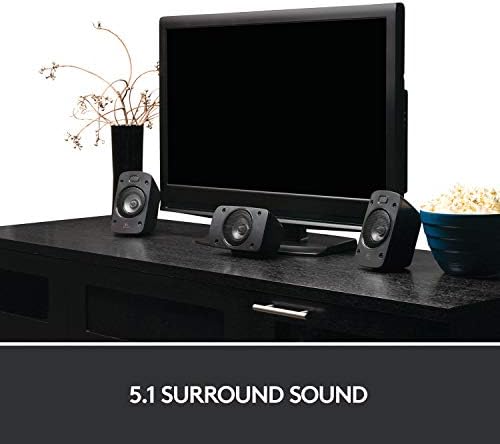
The Z906 is a full discrete 5.1 system with a control console and remote, designed for real surround decoding and placement around a room.

How the specs translate to capability
In short: Z906 gives discrete rear channels and on‑board multichannel decoding, so dolby. That matters for Blu‑rays and games with encoded 5.1 mixes — you get positional cues and a surround field. The Z625’s optical input is handy for TVs and some consoles, but it’s a stereo rig: multichannel sources are downmixed to two channels plus sub, so you lose discrete surrounds. Power and driver count also change the character: Z906’s many satellites and higher total power deliver broader room coverage and louder, more directional effects; Z625 focuses energy into a single, controlled sub for punchier movies and desktop gaming in smaller rooms.
Listening experience: staging, bass, clarity, and real-world performance
How they stage sound
We hear an immediate difference: the Z906 creates a three‑dimensional soundfield you can walk into. Discrete front/center/rear channels let effects move around you and give on‑screen action precise placement. The Z625, being a 2.1, collapses multichannel content into a wide stereo image — it’s spacious for a desktop but not truly enveloping. That matters if you watch films or play modern games that use discrete surround mixes.


Bass and dynamics
The Z625’s single powered subwoofer is tight and aggressive; it concentrates power into fewer drivers, so explosions and basslines feel punchy even at near‑field listening levels. The Z906’s larger sub and higher total wattage produce deeper, room‑filling low end — better for living rooms and parties — but requires placement and gain tuning to avoid boominess.
Dialogue and clarity
Because the Z906 includes a dedicated center channel, spoken dialogue sits forward and remains intelligible in busy mixes. The Z625 can sound clear, but voices sometimes blur into the stereo image on dense scenes. THX/thomas dolby/DTS decoding in the Z906 preserves channel separation and clarity the Z625 can’t replicate when fed encoded 5.1 tracks.


Real‑world: music, movies, games
Room, distance, and redundancy
If you sit close (desk/PC) or want simple setup, the 2.1’s sweet spot and focused bass often outperform an improperly placed 5.1. In larger rooms or for true cinematic/game realism, the Z906’s channels and decoding are worth the extra complexity.
Setup, ergonomics, and ecosystem integration
Unboxing and first‑time setup
We found the Z625 gets you playing faster. Everything you need is in the box and the bulky sub + two satellites mean a single power connection and a couple of cables to the right satellite (volume/bass on the cabinet). The Z906 is a bigger commitment: six speaker wires, a powered sub, and a compact control console to position. It works, but unboxing takes longer.
Cabling and placement
The differences are practical, not theoretical.
Controls and daily ergonomics
The Z625’s physical controls on the right satellite (volume, bass, headphone) are fast and reliable — no batteries, no menu hunting. The Z906’s control console plus infrared remote gives far more convenience for switching sources and adjusting levels from the couch, but you trade that for one more device to hide and maintain.
Compatibility, switching, and latency
Both systems avoid bluetooth stack (no wireless audio processing), so latency for gaming over optical or analog is effectively negligible. Differences that matter:
How they fit modern setups
If we’re building a PC/desk rig or want a low‑visual‑impact TV speaker, the Z625’s compact footprint and plug‑and‑play simplicity win. If we’re after true 5.1 playback in a living room and want easy remote/source control, the Z906’s extra wiring is a reasonable tradeoff.
Why this matters: an easier, more compatible setup often means the system actually gets used — and delivers value — more than the raw count of channels ever will.
Value, alternatives, and who should buy which
Price-to-performance and where they sit
We place the Z625 (~$223) as a strong price-to-performance pick for desktops and small rooms: powerful sub, simple connections, and THX branding for movie/gaming punch without fuss. The Z906 (~$450) demands more money and space, but it delivers genuine 5.1 decoding, louder output, and better positional imaging — features that matter in a living‑room setup.
Alternatives to consider
Longevity and upgrade paths
We see the Z625 as a mostly closed system: great now, limited expandability beyond replacing speakers or adding an external DAC. The Z906 is more future‑proof for surround use — technically a self‑contained system, but it fits into a larger home‑theater workflow (multiple digital inputs, source switching). Neither matches the long‑term modularity of passive speakers + receiver if you plan iterative upgrades.
Who should buy which
We recommend picking the system that matches your room and usage model rather than chasing channel count alone.
Frequently asked questions
Which is better, 2.1 or 5.1 Sound System?
There is no universal winner: 2.1 fits some buyers and 5.1 Sound System fits others. We compare specs, daily use, and trade-offs in this guide so you can match the pick to your budget and workflow, not a single spec sheet.
What is the main difference between 2.1 and 5.1 Sound System?
2.1 and 5.1 Sound System target overlapping but not identical use cases. The sections above break down design, performance, ecosystem, and value so you can see where each product pulls ahead and where it compromises.
Should I buy 2.1 or 5.1 Sound System first?
Buy the product that removes your biggest daily friction first. If 2.1 solves your primary pain point, start there; if 5.1 Sound System is the bottleneck in how you actually work or play, prioritize it. Many households add the other later.
Is 2.1 worth it over 5.1 Sound System?
2.1 is worth the premium over 5.1 Sound System when you will use the features that justify the price—extra performance, build quality, or ecosystem lock-in. If those extras go unused, 5.1 Sound System usually delivers better value.
Can 2.1 replace 5.1 Sound System?
For some users, yes; for others, no. 2.1 can cover most tasks 5.1 Sound System handles, but gaps in compatibility, accessories, or specialized workflows may still matter. Use our comparison table and verdict to see which gaps apply to you.
Who should choose 2.1 vs 5.1 Sound System?
Choose 2.1 if its strengths match how you will use it every day; choose 5.1 Sound System if you need its specific advantages or a lower entry price. When in doubt, favor the option that fixes your most frequent frustration—not the highest spec on paper.
Final verdict — Is surround worth it?
We pick the Logitech Z906 as the clear winner for anyone after genuine positional fidelity: its 5.1 layout, THX/DTS/Dolby support and flexible inputs matter now for movies and multi-channel games, provided you have space and multi-channel sources. The Z625 is the smarter, simpler choice if you want tighter, punchier bass, a smaller footprint, and lower cost without surround complexity.
For small rooms or desktop use buy the Z625. For living-room setups, media PCs, or future upgrades choose the Z906 — invest in routing and placement and you’ll get dramatically more immersion, every time.

Princess Rioboca is the Lead Editorial Writer at Option Cutter, bringing over seven years of hands-on experience in consumer technology journalism. Specializing in home networking and smart home architecture, she transforms complex technical data into practical, real-world upgrades. Princess personally tests and audits every product she reviews—evaluating real-world Wi‑Fi throughput, cable management durability, and streaming ecosystem stability—to filter out spec-sheet noise. Her rigorous, field-tested insights are designed to give readers transparent, unbiased buying advice on what to purchase, what to skip, and exactly why.